State · Europe

Grand Duchy of Lithuania

1236 – 1795 · 559 years

Came after Duchy of Lithuania and Principality of Drutsk

Europe's last pagan state, built by Baltic tribes into a realm reaching from the Baltic Sea to the Black Sea.

The Grand Duchy of Lithuania grew from the union of pagan Baltic tribes in the 13th century. Its first ruler, Mindaugas, took a Catholic crown in 1253, and the state survived the crusading Teutonic Knights and Livonian Order. Conquering much of the former Kievan Rus', it became Europe's largest state by 1440. Joined to Poland by dynastic union and then by the Union of Lublin in 1569, it vanished in the partitions of 1795.

What the record holds

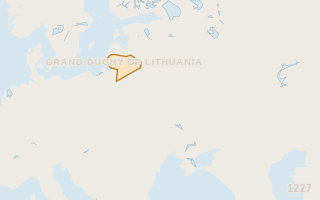
Its record opens in 1236, replacing the Duchy of Lithuania and the Principality of Drutsk.↓ Its borders are first mapped in 1227, around 60,100 km².↓ Over the years of the Lithuanian Crusade, 1283 – 1410, its ground went from 90,700 km² to 758,200 km².↓

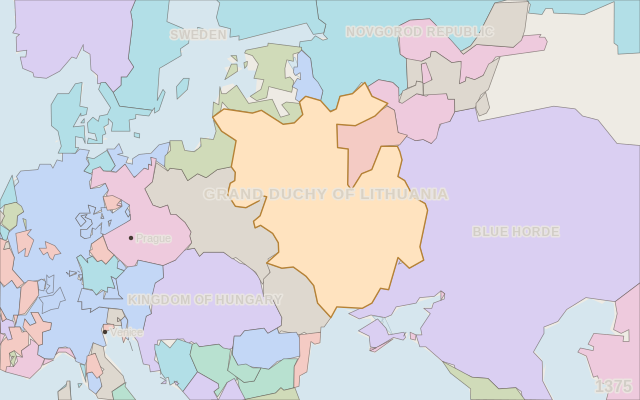
It reached its greatest extent in 1375: 812,400 km².↓ The record names 17 rulers in its line, covering 1236 – 1763, the median reign 10 years; 5 of 16 handovers were irregular.↓ The best known of them are Sigismund III Vasa, Vytautas the Great and Augustus III of Poland.↓ Most of the 43 rows the atlas files under it are people.↓ Its record closes in 1795, after 559 years.↑

From Wikipedia’s article, retold · CC BY-SA 4.0

559 years

Longer than Vikings, shorter than Huns

812,000 km²

At its height in 1375 · about the size of Chile

17 rulers

the Grand Duke of Lithuania

14 wars and battles

More per century than 95% of states · 43 entries in all

Map: Grand Duchy of Lithuania in 1375, its borders in gold among its neighbours
Battle of Saule, 1236Lithuanian Crusade, 1283 – 1410: 90,700 km² → 758,200 km²Union of Krewo, 1385Battle of the Vorskla River, 13991250130013501400
Beside it on the map in 1375: Blue Horde, Holy Roman Empire, Novgorod Republic, Kingdom of Hungary, Sweden and Kingdom of Norway (872–1397).How far it reached, year by year: its ground inside the borders Cliopatria draws (CC BY 4.0), measured on an equal-area grid; the map shows it at its largest, with the cities of the year.

The story

Four acts, 1236 – 1795

Grand Duchy of Lithuania in 1294, at the end of act I
I1236 – 129560,100 → 90,800 km²

Mindaugas and the pagan dukes

Mindaugas gains supreme power among the Lithuanian dukes, and in 1236 the Samogitians under Vykintas defeat the Livonian Order at Saule. Lithuania then annexes Navahrudak and Hrodna from Ruthenian lands, and Mindaugas is crowned king in 1253. Three grand dukes follow in quick succession, yet the state holds together under Traidenis.

Watch this act on the live map, from 1236
Grand Duchy of Lithuania in 1385, at the end of act II
II1295 – 138690,800 → 808,000 km²

The Gediminids build an empire

Gediminas builds a strong central government, makes Vilnius his permanent capital and takes Kiev in 1321, while most principalities of western Rus' become his vassals. His sons Algirdas and Kęstutis share rule and keep expanding, fighting Moscow and the crusading orders. Algirdas's son Jogaila ends the era by binding Lithuania to Poland at Krewo.

Watch this act on the live map, from 1295
III1386 – 1569

Christian, vast and tied to Poland

Lithuania is baptised in 1387, and Vytautas the Great, son of Kęstutis, rules as regent and then grand duke, carrying the state to its greatest extent and beating the Teutonic Knights at Grunwald in 1410. After his death relations with Poland sour and the nobility rises, but defeats by Moscow keep the union alive.

Watch this act on the live map, from 1386
IV1569 – 1795

A partner in the Commonwealth

Worn down by wars with the Teutonic Order and losses to Moscow, Lithuania enters a real union with Poland at Lublin in 1569. Within the Polish–Lithuanian Commonwealth it keeps a separate political identity, yet many of its lands pass to the Polish Crown and Polonization advances. The partitions of 1795 hand most of the rest to the Russian Empire.

Watch this act on the live map, from 1569
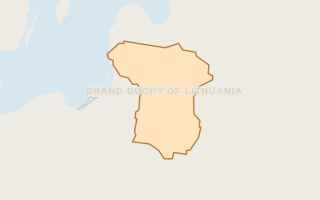
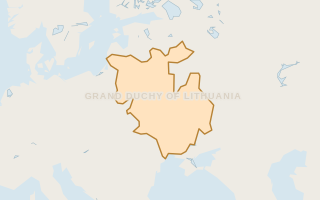
Grand Duchy of Lithuania in 1375, at its largestGrand Duchy of Lithuania in 1227, first mapped
The rise and the fall in one frame: drag across it from 1227, first mapped at 60,100 km², to 1375, at its largest at 812,400 km². Open the live map in 1227 or 1375.

Before and after

Before it

Where it sits in time

3000 BCE2000 BCE1000 BCE110002000Principality of Drutsk: 1101 – 1565Duchy of Lithuania: 1250 – 1413Grand Duchy of Lithuania: 1236 – 1795

Five thousand years, 3000 BCE to 2026; the state in gold, what it replaced or followed and what replaced or followed it in grey.

Its people

Lives across the Grand Duchy of Lithuania

1300140015001600
Statesmen and generalsWriters, artists and thinkersAll its people on the timeline →

How it was governed

17 dukes

17 dukes on record, 1236 to 1763; a reign lasted 10 years at the median. Each bar is a reign, as long as it lasted.

Mindaugas · 1236 – 1253 · left office aliveTreniota · 1263 – 1264 · killedVaišvilkas · 1264 – 1267 · left office aliveShvarn · 1267 – 1269 · died in office, manner not recordedTraidenis · 1269 – 1282 · died in office, manner not recordedButigeidis · 1282 – 1292 · died in office, manner not recordedButvydas · 1292 – 1296 · died in office, manner not recordedVytenis · 1295 – 1316 · died in office, manner not recordedJaunutis · 1341 – 1345 · deposed, the article saysAlgirdas · 1345 – 1377 · died in office, manner not recordedKęstutis · 1381 – 1382 · ended otherwise, as coded — neither deposed nor a natural deathVytautas the Great · 1392 – 1430 · died a natural deathŠvitrigaila / Svidrigiello · 1430 – 1432 · deposed or killedSigismund Kęstutaitis · 1432 – 1440 · deposed or killedCasimir IV Jagiellon · 1440 – 1492 · died a natural deathSigismund III Vasa · 1587 – 1632 · died in office of natural causesAugustus III of Poland · 1734 – 1763 · died in office, manner not recorded13001400150016001700
a second row: a reign that began before the last had ended — rival claimants, or a shared throne
How their terms ended, where it is known (17 of 17):Killed 1Deposed or removed 3Died in office 10Left office alive 3
Every term, with how it ended and its source

Rulers

How 17 reigns ended - choose one to show only those

How they died, where the record says: killed 2 · died of natural causes 2.

RulerReignLengthHow it ended · sourceTo the ruler before
13th century · 8 reigns · 1 killed or removed
Mindaugas · aged 331236 – 125317 yearsleft office aliveread off the dates alone
Treniota · aged 531263 – 12641 yearkilled in officeWikidata's manner of deathanother recorded relative
Vaišvilkas · aged 411264 – 12673 yearsleft office aliveread off the dates alonecousin
Shvarn · aged 371267 – 12692 yearsdied in officeread off the dates alone
Traidenis1269 – 128213 yearsdied in officeread off the dates alone
Butigeidis · aged 421282 – 129210 yearsdied in officeread off the dates alone
Butvydas · aged 311292 – 12964 yearsdied in officeread off the dates alone
Vytenis · aged 191295 – 131621 yearsdied in officeread off the dates alonechild
14th century · 4 reigns · 1 killed or removed
Jaunutis · aged 411341 – 13454 yearsdeposedread from the ruler's own articlenephew or niece
Algirdas · aged 491345 – 137732 yearsdied in officeread off the dates alonesibling
Kęstutis · aged 841381 – 13821 yearended otherwisecoded by Kokkonen & Sundelldied of natural causessibling
Vytautas the Great · aged 421392 – 143038 yearsnatural deathcoded by Kokkonen & Sundellchild
15th century · 3 reigns · 2 killed or removed
Švitrigaila / Svidrigiello · aged 741430 – 14322 yearsdeposed or killedcoded by Kokkonen & Sundell
Sigismund Kęstutaitis · aged 671432 – 14408 yearsdeposed or killedcoded by Kokkonen & Sundellkilled
Casimir IV Jagiellon · aged 131440 – 149252 yearsnatural deathcoded by Kokkonen & Sundell
16th century · 1 reign
Sigismund III Vasa · aged 211587 – 163245 yearsdied in officeWikidata's manner of deathdied of natural causes
18th century · 1 reign
Augustus III of Poland · aged 381734 – 176329 yearsdied in officeread off the dates alone

17 rulers, 17 with terms dated as terms, covering 1236 – 1763. Median reign 10 years. 5 of 16 handovers irregular - a killing, a deposition, a rival claimant, a rising or a coup beside it. A blank in the last column means no kin on record, which is coverage, never “unrelated”.

Flags and arms, in order

  • Royal banner of the Grand Duchy of Lithuania
    flag, undatedRoyal banner of the Grand Duchy of Lithuania · CC0
  • POL COA Grand Duchy of Lithuania
    coat of arms, from 1386POL COA Grand Duchy of Lithuania · CC BY-SA 4.0 · Guccee This W3C-unspecified vector image was created with Inkscape .

Its world

Rivals, and who else stood

Who it fought most

Wars and battles both took part in, on whichever side: the record names who took part, not who fought whom.

Meanwhile, elsewhere

The best-known states of other regions that stood while it did; the band is the Grand Duchy of Lithuania’s own years.

1200140016001800

How it compares

Among 3,073 states

Stood longer than 89% of 3,073 states
Grand Duchy of Lithuania · 559 yearsVikingsHunsHow long it stood, among the states with a recorded end or still standing.
Held more ground at its peak than 82% of 1,464 states
Grand Duchy of Lithuania · 812,400 km²ChileNamibiaThe most ground it held, among the states with a border in Cliopatria.
Had more wars on record per century than 95% of 3,073 states
Grand Duchy of Lithuania · 1.3Wars recorded per century, among the states, counting the wars the atlas hosts under each.

Why it fell

Why did the Grand Duchy of Lithuania fall?

Historians still argue. Here is what the atlas records about its last century:

What led to it, and what came of it

Duchy of Lithuania · Linked · 1250 – 1413Duchy of LithuaniaPrincipality of Drutsk · Linked · 1101 – 1565Principality of DrutskPeriod of Appanages · Linked · 1150 – 1550Period of AppanagesPrussian Crusade · Linked · 1217 – 1274Prussian CrusadePrincipality of Kyiv · Coincidence · 450 – 1471Principality of KyivPrincipality of Polotsk · Coincidence · 850 – 1397Principality of PolotskGrand Duchy of Lithuania · 1236 – 1795Grand Duchy of Lithuania50010001500
linkedcoincidence

Open the investigation: every row with its evidence, the conditions at the time, the theories condition by condition, and the succession analysed.

Its centuries in the record

1200 – 1299: 11 recorded — 2 wars and battles, 0 risings, regime changes and massacres, 9 other12001300 – 1399: 20 recorded — 7 wars and battles, 0 risings, regime changes and massacres, 13 other13001400 – 1499: 6 recorded — 2 wars and battles, 0 risings, regime changes and massacres, 4 other14001500 – 1599: 5 recorded — 2 wars and battles, 1 risings, regime changes and massacres, 2 other15001600 – 1699: 1 recorded — 1 wars and battles, 0 risings, regime changes and massacres, 0 other16001700 – 1799: 0 recorded — 0 wars and battles, 0 risings, regime changes and massacres, 0 other1700

Wars and battles in red, risings, coups and massacres beside them, everything else in grey, by the century each began in. A tall bar is partly a fact about Wikipedia: better-documented centuries hold more.

Each century’s own page:1200 – 12991300 – 13991400 – 14991500 – 15991600 – 16991700 – 1799

Keep exploring

Share this page
Copy link
Embed the map
Cite this page

How this page is made

Drawn from Wikidata (Q49683, CC0), the opening and history of its English Wikipedia article retold by the atlas (CC BY-SA 4.0), borders from Cliopatria (CC BY 4.0), coast and rivers from Natural Earth, cities from Reba, Reitsma & Seto 2016 (CC BY 4.0), symbols from Wikimedia Commons, each under its own licence. Data built 2026-11-26 · Pastlas v2.47.1, by Oleh Voronko; the published atlas and its data are for non-commercial use.

How to read it

Areas are measured on an equal-area grid from borders simplified to about five kilometres. “c.” marks an approximate date, and a date known to the century is never printed to the year. Counts are what the atlas holds, and they follow Wikipedia’s coverage: a busy century is partly a fact about the record.

Something wrong?

Tell us and name the entry. We fix the data, not just this page.

Report a problem