State · Europe

Kingdom of Hungary

1000 – 1946 · 946 years

Came after Principality of Hungary and Hungarian Republic · became First Hungarian Republic and Second Hungarian Republic

Stephen I's Catholic kingdom in Central Europe, which survived Mongol invasion, Ottoman partition and Habsburg rule for nearly a millennium.

The Kingdom of Hungary began when Stephen I was crowned at Esztergom c. 1000, carrying on the Grand Principality; his Árpád dynasty ruled for three centuries. In the 16th century Ottoman conquest split it in three, and from Mohács in 1526 the Habsburgs held its throne until 1918. Part of Austria-Hungary from 1867, it lost its king in 1918 and nearly three-quarters of its land at Trianon, returned under a regency in 1920 and ended under Soviet occupation in 1946.

What the record holds

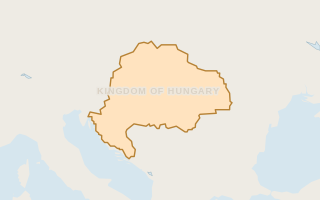
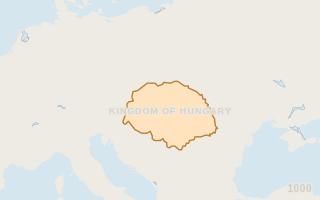
It was founded in 1000, replacing the Principality of Hungary and the Hungarian Republic.↓ In 1000, the first year its borders are mapped, it covered 271,200 km².↓

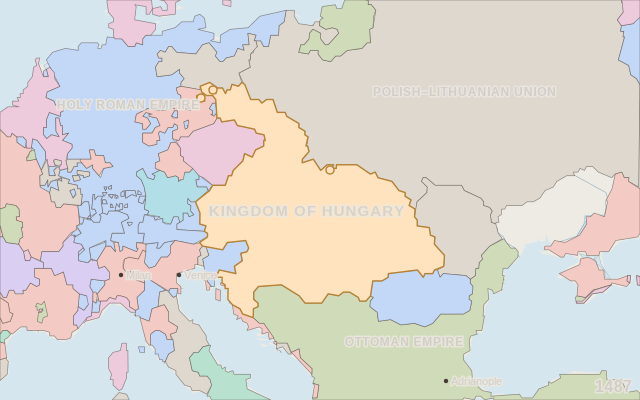
It reached its greatest extent in 1487: 465,000 km².↓ Its line counts 55 rulers, covering 1000 – 1919, the median reign 11 years; 25 of 55 handovers were irregular.↓ Among them, Maria Theresa, Franz Joseph I and Francis II, Holy Roman Emperor are the best known.↓ The atlas files 91 rows under it, most of them people.↓

It was replaced by the First Hungarian Republic and the Second Hungarian Republic in 1946, 946 years after it began.↓

From Wikipedia’s article, retold · CC BY-SA 4.0

946 years

Longer than the Holy Roman Empire, shorter than the Byzantine Empire

465,000 km²

At its height in 1487 · about the size of Yemen

55 rulers

the Apostolic King of Hungary

22 wars and battles

More per century than 89% of states · 91 entries in all

Map: Kingdom of Hungary in 1487, its borders in gold among its neighbours
Battle on the Marchfeld, 1278Battle of Krbava Field, 1493Battle of Zenta, 1697Hungarian Revolution of 1848, 1848 – 184910001200140016001800
Beside it on the map in 1487: Polish–Lithuanian union, Holy Roman Empire, Ottoman Empire, Kingdom of France, Principality of Moldavia and Crimean Khanate.How far it reached, year by year: its ground inside the borders Cliopatria draws (CC BY 4.0), measured on an equal-area grid; the map shows it at its largest, with the cities of the year.

The story

Five acts, 1000 – 1946

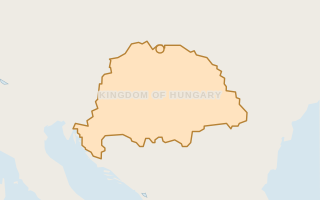
Kingdom of Hungary in 1300, at the end of act I
I1000 – 1301271,000 → 333,000 km²

The Árpád kings

Crowned at Esztergom in 1000, Stephen I founds a Christian kingdom that is a European power by the 12th century. Andrew II grants the Golden Bull in 1222. In 1241 the Mongols destroy the Hungarian and Cuman armies at Mohi and kill up to a quarter of the people; Béla IV raises fortresses. The Árpád line ends in 1301.

Watch this act on the live map, from 1000
Kingdom of Hungary in 1525, at the end of act II
II1301 – 1526333,000 → 333,000 km²

Angevins, Sigismund and Matthias

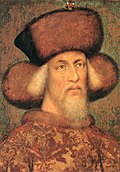
After the Árpáds, rival lords split the country until Charles I is crowned. Sigismund reforms the law and rebuilds the palaces of Buda and Visegrád. Under Matthias Corvinus the kingdom has its golden age: he strengthens the economy, prefers diplomacy to war and holds Vienna from 1485. Ottoman victory at Mohács in 1526 ends the era.

Watch this act on the live map, from 1301
III1526 – 1711

Divided between Habsburgs and Ottomans

After Mohács most nobles elect John Zápolya and a rump diet picks Ferdinand I, and the country splits into Royal Hungary, Ottoman Hungary and Transylvania. The Habsburgs lead the wars that finally expel the Turks, but Hungarians rise against them again and again; Francis II Rákóczi's war of 1703–1711 fails, but Hungary escapes full absorption into the Habsburg Empire.

Watch this act on the live map, from 1526
IV1711 – 1918

Under the Habsburg crown

From 1711 Habsburg monarchs rule Hungary through its own diet and constitution, though the monarch appoints its council. Language reform begins under Joseph II, and István Széchenyi opens the reform age. The revolution of 1848–1849 wars with Austria; after the Compromise of 1867 Hungary is half of the dual monarchy of Austria-Hungary, and industry and cities grow fast.

Watch this act on the live map, from 1711
V1918 – 1946

Republics, regency and war

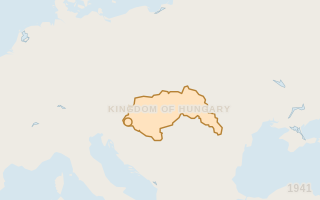
The last king, Charles IV, is deposed in 1918, and Béla Kun's Soviet Republic lasts only months in 1919. In 1920 the kingdom returns with Miklós Horthy as regent, and Trianon strips it of nearly three-quarters of its land. Regaining ground through the Vienna Awards, Hungary joins the Axis against the Soviet Union, whose occupation from 1944 ends the kingdom.

Watch this act on the live map, from 1918
Kingdom of Hungary in 1941, last mappedKingdom of Hungary in 1000, first mapped
The rise and the fall in one frame: drag across it from 1000, first mapped at 271,200 km², to 1941, last mapped at 173,600 km². Open the live map in 1000 or 1941.

Before and after

Before it

After it

Where it sits in time

3000 BCE2000 BCE1000 BCE110002000Hungarian Republic: 1919 – 1920Principality of Hungary: 895 – 1000First Hungarian Republic: 1918 – 1919Second Hungarian Republic: 1946 – 1949Kingdom of Hungary: 1000 – 1946

Five thousand years, 3000 BCE to 2026; the state in gold, what it replaced or followed and what replaced or followed it in grey.

Its people

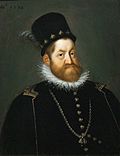
Lives across the Kingdom of Hungary
12001400160018002000
Statesmen and generalsWriters, artists and thinkersLived on after it endedAll its people on the timeline →

How it was governed

55 kings

55 kings on record, 1000 to 1919; a reign lasted 11 years at the median. Each bar is a reign, as long as it lasted.

Stephen I of Hungary · 1000 – 1038 · died a natural deathPeter, King of Hungary · 1038 – 1041 · deposed or killedSamuel Aba · 1041 – 1044 · deposed or killedPeter, King of Hungary · 1044 – 1046 · deposed or killedAndrew I of Hungary · 1047 – 1060 · deposed or killedBéla I of Hungary · 1060 – 1063 · died a natural deathSolomon, King of Hungary · 1063 – 1074 · deposed or killedGéza I of Hungary · 1074 – 1077 · died a natural deathLadislaus I of Hungary · 1077 – 1095 · died a natural deathColoman · 1095 – 1116 · died a natural deathStephen II of Hungary · 1116 – 1131 · died a natural deathBéla II of Hungary · 1131 – 1141 · died a natural deathGéza II of Hungary · 1141 – 1162 · died a natural deathLadislaus II of Hungary · 1161 – 1162 · died a natural deathStephen III of Hungary · 1162 – 1172 · died a natural deathStephen IV of Hungary · 1163 – 1165 · deposed or killedEmeric, King of Hungary · 1196 – 1204 · died a natural deathLadislaus III of Hungary · 1204 – 1205 · deposed or killedAndrew II of Hungary · 1205 – 1235 · died a natural deathBéla IV of Hungary · 1235 – 1270 · died a natural deathStephen V of Hungary · 1270 – 1272 · died a natural deathLadislaus IV of Hungary · 1272 – 1290 · deposed or killedAndrew III of Hungary · 1290 – 1301 · died a natural deathWenceslaus III of Bohemia · 1301 – 1305 · deposed or killedOtto III of Bavaria · 1305 – 1307 · deposed or killedCharles I of Hungary · 1308 – 1342 · died a natural deathMary, Queen of Hungary · 1382 – 1386 · deposed or killedCharles III of Naples · 1386 – 1386 · deposed or killedSigismund · 1387 – 1437 · died a natural deathAlbert II of Germany · 1437 – 1439 · died a natural deathWładysław III of Poland · 1440 – 1444 · ended otherwise, as coded — neither deposed nor a natural deathLadislaus the Posthumous · 1440 – 1457 · died a natural deathFrederick III, Holy Roman Emperor · 1458 – 1463 · died a natural deathMatthias Corvinus · 1458 – 1490 · died a natural deathVladislaus II of Hungary · 1490 – 1516 · died a natural deathLouis II of Hungary · 1516 – 1526 · ended otherwise, as coded — neither deposed nor a natural deathJohn Zápolya · 1526 – 1540 · died a natural deathFerdinand I, Holy Roman Emperor · 1526 – 1564 · died a natural deathMaximilian II, Holy Roman Emperor · 1564 – 1576 · died a natural deathRudolf II, Holy Roman Emperor · 1576 – 1608 · deposed or killedMatthias, Holy Roman Emperor · 1608 – 1619 · died a natural deathFerdinand II, Holy Roman Emperor · 1619 – 1637 · died a natural deathGabriel Bethlen · 1620 – 1621 · left office aliveFerdinand III, Holy Roman Emperor · 1637 – 1657 · died a natural deathFerdinand IV, King of the Romans · 1647 – 1654 · died in office of natural causesLeopold I, Holy Roman Emperor · 1657 – 1705 · died a natural deathJoseph I, Holy Roman Emperor · 1705 – 1711 · died a natural deathCharles VI, Holy Roman Emperor · 1711 – 1740 · died a natural deathMaria Theresa · 1740 – 1780 · died in office of natural causesJoseph II, Holy Roman Emperor · 1780 – 1790 · died in office, manner not recordedLeopold II, Holy Roman Emperor · 1790 – 1792 · died in office of natural causesFrancis II, Holy Roman Emperor · 1792 – 1835 · died in office, manner not recordedFerdinand I of Austria · 1835 – 1848 · left office aliveFranz Joseph I · 1848 – 1916 · died in office of natural causesCharles I of Austria · 1916 – 1918 · left office aliveGyula Peidl · 1919 – 1919 · left office alive10001200140016001800
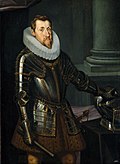
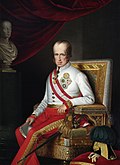
a second row: a reign that began before the last had ended — rival claimants, or a shared throne
How their terms ended, where it is known (56 of 56):Deposed or removed 13Died in office 37Left office alive 6
Every term, with how it ended and its source

Rulers

1 term is shared from Hungary.

How 56 reigns ended - choose one to show only those

How they died, where the record says: died of natural causes 10 · died by accident 5 · killed 3 · executed 1 · died in battle 1.

RulerReignLengthHow it ended · sourceTo the ruler before
10th century · 1 reign
Stephen I of Hungary · aged 251000 – 103838 yearsnatural deathcoded by Kokkonen & Sundell
11th century · 9 reigns · 5 killed or removed
Peter, King of Hungary · aged 271038 – 10413 yearsdeposed or killedcoded by Kokkonen & Sundellnephew or niece
Samuel Aba · aged 511041 – 10443 yearsdeposed or killedcoded by Kokkonen & Sundellexecuted
Peter, King of Hungary · aged 331044 – 10462 yearsdeposed or killedcoded by Kokkonen & Sundell
Andrew I of Hungary · aged 321047 – 106013 yearsdeposed or killedcoded by Kokkonen & Sundelldied by accident
Béla I of Hungary · aged 441060 – 10633 yearsnatural deathcoded by Kokkonen & Sundelldied by accidentsibling
Solomon, King of Hungary · aged 101063 – 107411 yearsdeposed or killedcoded by Kokkonen & Sundellnephew or niece
Géza I of Hungary · aged 341074 – 10773 yearsnatural deathcoded by Kokkonen & Sundell
Ladislaus I of Hungary · aged 371077 – 109518 yearsnatural deathcoded by Kokkonen & Sundellsibling
Coloman · aged 251095 – 111621 yearsnatural deathcoded by Kokkonen & Sundellnephew or niece
12th century · 7 reigns · 1 killed or removed
Stephen II of Hungary · aged 151116 – 113115 yearsnatural deathcoded by Kokkonen & Sundelldied of natural causeschild
Béla II of Hungary · aged 231131 – 114110 yearsnatural deathcoded by Kokkonen & Sundell
Géza II of Hungary · aged 111141 – 116221 yearsnatural deathcoded by Kokkonen & Sundellchild
Ladislaus II of Hungary · aged 301161 – 11621 yearnatural deathcoded by Kokkonen & Sundellkilledsibling
Stephen III of Hungary · aged 151162 – 117210 yearsnatural deathcoded by Kokkonen & Sundellnephew or niece
Stephen IV of Hungary · aged 301163 – 11652 yearsdeposed or killedcoded by Kokkonen & Sundellkilled
Emeric, King of Hungary · aged 221196 – 12048 yearsnatural deathcoded by Kokkonen & Sundell
13th century · 6 reigns · 2 killed or removed
Ladislaus III of Hungary · aged 51204 – 12051 yeardeposed or killedcoded by Kokkonen & Sundellchild
Andrew II of Hungary · aged 301205 – 123530 yearsnatural deathcoded by Kokkonen & Sundell
Béla IV of Hungary · aged 291235 – 127035 yearsnatural deathcoded by Kokkonen & Sundellchild
Stephen V of Hungary · aged 311270 – 12722 yearsnatural deathcoded by Kokkonen & Sundellchild
Ladislaus IV of Hungary · aged 101272 – 129018 yearsdeposed or killedcoded by Kokkonen & Sundellchild
Andrew III of Hungary · aged 251290 – 130111 yearsnatural deathcoded by Kokkonen & Sundell
14th century · 6 reigns · 4 killed or removed
Wenceslaus III of Bohemia · aged 121301 – 13054 yearsdeposed or killedcoded by Kokkonen & Sundell
Otto III of Bavaria · aged 441305 – 13072 yearsdeposed or killedcoded by Kokkonen & Sundell
Charles I of Hungary · aged 201308 – 134234 yearsnatural deathcoded by Kokkonen & Sundell
Mary, Queen of Hungary · aged 111382 – 13864 yearsdeposed or killedcoded by Kokkonen & Sundelldied by accidentgrandchild
Charles III of Naples · aged 411386 – 1386under a yeardeposed or killedcoded by Kokkonen & Sundellkilled
Sigismund · aged 191387 – 143750 yearsnatural deathcoded by Kokkonen & Sundell
15th century · 6 reigns
Albert II of Germany · aged 401437 – 14392 yearsnatural deathcoded by Kokkonen & Sundelldied of natural causesin-law
Władysław III of Poland · aged 161440 – 14444 yearsended otherwisecoded by Kokkonen & Sundelldied in battle
Ladislaus the Posthumous1440 – 145717 yearsnatural deathcoded by Kokkonen & Sundelldied of natural causes
Frederick III, Holy Roman Emperor · aged 431458 – 14635 yearsnatural deathcoded by Kokkonen & Sundell
Matthias Corvinus · aged 151458 – 149032 yearsnatural deathcoded by Kokkonen & Sundelldied of natural causes
Vladislaus II of Hungary · aged 341490 – 151626 yearsnatural deathcoded by Kokkonen & Sundell
16th century · 5 reigns · 1 killed or removed
Louis II of Hungary · aged 101516 – 152610 yearsended otherwisecoded by Kokkonen & Sundelldied by accidentchild
John Zápolya · aged 391526 – 154014 yearsnatural deathcoded by Kokkonen & Sundell
Ferdinand I, Holy Roman Emperor · aged 231526 – 156438 yearsnatural deathcoded by Kokkonen & Sundell
Maximilian II, Holy Roman Emperor · aged 371564 – 157612 yearsnatural deathcoded by Kokkonen & Sundellchild
Rudolf II, Holy Roman Emperor · aged 241576 – 160832 yearsdeposed or killedcoded by Kokkonen & Sundellchild
17th century · 6 reigns
Matthias, Holy Roman Emperor · aged 511608 – 161911 yearsnatural deathcoded by Kokkonen & Sundellsibling
Ferdinand II, Holy Roman Emperor · aged 411619 – 163718 yearsnatural deathcoded by Kokkonen & Sundell
Gabriel Bethlen · aged 401620 – 16211 yearleft office aliveread off the dates alone
Ferdinand III, Holy Roman Emperor · aged 291637 – 165720 yearsnatural deathcoded by Kokkonen & Sundell
Ferdinand IV, King of the Romans · aged 141647 – 16547 yearsdied in officeWikidata's manner of deathdied of natural causeschild
Leopold I, Holy Roman Emperor · aged 171657 – 170548 yearsnatural deathcoded by Kokkonen & Sundellsibling
18th century · 6 reigns
Joseph I, Holy Roman Emperor · aged 271705 – 17116 yearsnatural deathcoded by Kokkonen & Sundelldied of natural causeschild
Charles VI, Holy Roman Emperor · aged 261711 – 174029 yearsnatural deathcoded by Kokkonen & Sundelldied by accidentsibling
Maria Theresa · aged 231740 – 178040 yearsdied in officeWikidata's manner of deathdied of natural causeschild
Joseph II, Holy Roman Emperor · aged 391780 – 179010 yearsdied in officeWikidata's end cause on the termchild
Leopold II, Holy Roman Emperor · aged 431790 – 17922 yearsdied in officeWikidata's manner of deathdied of natural causessibling
Francis II, Holy Roman Emperor · aged 241792 – 183543 yearsdied in officeread off the dates alonechild
19th century · 2 reigns
Ferdinand I of Austria · aged 421835 – 184813 yearsleft office aliveread off the dates alonechild
Franz Joseph I · aged 181848 – 191668 yearsdied in officeWikidata's manner of deathdied of natural causesnephew or niece
20th century · 2 reigns
Charles I of Austria · aged 291916 – 19182 yearsleft office aliveread off the dates alonedied of natural causes
Gyula Peidl · from the line of Hungary · aged 461919 – 1919under a yearleft office aliveread off the dates alone

55 rulers, 55 with terms dated as terms, covering 1000 – 1919. Median reign 11 years. 25 of 55 handovers irregular - a killing, a deposition, a rival claimant, a rising or a coup beside it. A blank in the last column means no kin on record, which is coverage, never “unrelated”.

Heads of government

The line of Prime Minister of Hungary, drawn and never measured: a cabinet is not a reign.

Lajos Kossuth1848 – 1849
Lajos Batthyány1848 – 1848
Ádám Récsey1848 – 1848
Bertalan Szemere1849 – 1849
Gyula Andrássy1867 – 1871
Menyhért Lónyay1871 – 1872
József Szlávy1872 – 1874
István Bittó1874 – 1875
Kálmán Tisza1875 – 1890
Béla Wenckheim1875 – 1875
Gyula Szapáry1890 – 1892
Sándor Wekerle1892 – 1895
Dezső Bánffy1895 – 1899
Kálmán Széll1899 – 1903
István Tisza1903 – 1905
Károly Khuen-Héderváry1903 – 1903
Géza Fejérváry1905 – 1906
Sándor Wekerle1906 – 1910
Károly Khuen-Héderváry1910 – 1912
László Lukács1912 – 1913
István Tisza1913 – 1917
Sándor Wekerle1917 – 1918
Móric Esterházy1917 – 1917
Mihály Károlyi1918 – 1919
János Hadik1918 – 1918
István Friedrich1919 – 1919
Károly Huszár1919 – 1920
Gyula Peidl1919 – 1919
Sándor Garbai1919 – 1919
Dénes Berinkey1919 – 1919
Pál Teleki1920 – 1921
Sándor Simonyi-Semadam1920 – 1920
István Bethlen1921 – 1931
Gyula Károlyi1931 – 1932
Gyula Gömbös1932 – 1936
Kálmán Darányi1936 – 1938
Béla Imrédy1938 – 1939
Pál Teleki1939 – 1941
László Bárdossy1941 – 1942
Miklós Kállay1942 – 1944
Ferenc Keresztes-Fischer1942 – 1942
Ferenc Szálasi1944 – 1945
Géza Lakatos1944 – 1944
Döme Sztójay1944 – 1944
Béla Miklós1944 – 1945
Zoltán Tildy1945 – 1946

Flags and arms, in order

  • Flag of Stephen I of Hungary
    flag, 1000 – 1038Flag of Stephen I of Hungary · CC0
  • Flag of Hungary (11th-12th century)
    flag, 1046 – 1172Flag of Hungary (11th-12th century) · Public domain
  • Flag of Hungary (late 12th century)
    flag, 1172 – 1196Flag of Hungary (late 12th century) · Public domain
  • Flag of Hungary (13th century)
    flag, 1196 – 1301Flag of Hungary (13th century) · CC BY-SA 4.0 · Oppashi
  • Flag of Hungary (1301-1382)
    flag, 1301 – 1382Flag of Hungary (1301-1382) · Public domain
  • Flag of Sigismund of Hungary
    flag, 1387 – 1437Flag of Sigismund of Hungary · Public domain
  • Flag of Vladislaus I of Hungary
    flag, 1440 – 1444Flag of Vladislaus I of Hungary · Public domain
  • Flag of Matthias I of Hungary
    flag, 1458 – 1490Flag of Matthias I of Hungary · Public domain
  • Flag of Vladislaus II of Hungary
    flag, 1490 – 1516Flag of Vladislaus II of Hungary · Public domain
  • Flag of Louis II of Hungary
    flag, 1516 – 1526Flag of Louis II of Hungary · Public domain
  • Flag of the Habsburg Monarchy
    flag, 1720 – 1848Flag of the Habsburg Monarchy · Public domain
  • Flag of Hungary (1848-1849, 1867-1869)
    flag, 1848 – 1849Flag of Hungary (1848-1849, 1867-1869) · Public domain

14 more in the atlas.

Its world

Rivals, and who else stood

Who it fought most

Wars and battles both took part in, on whichever side: the record names who took part, not who fought whom.

Meanwhile, elsewhere

The best-known states of other regions that stood while it did; the band is the Kingdom of Hungary’s own years.

100012001400160018002000

How it compares

Among 3,073 states

Stood longer than 97% of 3,073 states
Kingdom of Hungary · 946 yearsHoly Roman EmpireByzantine EmpireHow long it stood, among the states with a recorded end or still standing.
Held more ground at its peak than 73% of 1,464 states
Kingdom of Hungary · 465,000 km²YemenCameroonThe most ground it held, among the states with a border in Cliopatria.
Had more wars on record per century than 89% of 3,073 states
Kingdom of Hungary · 0.7Wars recorded per century, among the states, counting the wars the atlas hosts under each.

Why it fell

Why did the Kingdom of Hungary fall?

Historians still argue. Here is what the atlas records about its last century:

2

wars and battles in its last century

What led to it, and what came of it

Principality of Hungary · Linked · 895 – 1000 · “The Hungarians, led by Árpád (who might have been either their sacred ruler known as a kende or their military leader known as a gyula), settled the Carpathia…”Principality of HungaryHungarians · In the article · 840 · “The Hungarians, led by Árpád (who might have been either their sacred ruler known as a kende or their military leader known as a gyula), settled the Carpathia…”HungariansÁrpád dynasty · Coincidence · 972 – 1301Árpád dynastyKingdom of Hungary · 1000 – 1946Kingdom of HungarySecond Hungarian Republic · Linked · 1946 – 1949Second Hungarian Republic80010001200140016001800
in the articlelinkedcoincidence

Open the investigation: every row with its evidence, the conditions at the time, the theories condition by condition, and the succession analysed.

Its centuries in the record

1000 – 1099: 9 recorded — 1 wars and battles, 0 risings, regime changes and massacres, 8 other10001100 – 1199: 8 recorded — 0 wars and battles, 0 risings, regime changes and massacres, 8 other11001200 – 1299: 9 recorded — 2 wars and battles, 0 risings, regime changes and massacres, 7 other12001300 – 1399: 6 recorded — 0 wars and battles, 0 risings, regime changes and massacres, 6 other13001400 – 1499: 17 recorded — 6 wars and battles, 1 risings, regime changes and massacres, 10 other14001500 – 1599: 11 recorded — 7 wars and battles, 0 risings, regime changes and massacres, 4 other15001600 – 1699: 3 recorded — 2 wars and battles, 1 risings, regime changes and massacres, 0 other16001700 – 1799: 2 recorded — 2 wars and battles, 0 risings, regime changes and massacres, 0 other17001800 – 1899: 16 recorded — 0 wars and battles, 2 risings, regime changes and massacres, 14 other18001900 – 1999: 9 recorded — 2 wars and battles, 1 risings, regime changes and massacres, 6 other1900

Wars and battles in red, risings, coups and massacres beside them, everything else in grey, by the century each began in. A tall bar is partly a fact about Wikipedia: better-documented centuries hold more.

Each century’s own page:1000 – 10991100 – 11991200 – 12991300 – 13991400 – 14991500 – 15991600 – 16991700 – 17991800 – 18991900 – 1999

Keep exploring

Share this page
Copy link
Embed the map
Cite this page

How this page is made

Drawn from Wikidata (Q171150, CC0), the opening and history of its English Wikipedia article retold by the atlas (CC BY-SA 4.0), borders from Cliopatria (CC BY 4.0), coast and rivers from Natural Earth, cities from Reba, Reitsma & Seto 2016 (CC BY 4.0), symbols from Wikimedia Commons, each under its own licence. Data built 2026-11-26 · Pastlas v2.47.1, by Oleh Voronko; the published atlas and its data are for non-commercial use.

How to read it

Areas are measured on an equal-area grid from borders simplified to about five kilometres. “c.” marks an approximate date, and a date known to the century is never printed to the year. Counts are what the atlas holds, and they follow Wikipedia’s coverage: a busy century is partly a fact about the record.

Something wrong?

Tell us and name the entry. We fix the data, not just this page.

Report a problem