Battle of Bakhmach
battle · 8 March 1918
State · Europe
1917 – 1921 · 4 years
Became  Ukraine and
 Ukrainian Soviet Socialist Republic
A short-lived Ukrainian republic born of the February Revolution, which declared independence from Russia and lost its land to the Bolsheviks.
Elected in March 1917 after the February Revolution, the Central Council of Ukraine won autonomy within Russia, condemned the October Revolution and proclaimed the Ukrainian People's Republic, independent from January 1918. Soviet-backed rivals, Poland, the White movement, Green armies and anarchists fought it; a pro-German Ukrainian State displaced it for most of 1918. Restored under the Directorate and Symon Petliura, it lost its last territory in the Polish-Soviet War.
The Ukrainian People's Republic began in 1917.↑ The record names 4 rulers in its line, covering 1917 – 1948; 3 of 3 handovers were irregular.↓ The best known of them are  Symon Petliura,
 Mykhailo Hrushevsky and
 Volodymyr Vynnychenko.↓ Most of the 34 rows the atlas files under it are people.↓
In 1921, after 4 years, it was replaced by Ukraine, the  Ukrainian People's Republic of Soviets and the Ukrainian Soviet Socialist Republic.↓
From Wikipedia’s article, retold · CC BY-SA 4.0
Best known for
4 years
Longer than New Caledonia, shorter than Freetown
521,000 km²
At its height in 1919 · about the size of Thailand
4 rulers
the Chairman of the Directorate of Ukraine
10 wars and battles
More per century than 92% of states · 34 entries in all
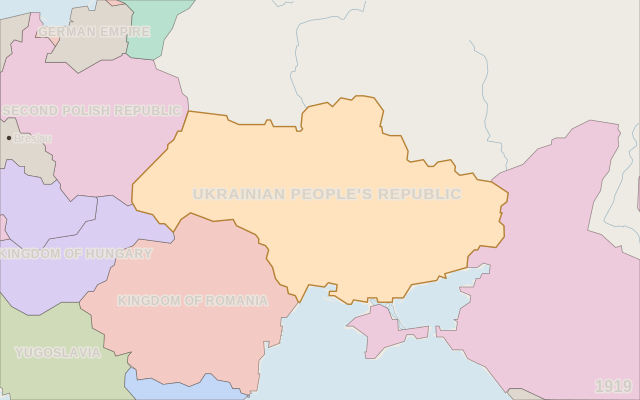
 Russian Soviet Federative Socialist Republic,
 Kingdom of Romania,
 Second Polish Republic,
 Yugoslavia,
 Kingdom of Hungary and
 German Empire.How far it reached, year by year: its ground inside the borders Cliopatria draws (CC BY 4.0), measured on an equal-area grid; the map shows it at its largest, with the cities of the year.
The story
The best-known wars, battles, risings and changes of regime the record files under it; a war within a war is folded into it.
battle · 8 March 1918
battle · 1918
battle · 30 January 1918
treaty · 22 January 1919
battle · 1920
The states the record files it as replacing or following, and those that replaced or followed it - Wikidata's own statements, each read from this state's side.
Ukrainian Soviet Socialist Republic · followed by · 1919 – 1991Ukrainian State · followed by · 1918Ukraine · replaced by · 1991 – presentUkrainian People's Republic of Soviets · replaced by · 1917 – 1918 South Russia · replaced by · 1919 – 1920
Five thousand years, 3000 BCE to 2026; the state in gold, what it replaced or followed and what replaced or followed it in grey.
Its people
One axis for everyone, so you can see who knew whom: the best-known, ordered by birth.
 Mykhailo Hrushevskychairman · writer
 Symon Petliurachairman · writer
 Volodymyr Vynnychenkochairman · writer
 Ignacy Tokarczukreligious leader
 Marek Edelmanphysician · politician
 Isaac Boleslavskywriter
 Kateryna Yushchenkoscientist
 Polina Gelmanpolitician · writer
 Omeljan Pritsakscientist
 Anatoly Dneprovphysicist · writer
 Benjamin Tammuzsculptor · painter
 Mykola Lukashscientist
 Aleksei Pogorelovphysicist · mathematician
How it was governed
4 chairmen on record, 1917 to 1948. Each bar is a reign, as long as it lasted.
The line of Chairman of the Directorate of Ukraine - the office this state names as its head of state.
| Ruler | Reign | Length | How it ended · source | To the ruler before |
|---|---|---|---|---|
| 20th century · 4 reigns · 2 killed or removed | ||||
| Mykhailo Hrushevsky · aged 51 | 1917 – 1918 | 1 year | exiledread from the ruler's own articledied of natural causes | |
| Volodymyr Vynnychenko · aged 38 | 1918 – 1919 | 1 year | left office aliveread off the dates alone | |
| Symon Petliura · aged 40 | 1919 – 1926 | 7 years | killed in officeWikidata's manner of death | |
 Andriy Livytskyi · aged 47 | 1926 – 1948 | 22 years | left office aliveread off the dates alone | |
4 rulers, 4 with terms dated as terms, covering 1917 – 1948. Only 31 years of the line are dated - too short for a median. 3 of 3 handovers irregular - a killing, a deposition, a rival claimant, a rising or a coup beside it. A blank in the last column means no kin on record, which is coverage, never “unrelated”.
Each symbol with the years its own statement gives; the timeline flies the one of the year on screen.

 Andriy Livytskyi22 yrsSymon Petliura7 yrsMykhailo Hrushevsky1 yrsVolodymyr Vynnychenko1 yrs
How it compares
Each column is a share of the states; gold is the Ukrainian People's Republic.
Why it fell
It lost the last of its land to the Bolsheviks in the Polish-Soviet War, and after the Peace of Riga in 1921 its government carried on in exile.
Historians still argue. Here is what the atlas records about its last century:
1926
Symon Petliura, killed in office
The investigation's own picture: 14 causes the record names and 3 results, the strongest six of each at their own years, joined to the state by the kind of claim - a recorded statement solid, the article's sentence dashed, a theory dash-dot.
Open the investigation: every row with its evidence, the conditions at the time, the theories condition by condition, and the succession analysed.
34 entries the atlas files under it, all in 1900 – 1999.
“Ukrainian People's Republic”, Pastlas, a historical atlas, 2026-11-26. https://app.pastlas.com/state/ukrainian-peoples-republic/
Drawn from Wikidata (Q243610, CC0), the opening and history of its English Wikipedia article retold by the atlas (CC BY-SA 4.0), borders from Cliopatria (CC BY 4.0), coast and rivers from Natural Earth, cities from Reba, Reitsma & Seto 2016 (CC BY 4.0), symbols from Wikimedia Commons, each under its own licence. Data built 2026-11-26 · Pastlas v2.47.1, by Oleh Voronko; the published atlas and its data are for non-commercial use.
Areas are measured on an equal-area grid from borders simplified to about five kilometres. “c.” marks an approximate date, and a date known to the century is never printed to the year. Counts are what the atlas holds, and they follow Wikipedia’s coverage: a busy century is partly a fact about the record.