State · Europe

West Germany

1949 – 1990 · 41 years

Came after German Reich and Trizone · became Germany

The Bonn Republic: the western part of a divided Germany, which rebuilt in an economic miracle, joined NATO and reunified the country.

West Germany, formally the Federal Republic of Germany, was founded in May 1949 from twelve states in the occupation zones of France, the United Kingdom and the United States, with Bonn as its capital. A member of NATO and the Western Bloc, it rebuilt from the destruction of World War II and, in the economic miracle of the 1950s, grew into the world's second-largest economy. In October 1990 it was reunified with East Germany.

What the record holds

It was founded in 1949, replacing German Reich and Trizone.↓ In 1950, the first year its borders are mapped, it covered 243,300 km².↓

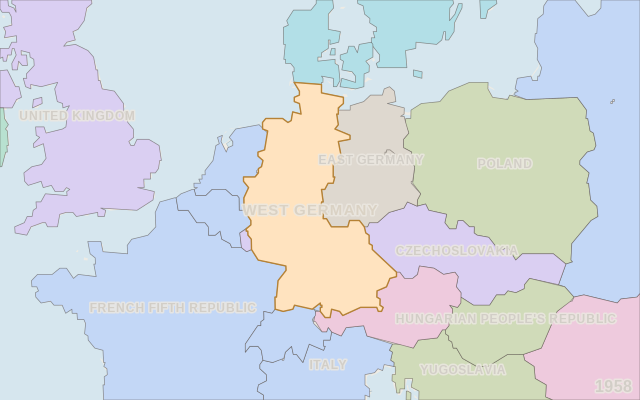
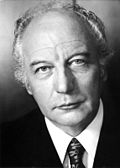
Its ground peaked in 1958 at 246,400 km².↓ Its highest office was held by 6 rulers, covering 1949 – 1994; none of its 5 handovers was irregular.↓ Among them, Richard von Weizsäcker, Theodor Heuss and Walter Scheel are the best known.↓ The atlas files 28 rows under it, most of them people.↓

It was replaced by Germany in 1990, 41 years after it began.↓ One theory of why states fall has every condition present at its end: “Demographic-structural breakdown”.↓

From Wikipedia’s article, retold · CC BY-SA 4.0

41 years

Longer than Daman and Diu, shorter than the German Empire

246,000 km²

At its height in 1958 · about the size of Guinea

6 rulers

the President

Map: West Germany in 1958, its borders in gold among its neighbours
Cologne school massacre, 1964Munich massacre, 1972European Patent Convention, 1973Convention on the Conservation of Migratory Species of Wild Animals, 1979Oktoberfest bombing, 19801960197019801990
Beside it on the map in 1958: French Fifth Republic, Poland, Soviet Union, United Kingdom, United States and Czechoslovakia.How far it reached, year by year: its ground inside the borders Cliopatria draws (CC BY 4.0), measured on an equal-area grid; the map shows it at its largest, with the cities of the year.

The story

Three acts, 1949 – 1990

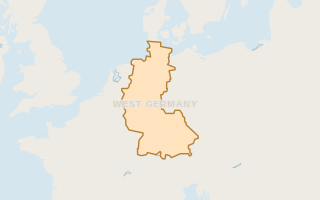
West Germany in 1962, at the end of act I
I1949 – 1963

Adenauer and the economic miracle

Konrad Adenauer, seventy-three when he becomes chancellor, rules for fourteen years and ties the republic to the West: it gains the authority of a sovereign state and joins NATO in May 1955, promising to rearm. The Saarland joins in 1957. In 1962 police raid Der Spiegel over an article on defence weaknesses, and in 1963 Adenauer is pushed from office.

Watch this act on the live map, from 1949
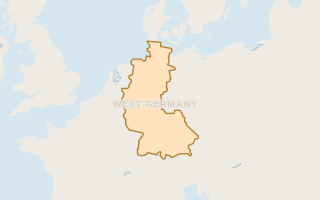
West Germany in 1981, at the end of act II
II1963 – 1982246,000 → 246,000 km²

Brandt, Schmidt and Ostpolitik

Willy Brandt becomes chancellor in October 1969, keeping close ties with the United States while launching Ostpolitik to improve relations with Eastern Europe. Helmut Schmidt, chancellor from 1974 to 1982, backs the Atlantic alliance and the European Community, and protests as the USSR upgrades its intermediate-range missiles. In 1975 West Germany joins the G6.

Watch this act on the live map, from 1963
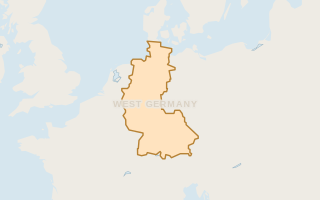
West Germany in 1989, at the end of act III
III1982 – 1990246,000 → 246,000 km²

Kohl and reunification

In October 1982 the FDP joins the CDU/CSU to elect Helmut Kohl chancellor by a constructive vote of no confidence. The Greens enter the Bundestag in 1983, and the Kohl–Genscher government is returned in 1987. In 1989 the Eastern Bloc collapses and the Berlin Wall opens; East Germany accedes to the Federal Republic under the Unification Treaty in 1990.

Watch this act on the live map, from 1982

Before and after

Before it

  • German Reich · replaces · 1871 – 1949
  • Trizone · replaces
  • Allied Control Council · replaces

After it

  • Germany · replaced by · 1990 – present

Where it sits in time

3000 BCE2000 BCE1000 BCE110002000German Reich: 1871 – 1949Germany: 1990 – 2026West Germany: 1949 – 1990

Five thousand years, 3000 BCE to 2026; the state in gold, what it replaced or followed and what replaced or followed it in grey.

Its people

Lives across West Germany

190019251950197520002025
Statesmen and generalsLived on after it endedAll its people on the timeline →

How it was governed

6 presidents

6 presidents on record, 1949 to 1994. Each bar is a reign, as long as it lasted.

Theodor Heuss · 1949 – 1959 · no death date to read the end againstHeinrich Lübke · 1959 – 1969 · left office aliveGustav Heinemann · 1969 – 1974 · left office aliveWalter Scheel · 1974 – 1979 · left office aliveKarl Carstens · 1979 – 1984 · left office aliveRichard von Weizsäcker · 1984 – 1994 · no death date to read the end against19501960197019801990
How their terms ended, where it is known (4 of 6):Left office alive 4Not on record 2
Every term, with how it ended and its source

Rulers

4 terms are shared from Germany.

How 6 reigns ended - choose one to show only those

How they died, where the record says: died of natural causes 2.

RulerReignLengthHow it ended · sourceTo the ruler before
20th century · 6 reigns
Theodor Heuss1949 – 195910 yearsending not on record
Heinrich Lübke · from the line of Germany · aged 651959 – 196910 yearsleft office aliveread off the dates alonedied of natural causes
Gustav Heinemann · from the line of Germany · aged 701969 – 19745 yearsleft office aliveread off the dates alone
Walter Scheel · from the line of Germany · aged 551974 – 19795 yearsleft office aliveread off the dates alonedied of natural causes
Karl Carstens · from the line of Germany · aged 651979 – 19845 yearsleft office aliveread off the dates alone
Richard von Weizsäcker1984 – 199410 yearsending not on record

6 rulers, 6 with terms dated as terms, covering 1949 – 1994. Only 45 years of the line are dated - too short for a median. 0 of 5 handovers irregular - a killing, a deposition, a rival claimant, a rising or a coup beside it. The violent-handover count is withheld: power changed hands so often that any rising falls beside one (exposure 0.63, limit 0.6). A blank in the last column means no kin on record, which is coverage, never “unrelated”.

Heads of government

The line of Federal Chancellor of Germany, drawn and never measured: a cabinet is not a reign.

Konrad Adenauer1949 – 1963
Ludwig Erhard1963 – 1966
Kurt Georg Kiesinger1966 – 1969
Willy Brandt1969 – 1974
Helmut Schmidt1974 – 1982
Walter Scheel1974 – 1974
Helmut Kohl1982 – 1998

Flags and arms, in order

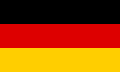
  • Flag of East Germany (1949–1959), Flag of West Germany (1949–1990), Flag of Germany (1990–1996)
    flag, undatedFlag of East Germany (1949–1959), Flag of West Germany (1949–1990), Flag of Germany (1990–1996) · Public domain
  • Flag of Germany
    flag, from 1917Flag of Germany · Public domain
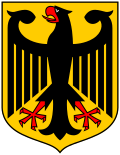
  • Coat of arms of Germany
    coat of arms, from 1950Coat of arms of Germany · Public domain

Its world

Who else stood

Meanwhile, elsewhere

The best-known states of other regions that stood while it did; the band is West Germany’s own years.

1940196019802000

How it compares

Among 3,073 states

Stood longer than 30% of 3,073 states
West Germany · 41 yearsDaman and DiuGerman EmpireHow long it stood, among the states with a recorded end or still standing.
Held more ground at its peak than 63% of 1,464 states
West Germany · 246,400 km²GhanaGuineaThe most ground it held, among the states with a border in Cliopatria.

Why it fell

Why did West Germany fall?

Historians still argue. Here is what the atlas records about its last century:

What led to it, and what came of it

Allied Control Council · Linked · 1945 – 1948Allied Control CouncilGerman Reich · Linked · 1871 – 1949German ReichTrizone · Linked · 1948 – 1949TrizoneOtto Hahn · Coincidence · 1879 – 1968Otto HahnWaldemar Pabst · Coincidence · 1880 – 1970Waldemar PabstAlbert Kesselring · Coincidence · 1885 – 1960Albert KesselringWest Germany · 1949 – 1990West GermanyGermany · Linked · 1990 – 2026Germany190019502000
linkedcoincidence

Open the investigation: every row with its evidence, the conditions at the time, the theories condition by condition, and the succession analysed.

Theories that apply to its ending

  • Demographic-structural breakdown

    Goldstone 1991 · Turchin & Nefedov 2009

    Applies by its own logic: 2 of its 3 conditions held here (it needs 2), and this is the kind of outcome it predicts — unrest, adverse regime change or the state's ending.

    • famine, plague or disaster within 30 y in the state, or population up 25% over 50 y — prior
    • overlapping reigns — rival claimants — within 20 y, or 3 or more changes of ruler within 20 y, or 2 or more reigns of two years or less within 20 y, or a monarch deposed or killed within 20 y — handovers 3

In the record

28 entries the atlas files under it, all in 1900 – 1999.

Keep exploring

Share this page
Copy link
Embed the map
Cite this page

How this page is made

Drawn from Wikidata (Q713750, CC0), the opening and history of its English Wikipedia article retold by the atlas (CC BY-SA 4.0), borders from Cliopatria (CC BY 4.0), coast and rivers from Natural Earth, cities from Reba, Reitsma & Seto 2016 (CC BY 4.0), symbols from Wikimedia Commons, each under its own licence. Data built 2026-11-26 · Pastlas v2.47.1, by Oleh Voronko; the published atlas and its data are for non-commercial use.

How to read it

Areas are measured on an equal-area grid from borders simplified to about five kilometres. “c.” marks an approximate date, and a date known to the century is never printed to the year. Counts are what the atlas holds, and they follow Wikipedia’s coverage: a busy century is partly a fact about the record.

Something wrong?

Tell us and name the entry. We fix the data, not just this page.

Report a problem