State · Europe

Austria

1918 – present · 108 years · still standing

Came after Austria-Hungary

The small Alpine republic left by the Habsburg collapse: annexed by Hitler, occupied by the Allies, and reborn as a neutral state.

Austria became a republic when Austria-Hungary collapsed at the end of World War I: German-Austria was proclaimed in 1918 and the First Republic in 1919. Its parliament gave way to Engelbert Dollfuss's Austrofascist dictatorship in 1934, and in 1938 Hitler annexed the country to Nazi Germany. Liberated in 1945, it spent a decade under Allied occupation before the State Treaty of 1955 restored its sovereignty and it declared permanent neutrality.

What the record holds

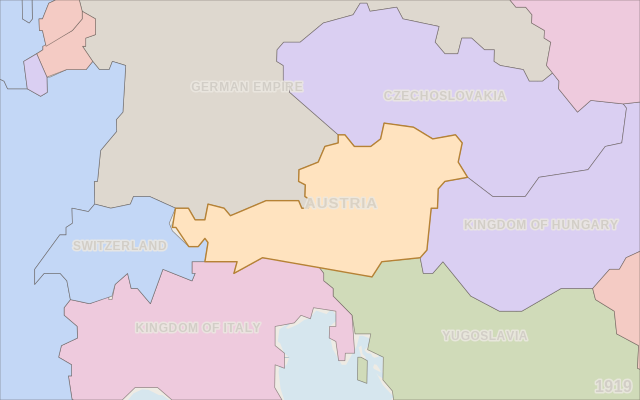
It was founded in 1918, replacing Austria-Hungary.↓ Its borders are first mapped in 1919, around 87,000 km².↓

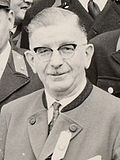
Its highest office was held by 13 rulers, covering 1919 – 2017, the median reign 8 years; none of its 12 handovers was irregular.↓ The best known of them are Kurt Waldheim, Alexander Van der Bellen and Heinz Fischer.↓ Most of the 84 rows the atlas files under it are people.↓

From Wikipedia’s article, retold · CC BY-SA 4.0

108 years

Longer than Nizhny Novgorod, shorter than the Maurya Empire

87,000 km²

At its height in 1919 · about the size of Panama

13 rulers

the President of Austria

3 wars and battles

More per century than 90% of states · 84 entries in all

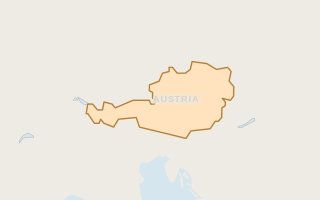
Map: Austria in 1919, its borders in gold among its neighbours
First Vienna Award, 1938Austrian State Treaty, 1955Vienna Convention on Diplomatic Relations, 1961Vienna Convention on the Law of Treaties, 1969Strategic Arms Limitation Talks, 19791940196019802000
Beside it on the map in 1919: German Empire, Czechoslovakia, Yugoslavia, Kingdom of Italy, French Third Republic and Kingdom of Hungary.How far it reached, year by year: its ground inside the borders Cliopatria draws (CC BY 4.0), measured on an equal-area grid; the map shows it at its largest, with the cities of the year.

The story

Four acts, 1918 – present

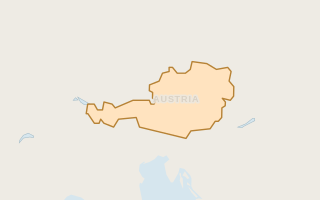
Austria in 1933, at the end of act I
I1918 – 1934

The First Republic

German members of the imperial parliament meet in October 1918 as an assembly for German-Austria, and the First Republic follows in 1919. Austrians and Slovenes clash over Carinthia. Inflation erodes the krone until a League of Nations loan in 1922; the schilling arrives in 1925, the July Revolt breaks out in 1927, and Black Tuesday ends a short boom.

Watch this act on the live map, from 1918
II1934 – 1945

Dictatorship and Anschluss

Engelbert Dollfuss sets up an Austrofascist dictatorship. Kurt Schuschnigg plans a referendum, but on 12 March 1938 Austrian Nazis take the government as German troops occupy the country; the Anschluss is declared next day and confirmed by a vote in April. Austria stays inside the Reich until Vienna falls to the Soviet offensive on 13 April 1945.

Watch this act on the live map, from 1934
Austria in 1954, at the end of act III
III1945 – 1955

Ten years of occupation

Karl Renner and leaders of the Socialist, Christian Social and Communist parties declare Austria's break with the Reich on 27 April 1945 and form a provisional government, with Renner as president from 1945. The Allies occupy the country for a decade. After years of talks shaped by the Cold War, the State Treaty of 15 May 1955 returns full independence.

Watch this act on the live map, from 1945
IV1955 – present

Neutral Austria

On 26 October 1955 the last occupying troops are gone and parliament declares permanent neutrality. Vienna lends its name to conventions on diplomatic relations in 1961 and on the law of treaties in 1969, while Tyrol stays a sore point with Italy. The presidency passes from Franz Jonas and Kurt Waldheim to Alexander Van der Bellen.

Watch this act on the live map, from 1955

Before and after

Before it

Where it sits in time

3000 BCE2000 BCE1000 BCE110002000Austria-Hungary: 1867 – 1918Austria: 1918 – 2026

Five thousand years, 3000 BCE to 2026; the state in gold, what it replaced or followed and what replaced or followed it in grey.

Its people

Lives across Austria

190019502000
Statesmen and generalsWriters, artists and thinkersAll its people on the timeline →

How it was governed

13 presidents

13 presidents on record, 1919 to 2017; a reign lasted 8 years at the median. Each bar is a reign, as long as it lasted.

Karl Seitz · 1919 – 1920 · left office aliveMichael Hainisch · 1920 – 1928 · left office aliveWilhelm Miklas · 1928 – 1938 · left office aliveKarl Renner · 1945 – 1950 · died in office, manner not recordedLeopold Figl · 1950 – 1951 · left office aliveTheodor Körner · 1951 – 1957 · died in office of natural causesAdolf Schärf · 1957 – 1965 · died in office, manner not recordedFranz Jonas · 1965 – 1974 · died in office of natural causesRudolf Kirchschläger · 1974 – 1986 · left office aliveKurt Waldheim · 1986 – 1992 · resigned or stood down, the article saysThomas Klestil · 1992 – 2004 · died in office of natural causesHeinz Fischer · 2004 – 2016 · no death date to read the end againstAlexander Van der Bellen · 2017 – … · still in office192019401960198020002020
How their terms ended, where it is known (12 of 13):Died in office 5Left office alive 6In office 1Not on record 1
Every term, with how it ended and its source

Rulers

How 13 reigns ended - choose one to show only those

How they died, where the record says: died of natural causes 6.

RulerReignLengthHow it ended · sourceTo the ruler before
20th century · 11 reigns
Karl Seitz · aged 501919 – 19201 yearleft office aliveread off the dates alone
Michael Hainisch · aged 621920 – 19288 yearsleft office aliveread off the dates alone
Wilhelm Miklas · aged 561928 – 193810 yearsleft office aliveread off the dates alone
Karl Renner · aged 751945 – 19505 yearsdied in officeread off the dates alone
Leopold Figl · aged 481950 – 19511 yearleft office aliveread off the dates alonedied of natural causes
Theodor Körner · aged 781951 – 19576 yearsdied in officeWikidata's manner of deathdied of natural causes
Adolf Schärf · aged 671957 – 19658 yearsdied in officeread off the dates alone
Franz Jonas · aged 661965 – 19749 yearsdied in officeWikidata's manner of deathdied of natural causes
Rudolf Kirchschläger · aged 591974 – 198612 yearsleft office aliveread off the dates alonedied of natural causes
Kurt Waldheim · aged 681986 – 19926 yearsresignedread from the ruler's own articledied of natural causes
Thomas Klestil · aged 601992 – 200412 yearsdied in officeWikidata's manner of deathdied of natural causes
21st century · 2 reigns
Heinz Fischer · aged 662004 – 201612 yearsending not on record
Alexander Van der Bellen · aged 732017 – in officein office since 2017still in office

13 rulers, 13 with terms dated as terms, covering 1919 – 2017. Median reign 8 years. 0 of 12 handovers irregular - a killing, a deposition, a rival claimant, a rising or a coup beside it. The violent-handover count is withheld: power changed hands so often that any rising falls beside one (exposure 0.75, limit 0.6). A blank in the last column means no kin on record, which is coverage, never “unrelated”.

Heads of government

The line of Federal Chancellor of Austria, drawn and never measured: a cabinet is not a reign.

Heinrich Lammasch1918 – 1918
Karl Renner1918 – 1919
Michael Mayr1920 – 1921
Walter Breisky1922 – 1922
Johannes Schober1922 – 1922
Ignaz Seipel1922 – 1924
Rudolf Ramek1924 – 1926
Ignaz Seipel1926 – 1929
Johannes Schober1929 – 1930
Carl Vaugoin1930 – 1930
Otto Ender1930 – 1931
Engelbert Dollfuss1932 – 1934
Kurt Schuschnigg1934 – 1938
Walter Schwaigerlived 1935 – 2012
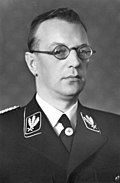
Arthur Seyss-Inquart1938 – 1938
Leopold Figl1945 – 1953
Karl Renner1945 – 1945
Julius Raab1953 – 1961
Alfons Gorbach1961 – 1964
Josef Klaus1964 – 1970
Bruno Kreisky1970 – 1983
Fred Sinowatz1983 – 1986
Franz Vranitzky1986 – 1997
Viktor Klima1997 – 2000
Wolfgang Schüssel2000 – 2007
Alfred Gusenbauer2007 – 2008
Werner Faymann2008 – 2016
Christian Kern2016 – 2017
Reinhold Mitterlehner2016 – 2016
Sebastian Kurz2017 – 2019
Hartwig Löger2019 – 2019
Brigitte Bierlein2019 – 2020
Sebastian Kurz2020 – 2021
Karl Nehammer2021 – 2025
Alexander Schallenberg2021 – 2021
Alexander Schallenberg2025 – 2025
Christian Stocker2025 – …

Flags and arms, in order

  • Flag of the Habsburg Monarchy
    flag, 1804 – 1867Flag of the Habsburg Monarchy · Public domain
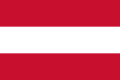
  • Flag of Austria
    flag, 1919 – 1938Flag of Austria · Public domain
  • Coat of arms of Austria
    coat of arms, from 1919Coat of arms of Austria · Public domain
  • Flag of Austria
    flag, from 1945Flag of Austria · Public domain

Its world

Rivals, and who else stood

Who it fought most

Wars and battles both took part in, on whichever side: the record names who took part, not who fought whom.

Meanwhile, elsewhere

The best-known states of other regions that stood while it did; the band is Austria’s own years.

19251950197520002025

How it compares

Among 3,073 states

Stood longer than 48% of 3,073 states
Austria · 108 yearsNizhny NovgorodMaurya EmpireHow long it stood, among the states with a recorded end or still standing.
Held more ground at its peak than 42% of 1,464 states
Austria · 87,000 km²PanamaJordanThe most ground it held, among the states with a border in Cliopatria.
Had more wars on record per century than 90% of 3,073 states
Austria · 0.9Wars recorded per century, among the states, counting the wars the atlas hosts under each.

How it began

How did Austria begin?

What led to it, and what came of it

Austria-Hungary · Linked · 1867 – 1918Austria-HungaryDuchy of Styria · Coincidence · 1180 – 1918Duchy of StyriaDuchy of Salzburg · Coincidence · 1849 – 1918Duchy of SalzburgFranz Conrad von Hötzendorf · Coincidence · 1852 – 1925Franz Conrad von HötzendorfSigmund Freud · Coincidence · 1856 – 1939Sigmund FreudRudolf Steiner · Coincidence · 1861 – 1925Rudolf SteinerAustria · 1918 – 2026Austria12001400160018002000
linkedcoincidence

Open the investigation: every row with its evidence, the conditions at the time, the theories condition by condition, and the succession analysed.

Its centuries in the record

1900 – 1999: 60 recorded — 3 wars and battles, 2 risings, regime changes and massacres, 55 other19002000 – 2099: 4 recorded — 0 wars and battles, 3 risings, regime changes and massacres, 1 other2000

Wars and battles in red, risings, coups and massacres beside them, everything else in grey, by the century each began in. A tall bar is partly a fact about Wikipedia: better-documented centuries hold more.

Each century’s own page:1900 – 19992000 – 2099

Keep exploring

Share this page
Copy link
Embed the map
Cite this page

How this page is made

Drawn from Wikidata (Q40, CC0), the opening and history of its English Wikipedia article retold by the atlas (CC BY-SA 4.0), borders from Cliopatria (CC BY 4.0), coast and rivers from Natural Earth, cities from Reba, Reitsma & Seto 2016 (CC BY 4.0), symbols from Wikimedia Commons, each under its own licence. Data built 2026-11-26 · Pastlas v2.47.1, by Oleh Voronko; the published atlas and its data are for non-commercial use.

How to read it

Areas are measured on an equal-area grid from borders simplified to about five kilometres. “c.” marks an approximate date, and a date known to the century is never printed to the year. Counts are what the atlas holds, and they follow Wikipedia’s coverage: a busy century is partly a fact about the record.

  • Wikidata records foundings in 996 and 1918; the atlas draws the preferred founding.
  • Still standing: the span runs to the year of the build, 2026.

Something wrong?

Tell us and name the entry. We fix the data, not just this page.

Report a problem