The Savoy kingdom that united Italy, took Rome from the popes, bowed to Mussolini and was voted out by its people.
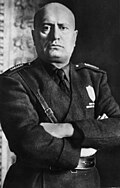
The Kingdom of Italy was proclaimed on 17 March 1861 with Victor Emmanuel II of Sardinia as king, and lasted until 18 June 1946. Born of the Risorgimento, it won Veneto in 1866 and Rome in 1870, became a colonial power and fought with the Allies in World War I. From 1922 Mussolini's Fascists ruled it as a dictatorship and led it into World War II; defeat and a referendum ended the monarchy.
What the record holdsShow less
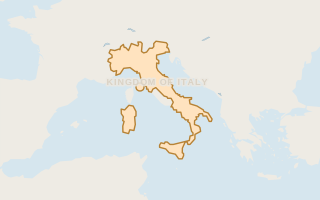
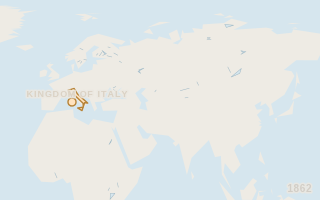
It was founded in 1861, replacing the Kingdom of Sardinia and the Kingdom of the Two Sicilies.↓ Its borders are first mapped in 1862, around 235,100 km².↓ The Second Italo-Ethiopian War, 1935 – 1937, began with it holding 295,100 km² and ended with 294,800 km².↓
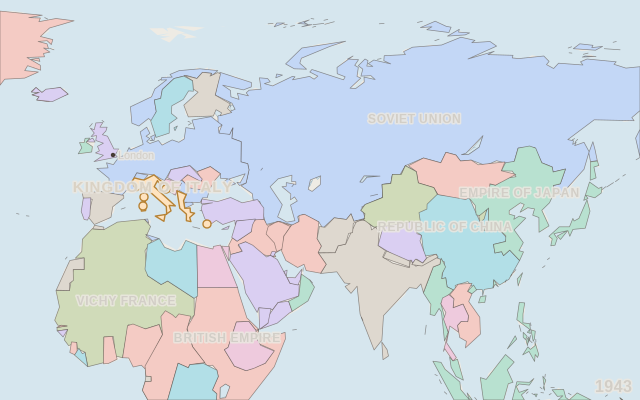
It reached its greatest extent in 1943: 454,800 km².↓ Its line counts 4 rulers, covering 1861 – 1946, the median reign 19.5 years; 2 of 3 handovers were irregular.↓ Among them, Victor Emmanuel II, Umberto I of Italy and Victor Emmanuel III are the best known.↓ The atlas files 206 rows under it, most of them people.↓
Italy replaced it in 1946, after 85 years.↓ One theory of why states fall has every condition present at its end: “The five conditions of revolution”.↓
Its life in chapters, drawn from its article’s own history; each opens on the live map.
I1861 – 1870
Completing the unification
The new kingdom must fuse seven different parts into one system, and Cavour dies in June 1861 before his plans are complete. Allied with Prussia, Italy fights Austria in 1866 and gains Veneto. In 1870 Italian troops enter Rome, ending the popes' temporal rule of more than a thousand years.
Liberal prime ministers such as Depretis and Giolitti hold power through trasformismo, bribery and rigged votes. Italy joins the Triple Alliance in 1882 and seeks colonies, but Crispi's ambitions end in defeat by Ethiopia in 1896. The North prospers while the South stays poor and mass emigration spreads; in 1898 soldiers fire on bread protesters in Milan.
Italy gives up neutrality in 1915 and joins the Allies, aiming to complete national unity with Trentino and Trieste. Victory brings a permanent seat on the League of Nations council but not all the land it was promised. Amid the Red Biennium, Mussolini's Fasci di Combattimento, founded in 1919, grow fast.
In 1922 Mussolini becomes prime minister; he crushes all opposition and rules as dictator, and the Lateran Treaties of 1929 settle the quarrel with the Church. Italy attacks Ethiopia in 1935, intervenes in Spain and seizes Albania, then allies with Germany and Japan. In 1940 it invades France; in 1943 the Allies land in Italy and Mussolini is ousted.
A German commando frees Mussolini, who heads a puppet Italian Social Republic in the north while the Allies advance from the south. Naples rises, a large resistance wages guerrilla war on German and Fascist forces, and Italians fight Italians. In June 1946 the voters decide the fate of a crown compromised by Fascism.
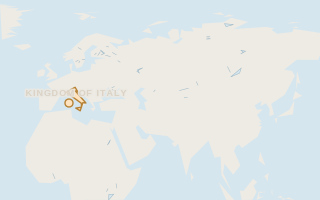
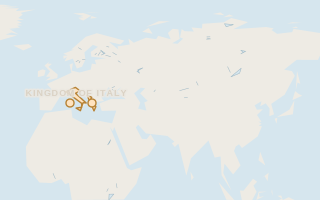
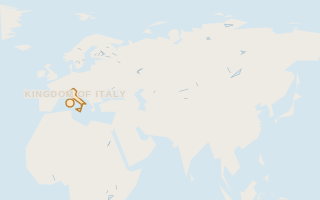
The rise and the fall in one frame: drag across it from 1862, first mapped at 235,100 km², to 1943, at its largest at 454,800 km². Open the live map in 1862 or 1943.
Before and after
The states the record files it as replacing or following, and those that replaced or followed it - Wikidata's own statements, each read from this state's side.
4 rulers, 4 with terms dated as terms, covering 1861 – 1946. Median reign 19.5 years. 2 of 3 handovers irregular - a killing, a deposition, a rival claimant, a rising or a coup beside it. A blank in the last column means no kin on record, which is coverage, never “unrelated”.
Heads of government
The line of Prime Minister of the Kingdom of Italy, drawn and never measured: a cabinet is not a reign.
Each symbol with the years its own statement gives; the timeline flies the one of the year on screen.
flag, undatedFlag of Italy (1861-1946) crowned · Public domain
flag, undatedFlag of Italy (1861–1946) · Public domain
coat of arms, undatedCoat of arms of the Kingdom of Italy (1890) · CC BY-SA 3.0 · Sodacan , Katepanomegas , ZuppaDiCarlo This file was derived from: Great coat of arms of…
The investigation's own picture: 42 causes the record names and 1 result, the strongest six of each at their own years, joined to the state by the kind of claim - a recorded statement solid, the article's sentence dashed, a theory dash-dot.
linked
Open the investigation: every row with its evidence, the conditions at the time, the theories condition by condition, and the succession analysed.
Theories that apply to its ending
Of 5 theories of why states fall, 1 has every condition present at this ending and 2 some of them; each is applied by its own logic, condition by condition, and whether its authors named this case is a footnote.
The five conditions of revolution
Goldstone 2014 · Goldstone 2001
Applies by its own logic: 4 of its 5 conditions held here (it needs 4), and this is the kind of outcome it predicts — unrest, adverse regime change or the state's ending.
GDP per capita down 5% over 5 y, or a war the state is fighting, still under way, or a war the state fought, ended within 5 y, or famine within 5 y in the state — warEnded
an elite group among the regime's opposition within 5 y, or an elite group left the regime's support over 10 y, or a monarch deposed or killed within 10 y, or overlapping reigns — rival claimants — within 10 y, or 2 or more reigns of two years or less within 10 y — the aristocracy, agrarian elites, party elites, business elites, civil servants, the military (1946)
mass mobilisation at 3 or more of 4 within 5 y, or a popular class among the regime's opposition within 5 y, or unrest within 5 y in the state — many large-scale and small-scale events (1941); urban working classes (1941); prior
anti-system movements at 3 or more of 4 within 5 y — a high level, a substantial threat (1943)
Its centuries in the record
Wars and battles in red, risings, coups and massacres beside them, everything else in grey, by the century each began in. A tall bar is partly a fact about Wikipedia: better-documented centuries hold more.
Share this pageCopy linkEmbed the mapCite this page
“Kingdom of Italy”, Pastlas, a historical atlas, 2026-11-26. https://app.pastlas.com/state/kingdom-of-italy/
How this page is made
Drawn from Wikidata (Q172579, CC0), the opening and history of its English Wikipedia article retold by the atlas (CC BY-SA 4.0), borders from Cliopatria (CC BY 4.0), coast and rivers from Natural Earth, cities from Reba, Reitsma & Seto 2016 (CC BY 4.0), symbols from Wikimedia Commons, each under its own licence. Data built 2026-11-26 · Pastlas v2.47.1, by Oleh Voronko; the published atlas and its data are for non-commercial use.
How to read it
Areas are measured on an equal-area grid from borders simplified to about five kilometres. “c.” marks an approximate date, and a date known to the century is never printed to the year. Counts are what the atlas holds, and they follow Wikipedia’s coverage: a busy century is partly a fact about the record.
Something wrong?
Tell us and name the entry. We fix the data, not just this page.