State · Europe

Golden Horde

1243 – 1502 · 259 years

Became Principality of Moldavia and Great Horde

The Mongol khanate of Jochi's heirs, which ruled from Siberia to the Danube and held Russia under the Tatar yoke.

The Golden Horde, also called the Ulus of Jochi or the Kipchak Khanate, grew from the lands Genghis Khan gave his son Jochi, at the north-western edge of the Mongol Empire. Under Batu Khan it expanded greatly, and after the empire divided in 1259 it acted as an independent khanate. Its armies were strongest under Özbeg Khan, who adopted Islam. Two decades of turmoil and Timur's invasion of 1396 broke it into smaller khanates.

What the record holds

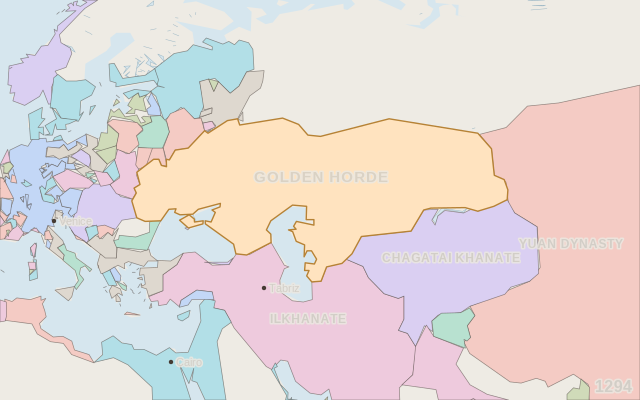
The record dates its beginning to 1243.↑ When the borders dataset first draws it, in 1294, it held 4.92 million km².↓

Its highest office was held by 28 rulers, covering 1227 – 1395, the median reign 2 years; 2 of 29 handovers were irregular.↓ The best known of them are Batu Khan, Tokhtamysh and Berke.↓ Most of the 33 rows the atlas files under it are people.↓

The Principality of Moldavia and the Great Horde followed it in 1502, after 259 years.↓

From Wikipedia’s article, retold · CC BY-SA 4.0

259 years

Longer than the Gupta Empire, shorter than the Qing dynasty

4.92 million km²

At its height in 1294

28 rulers

the khan

4 wars and battles

More per century than 89% of states · 33 entries in all

Map: Golden Horde in 1294, its borders in gold among its neighbours
Battle on the Irpin River, 1320Battle of Blue Waters, 1362 – 1363Polish–Ottoman War (1485–1503), 1485 – 1503135014001450
Beside it on the map in 1294: Yuan dynasty, Ilkhanate, Chagatai Khanate, Mamluk Sultanate, Novgorod Republic and Holy Roman Empire.How far it reached, year by year: its ground inside the borders Cliopatria draws (CC BY 4.0), measured on an equal-area grid; the map shows it at its largest, with the cities of the year.

The story

Four acts, 1243 – 1502

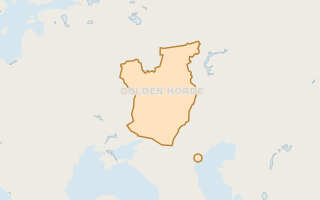
Golden Horde in 1501, at the end of act IV
IV1381 – 1502

Tokhtamysh, Timur and break-up

Tokhtamysh reunites the Horde, but Timur invades in 1396 and the khanate splinters. Temür Qutlugh rules from Sarai with Edigu as co-ruler, and in 1399 they defeat Tokhtamysh and Vytautas of Lithuania at the Vorskla River. By 1466 it is called simply the Great Horde, and in 1480 Moscow throws off the Tatar yoke at the Ugra.

Watch this act on the live map, from 1381
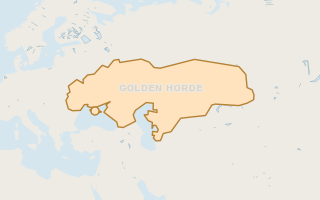
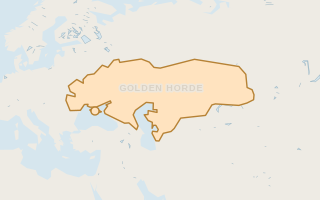
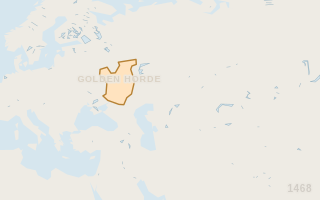
Golden Horde in 1468, last mappedGolden Horde in 1294, at its largest
The rise and the fall in one frame: drag across it from 1294, at its largest at 4.92 million km², to 1468, last mapped at 548,100 km². Open the live map in 1294 or 1468.

Before and after

After it

Where it sits in time

3000 BCE2000 BCE1000 BCE110002000Principality of Moldavia: 1346 – 1859Great Horde: 1433 – 1502Golden Horde: 1243 – 1502

Five thousand years, 3000 BCE to 2026; the state in gold, what it replaced or followed and what replaced or followed it in grey.

Its people

Lives across the Golden Horde

12501300135014001450
Statesmen and generalsAll its people on the timeline →

How it was governed

28 khans

28 khans on record, 1227 to 1395; a reign lasted 2 years at the median. Each bar is a reign, as long as it lasted.

Batu Khan · 1227 – 1255 · died in office, manner not recordedSartaq Khan · 1255 – 1256 · left office aliveUlaghchi · 1256 – 1257 · died in office, manner not recordedBerke · 1257 – 1266 · died in battleMengu-Timur · 1266 – 1280 · died in office, manner not recordedTode Mongke · 1280 – 1287 · died in office, manner not recordedTalabuga · 1287 – 1290 · died in office, manner not recordedToqta · 1290 – 1312 · died in office, manner not recordedÖzbeg Khan · 1312 – 1341 · died in office, manner not recordedTini Beg · 1341 – 1342 · died in office, manner not recordedJani Beg · 1342 – 1357 · died in office, manner not recordedBerdi Beg · 1357 – 1359 · killedQulpa · 1359 – 1360 · died in office, manner not recordedNawruz Beg · 1360 – 1360 · died in office, manner not recordedKhiḍr Khan · 1360 – 1361 · died in office, manner not recordedTimur Khwaja · 1361 – 1361 · died in office, manner not recordedOrdu Malik · 1361 – 1361 · died in office, manner not recordedKildi Beg · 1361 – 1362 · died in office, manner not recordedAbdallāh · 1362 – 1362 · left office aliveMurad (Golden Horde) · 1362 – 1362 · left office aliveKhayr Pulad · 1362 – 1364 · left office aliveAziz Shaykh · 1364 – 1367 · died in office, manner not recordedAbdallāh · 1367 – 1369 · left office aliveMuhammad Sultan (Golden Horde) · 1371 – 1373 · left office aliveUrus Khan · 1373 – 1373 · left office aliveIl Beg · 1374 – 1374 · died in office, manner not recordedMuhammad Sultan (Golden Horde) · 1374 – 1374 · left office aliveQaghan Beg · 1375 – 1377 · died in office, manner not recordedArab Shah · 1377 – 1380 · died in office, manner not recordedTokhtamysh · 1380 – 1395 · left office alive125013001350140014501500
How their terms ended, where it is known (30 of 30):Killed 2Died in office 19Left office alive 9
Every term, with how it ended and its source

Rulers

How 30 reigns ended - choose one to show only those

How they died, where the record says: died in battle 1 · killed 1.

RulerReignLengthHow it ended · sourceTo the ruler before
13th century · 8 reigns · 1 killed or removed
Batu Khan · aged 221227 – 125528 yearsdied in officeread off the dates alone
Sartaq Khan · aged 251255 – 12561 yearleft office aliveread off the dates alonechild
Ulaghchi · aged 91256 – 12571 yeardied in officeread off the dates alonechild
Berke · aged 481257 – 12669 yearsdied in battleWikidata's manner of death
Mengu-Timur · aged 241266 – 128014 yearsdied in officeread off the dates alone
Tode Mongke1280 – 12877 yearsdied in officeread off the dates alonesibling
Talabuga1287 – 12903 yearsdied in officeread off the dates alone
Toqta · aged 341290 – 131222 yearsdied in officeread off the dates alone
14th century · 22 reigns · 1 killed or removed
Özbeg Khan · aged 301312 – 134129 yearsdied in officeread off the dates alone
Tini Beg1341 – 13421 yeardied in officeread off the dates alonechild
Jani Beg1342 – 135715 yearsdied in officeread off the dates alonesibling
Berdi Beg · aged 471357 – 13592 yearskilled in officeWikidata's manner of deathchild
Qulpa · aged 91359 – 13601 yeardied in officeread off the dates alonesibling
Nawruz Beg · aged 101360 – 1360under a yeardied in officeread off the dates alonesibling
Khiḍr Khan1360 – 13611 yeardied in officeread off the dates alone
Timur Khwaja1361 – 1361under a yeardied in officeread off the dates alonechild
Ordu Malik1361 – 1361under a yeardied in officeread off the dates alone
Kildi Beg1361 – 13621 yeardied in officeread off the dates alone
Abdallāh · aged 221362 – 1362under a yearleft office aliveread off the dates alone
Murad (Golden Horde)1362 – 1362under a yearleft office aliveread off the dates alone
Khayr Pulad · aged 321362 – 13642 yearsleft office aliveread off the dates alone
Aziz Shaykh1364 – 13673 yearsdied in officeread off the dates alone
Abdallāh · aged 271367 – 13692 yearsleft office aliveread off the dates alone
Muhammad Sultan (Golden Horde) · aged 111371 – 13732 yearsleft office aliveread off the dates alonechild
Urus Khan · aged 231373 – 1373under a yearleft office aliveread off the dates alone
Il Beg1374 – 1374under a yeardied in officeread off the dates alone
Muhammad Sultan (Golden Horde) · aged 141374 – 1374under a yearleft office aliveread off the dates alone
Qaghan Beg1375 – 13772 yearsdied in officeread off the dates alone
Arab Shah1377 – 13803 yearsdied in officeread off the dates alone
Tokhtamysh · aged 381380 – 139515 yearsleft office aliveread off the dates alone

28 rulers, 28 with terms dated as terms, covering 1227 – 1395. Median reign 2 years. 2 of 29 handovers irregular - a killing, a deposition, a rival claimant, a rising or a coup beside it. A blank in the last column means no kin on record, which is coverage, never “unrelated”.

Its world

Rivals, and who else stood

Who it fought most

Wars and battles both took part in, on whichever side: the record names who took part, not who fought whom.

Meanwhile, elsewhere

The best-known states of other regions that stood while it did; the band is the Golden Horde’s own years.

130014001500

How it compares

Among 3,073 states

Stood longer than 69% of 3,073 states
Golden Horde · 259 yearsGupta EmpireQing dynastyHow long it stood, among the states with a recorded end or still standing.
Held more ground at its peak than 97% of 1,464 states
Golden Horde · 4,918,000 km²IndiaAustraliaThe most ground it held, among the states with a border in Cliopatria.
Had more wars on record per century than 89% of 3,073 states
Golden Horde · 0.8Wars recorded per century, among the states, counting the wars the atlas hosts under each.

Why it fell

Why did the Golden Horde fall?

Historians still argue. Here is what the atlas records about its last century:

÷2.8

its land, between 1402 and 1501

What led to it, and what came of it

Battle of Legnica · Linked · 1241Battle of LegnicaMongol Empire · Linked · 1206 – 1368Mongol EmpireShiban · Coincidence · 1210 – 1248ShibanGolden Horde · 1243 – 1502Golden HordeGreat Horde · Linked · 1433 – 1502Great HordePrincipality of Moldavia · Linked · 1346 – 1859Principality of Moldavia1200140016001800
linkedcoincidence

Open the investigation: every row with its evidence, the conditions at the time, the theories condition by condition, and the succession analysed.

Its centuries in the record

1200 – 1299: 10 recorded — 1 wars and battles, 0 risings, regime changes and massacres, 9 other12001300 – 1399: 21 recorded — 2 wars and battles, 0 risings, regime changes and massacres, 19 other13001400 – 1499: 2 recorded — 1 wars and battles, 0 risings, regime changes and massacres, 1 other14001500 – 1599: 0 recorded — 0 wars and battles, 0 risings, regime changes and massacres, 0 other1500

Wars and battles in red, risings, coups and massacres beside them, everything else in grey, by the century each began in. A tall bar is partly a fact about Wikipedia: better-documented centuries hold more.

Each century’s own page:1200 – 12991300 – 13991400 – 14991500 – 1599

Keep exploring

Share this page
Copy link
Embed the map
Cite this page

How this page is made

Drawn from Wikidata (Q79965, CC0), the opening and history of its English Wikipedia article retold by the atlas (CC BY-SA 4.0), borders from Cliopatria (CC BY 4.0), coast and rivers from Natural Earth, cities from Reba, Reitsma & Seto 2016 (CC BY 4.0). Data built 2026-11-26 · Pastlas v2.47.1, by Oleh Voronko; the published atlas and its data are for non-commercial use.

How to read it

Areas are measured on an equal-area grid from borders simplified to about five kilometres. “c.” marks an approximate date, and a date known to the century is never printed to the year. Counts are what the atlas holds, and they follow Wikipedia’s coverage: a busy century is partly a fact about the record.

Something wrong?

Tell us and name the entry. We fix the data, not just this page.

Report a problem