 Tokhtamysh, Urus Khan and Bayan Khan are the best known.
Muscovite–Volga Bulgars war
battle · 1376
State · Europe
1227 – 1401
Best known for
1.82 million km²
At its height in 1363 · about the size of Sudan
8 rulers
the khan
3 wars and battles
10 entries in all
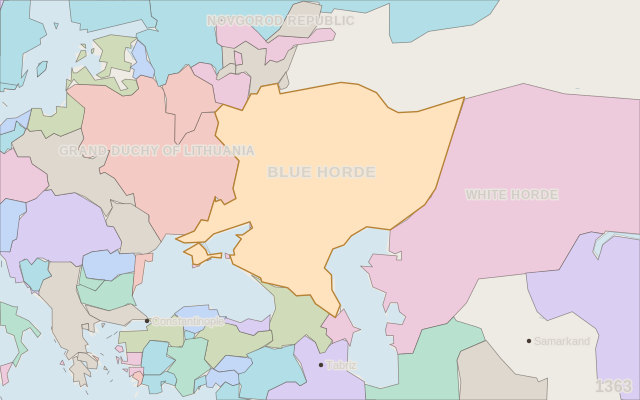
 Grand Duchy of Lithuania, Novgorod Republic, Chagatai Khanate,
 Kingdom of Hungary and Sarbadars.How far it reached, year by year: its ground inside the borders Cliopatria draws (CC BY 4.0), measured on an equal-area grid; the map shows it at its largest, with the cities of the year.
The story
The best-known wars, battles, risings and changes of regime the record files under it; a war within a war is folded into it.
battle · 1376
battle · 1378
battle · 1391
Five thousand years, 3000 BCE to 2026; the state in gold.
Its people
One axis for everyone, so you can see who knew whom: the best-known, ordered by birth.
The best-known people the record files under it, by how many Wikipedias write about them.
 Tokhtamyshruler · 1342 – 1406
How it was governed
8 khans on record, 1280 to 1395; a reign lasted 13.5 years at the median. Each bar is a reign, as long as it lasted.
The line of khan.
| Ruler | Reign | Length | How it ended · source | To the ruler before |
|---|---|---|---|---|
| 13th century · 2 reigns | ||||
| Köchü · aged 45 | 1280 – — | no end recorded | ending not on record | |
| Bayan Khan | 1298 – — | no end recorded | ending not on record | child |
| 14th century · 6 reigns | ||||
| Sasibuqa · aged 62 | 1312 – 1320 | 8 years | died in officeread off the dates alone | child |
| Ilbasan · aged 70 | 1320 – 1344 | 24 years | died in officeread off the dates alone | child |
| Chimtay | 1344 – 1361 | 17 years | died in officeread off the dates alone | child |
| Mubarak Khwaja | 1366 – 1368 | 2 years | ending not on record | sibling |
| Urus Khan · aged 18 | 1368 – 1378 | 10 years | dates disagreeread off the dates alone | |
| Tokhtamysh · aged 36 | 1378 – 1395 | 17 years | left office aliveread off the dates alone | |
8 rulers, 8 with terms dated as terms, covering 1280 – 1395. Median reign 13.5 years. 0 of 7 handovers irregular - a killing, a deposition, a rival claimant, a rising or a coup beside it. A blank in the last column means no kin on record, which is coverage, never “unrelated”.
Tokhtamysh17 yrsIts world
The best-known states of other regions that stood while it did; the band is the Blue Horde’s own years.
 Persian EmpireMiddle East and North Africa
 KathmanduSouth Asia
 Mongol EmpireEast and Southeast Asia
 Delhi SultanateSouth Asia
How it compares
Each column is a share of the states; gold is the Blue Horde.
How it began
The investigation's own picture: 1 cause the record names and 0 results, the strongest six of each at their own years, joined to the state by the kind of claim - a recorded statement solid, the article's sentence dashed, a theory dash-dot.
Open the investigation: every row with its evidence, the conditions at the time, the theories condition by condition, and the succession analysed.
Wars and battles in red, risings, coups and massacres beside them, everything else in grey, by the century each began in. A tall bar is partly a fact about Wikipedia: better-documented centuries hold more.
Each century’s own page:1200 – 12991300 – 13991400 – 1499
“Blue Horde”, Pastlas, a historical atlas, 2026-11-26. https://app.pastlas.com/state/blue-horde/
Drawn from Wikidata (Q644979, CC0), borders from Cliopatria (CC BY 4.0), coast and rivers from Natural Earth, cities from Reba, Reitsma & Seto 2016 (CC BY 4.0). Data built 2026-11-26 · Pastlas v2.47.1, by Oleh Voronko; the published atlas and its data are for non-commercial use.
Areas are measured on an equal-area grid from borders simplified to about five kilometres. “c.” marks an approximate date, and a date known to the century is never printed to the year. Counts are what the atlas holds, and they follow Wikipedia’s coverage: a busy century is partly a fact about the record.