Battle of Valdejunquera
battle · 920
State · Europe
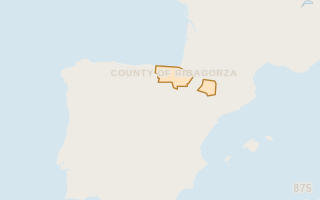
The County of Ribagorza began in the 9th century, replacing Spanish march.↓ When the borders dataset first draws it, in 875, it held 20,900 km².↓
It reached its greatest extent in 1034: 171,800 km².↓ The record names 23 rulers in its line, covering 872 – 1573, the median reign 16.5 years; 3 of 21 handovers were irregular.↓ The best known of them are  Ferdinand II of Aragon,
 John II of Aragon and
 Alfonso the Battler.↓ Most of the 18 rows the atlas files under it are people.↓
It was replaced by the  Kingdom of Aragon in 1598, 698 years after it began.↓
Best known for
698 years
Longer than the Ottoman Empire, shorter than the House of Habsburg
172,000 km²
At its height in 1034 · about the size of Uruguay
23 rulers
the Count of Ribagorza
3 wars and battles
More per century than 86% of states · 18 entries in all
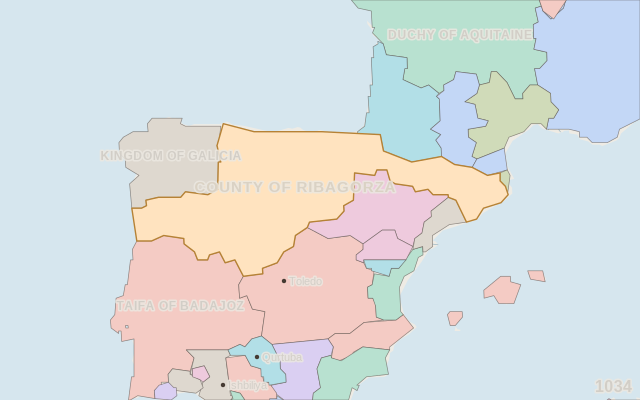
 Duchy of Aquitaine,
 Holy Roman Empire, Taifa of Toledo,
 Kingdom of Galicia and
 Duchy of Gascony.How far it reached, year by year: its ground inside the borders Cliopatria draws (CC BY 4.0), measured on an equal-area grid; the map shows it at its largest, with the cities of the year.
The story
The best-known wars, battles, risings and changes of regime the record files under it; a war within a war is folded into it.
battle · 920
battle · 1037
war · 1065 – 1067
The states the record files it as replacing or following, and those that replaced or followed it - Wikidata's own statements, each read from this state's side.
Kingdom of Aragon · replaced by · 1035 – 1707Five thousand years, 3000 BCE to 2026; the state in gold, what it replaced or followed and what replaced or followed it in grey.
Its people
One axis for everyone, so you can see who knew whom: the best-known, ordered by birth.
 Bernardo I de Ribagorzacount880 – 955
 García Sánchez III of Pamplonaruler1012 – 1054
 Alfonso II, Duke of Gandiacount1358 – 1425
 Alfonso de Aragón y Escobarcount · military personnel1417 – 1485
 Juan II de Ribagorzapolitician · military personnel1457 – 1528
How it was governed
23 counts on record, 872 to 1573; a reign lasted 16.5 years at the median. Each bar is a reign, as long as it lasted.
The line of Count of Ribagorza - the office this state names as its head of state.
| Ruler | Reign | Length | How it ended · source | To the ruler before |
|---|---|---|---|---|
| 9th century · 1 reign | ||||
| Raymond I of Ribagorza · aged 12 | 872 – 920 | 48 years | died in officeread off the dates alone | |
| 10th century · 5 reigns · 1 killed or removed | ||||
| Bernardo I de Ribagorza · aged 40 | 920 – 955 | 35 years | died in officeread off the dates alone | child |
| Ramon II of Ribagorza · aged 54 | 955 – 970 | 15 years | died in officeread off the dates alone | child |
 Unifred, Count of Ribagorza · aged 69 | 970 – 979 | 9 years | died in officeread off the dates alone | child |
| Arnold, Count of Ribagorza · aged 78 | 979 – 990 | 11 years | died in officeread off the dates alone | sibling |
| Isarn, Count of Ribagorza · aged 89 | 990 – 1003 | 13 years | died in battleWikidata's manner of death | sibling |
| 11th century · 7 reigns · 2 killed or removed | ||||
| Tota of Ribagorza · aged 102 | 1003 – 1011 | 8 years | died in officeread off the dates alone | sibling |
| William Isarn · aged 110 | 1011 – 1017 | 6 years | killed in officeWikidata's manner of death | nephew or niece |
 Sancho III of Pamplona · aged 53 | 1018 – 1035 | 17 years | died in officeread off the dates alone | |
| Gonzalo of Sobrarbe and Ribagorza · aged 18 | 1035 – 1043 | 8 years | left office aliveread off the dates alonekilled | child |
 Ramiro I of Aragon · aged 35 | 1043 – 1063 | 20 years | died in battleWikidata's manner of death | sibling |
 Sancho Ramírez · aged 18 | 1063 – 1085 | 22 years | left office aliveread off the dates alone | child |
 Peter I of Aragon and Pamplona · aged 17 | 1085 – 1104 | 19 years | died in officeread off the dates alone | child |
| 12th century · 2 reigns | ||||
 Alfonso the Battler · aged 31 | 1104 – 1134 | 30 years | died in officeread off the dates alone | sibling |
 Ramiro II of Aragon · aged 54 | 1134 – 1157 | 23 years | died in officeread off the dates alone | sibling |
| 14th century · 2 reigns | ||||
| Peter, Count of Ribagorza · aged 17 | 1322 – 1381 | 59 years | dates disagreeread off the dates alone | |
| Alfonso I, Duke of Gandia · aged 49 | 1381 – 1412 | 31 years | died in officeread off the dates alone | child |
| 15th century · 4 reigns | ||||
| Alfonso II, Duke of Gandia · aged 54 | 1412 – 1425 | 13 years | died in officeread off the dates alone | child |
 John II of Aragon · aged 27 | 1425 – 1458 | 33 years | left office aliveread off the dates alone | |
 Ferdinand II of Aragon · aged 6 | 1458 – 1469 | 11 years | left office aliveread off the dates alone | child |
| Alfonso de Aragón y Escobar · aged 52 | 1469 – 1485 | 16 years | died in officeread off the dates alone | sibling |
| 16th century · 1 reign · 1 killed or removed | ||||
| Juan de Gurrea y Aragón · aged 22 | 1565 – 1573 | 8 years | executedWikidata's manner of death | |
23 rulers, 22 with terms dated as terms, covering 872 – 1573. Median reign 16.5 years. 3 of 21 handovers irregular - a killing, a deposition, a rival claimant, a rising or a coup beside it. A blank in the last column means no kin on record, which is coverage, never “unrelated”.
Each symbol with the years its own statement gives; the timeline flies the one of the year on screen.
 Bernardo I de Ribagorza35 yrsJohn II of Aragon33 yrs
Its world
Wars and battles both took part in, on whichever side: the record names who took part, not who fought whom.
 Kingdom of LeónBattle of Valdejunquera2
The best-known states of other regions that stood while it did; the band is the County of Ribagorza’s own years.
 Abbasid CaliphateMiddle East and North Africa
 KathmanduSouth Asia
 Mongol EmpireEast and Southeast Asia
 Delhi SultanateSouth Asia
 Ming dynastyEast and Southeast Asia
How it compares
Each column is a share of the states; gold is the County of Ribagorza.
Why it fell
Historians still argue. Here is what the atlas records about its last century:
1573
Juan de Gurrea y Aragón, killed in office
The investigation's own picture: 1 cause the record names and 1 result, the strongest six of each at their own years, joined to the state by the kind of claim - a recorded statement solid, the article's sentence dashed, a theory dash-dot.
Open the investigation: every row with its evidence, the conditions at the time, the theories condition by condition, and the succession analysed.
Wars and battles in red, risings, coups and massacres beside them, everything else in grey, by the century each began in. A tall bar is partly a fact about Wikipedia: better-documented centuries hold more.
Each century’s own page:900 – 9991000 – 10991100 – 11991200 – 12991300 – 13991400 – 14991500 – 1599
“County of Ribagorza”, Pastlas, a historical atlas, 2026-11-26. https://app.pastlas.com/state/county-of-ribagorza/
Drawn from Wikidata (Q1297894, CC0), borders from Cliopatria (CC BY 4.0), coast and rivers from Natural Earth, cities from Reba, Reitsma & Seto 2016 (CC BY 4.0), symbols from Wikimedia Commons, each under its own licence. Data built 2026-11-26 · Pastlas v2.47.1, by Oleh Voronko; the published atlas and its data are for non-commercial use.
Areas are measured on an equal-area grid from borders simplified to about five kilometres. “c.” marks an approximate date, and a date known to the century is never printed to the year. Counts are what the atlas holds, and they follow Wikipedia’s coverage: a busy century is partly a fact about the record.