State · East and Southeast Asia

Yuan dynasty

1271 – 1368 · 97 years

Came after Song dynasty and House of Ögedei · became Ming dynasty and Northern Yuan

Kublai Khan's Mongol dynasty, the first of non-Han founding to rule all of China proper, undone by court feuds, famine and revolt.

The Yuan dynasty was the Mongol-led imperial dynasty of China, a successor of the divided Mongol Empire. Kublai Khan proclaimed it in Chinese style in 1271, completed the conquest of the Southern Song in 1279 and ruled most of China and Mongolia from Khanbaliq. Succession feuds, debt and famine weakened it, and in 1368 the Ming dynasty drove its rulers back to the Mongolian Plateau.

What the record holds

It was founded in 1271, replacing the Song dynasty and the House of Ögedei.↓ When the borders dataset first draws it, in 1294, it held 14.23 million km².↓

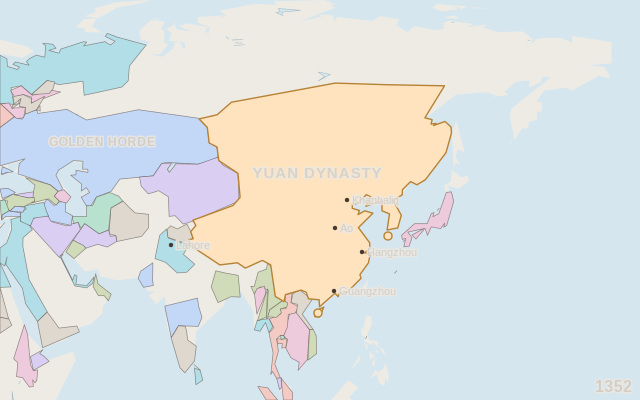
Its ground peaked in 1352 at 14.23 million km².↓ Its line counts 11 rulers, covering 1271 – 1368, the median reign 4 years; 1 of 10 handovers was irregular.↓ The best known of them are Kublai Khan, Toghon Temür and Temür Khan.↓ Most of the 18 rows the atlas files under it are people.↓

The Ming dynasty and Northern Yuan replaced it in 1368, after 97 years.↓ Its end fits “Dynastic cycle and the decay of group feeling”, every condition present.↓

From Wikipedia’s article, retold · CC BY-SA 4.0

97 years

Longer than the Inca Empire, shorter than Nizhny Novgorod

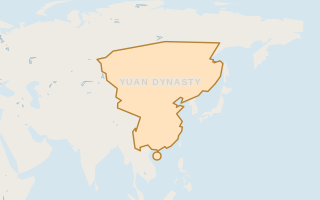
14.2 million km²

At its height in 1352 · almost the size of Russia

11 rulers

the Emperor of China

4 wars and battles

More per century than 98% of states · 18 entries in all

Map: Yuan dynasty in 1352, its borders in gold among its neighbours
War of the Two Capitals, 1328 – 1332Red Turban Rebellions, 1351 – 1368Battle of Lake Poyang, 1363132013401360
Beside it on the map in 1352: Golden Horde, Novgorod Republic, Chagatai Khanate, Mamluk Sultanate, Kart dynasty and Jalayirid Sultanate.How far it reached, year by year: its ground inside the borders Cliopatria draws (CC BY 4.0), measured on an equal-area grid; the map shows it at its largest, with the cities of the year.

The story

Three acts, 1271 – 1368

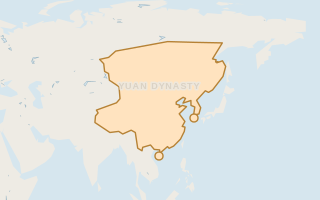
Yuan dynasty in 1332, at the end of act II
II1294 – 133314.2 million → 14.2 million km²

Heirs at war

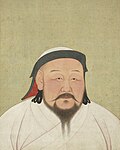
Succession becomes a constant source of strife. Temür Khan follows Kublai; under Külüg Khan, who prints new banknotes, China sinks into debt; Ayurbarwada embraces Chinese culture and restores the imperial examinations in 1313. His son Gegeen Khan is murdered in a coup, and from 1328 the War of the Two Capitals pits Khanbaliq against Shangdu.

Watch this act on the live map, from 1294
Yuan dynasty in 1367, at the end of act III
III1333 – 136814.2 million → 12.2 million km²

Toghon Temür and the fall

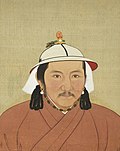
Toghon Temür, recalled from exile in Koryo, reigns amid the plots of El Temür, Bayan and Toqto'a. Cut off from army and people, the court lets outlaws roam, and from the late 1340s the countryside knows famine. The Red Turban Rebellions erupt in 1351, and in 1368 the Ming dynasty drives the Yuan back to the Mongolian Plateau.

Watch this act on the live map, from 1333

Before and after

Before it

After it

Where it sits in time

3000 BCE2000 BCE1000 BCE110002000House of Ögedei: 1200 – 1400Song dynasty: 960 – 1279Northern Yuan: 1368 – 1691Ming dynasty: 1368 – 1644Yuan dynasty: 1271 – 1368

Five thousand years, 3000 BCE to 2026; the state in gold, what it replaced or followed and what replaced or followed it in grey.

Its people

Lives across the Yuan dynasty

1250130013501400
Statesmen and generalsScientists and explorersWriters, artists and thinkersLived on after it endedAll its people on the timeline →

How it was governed

11 emperors

11 emperors on record, 1271 to 1368; a reign lasted 4 years at the median. Each bar is a reign, as long as it lasted.

Kublai Khan · 1271 – 1294 · died in office, manner not recordedTemür Khan · 1294 – 1307 · died in office, manner not recordedKülüg Khan · 1307 – 1311 · died in office, manner not recordedAyurbarwada Buyantu Khan · 1311 – 1320 · died in office, manner not recordedGegeen Khan · 1320 – 1323 · killedYesün Temür · 1323 – 1328 · died in office, manner not recordedRagibagh Khan · 1328 – 1328 · died in office, manner not recordedKhutughtu Khan Kusala · 1329 – 1329 · died in office, manner not recordedJayaatu Khan Tugh Temür · 1329 – 1332 · died in office, manner not recordedRinchinbal Khan · 1332 – 1332 · died in office, manner not recordedToghon Temür · 1333 – 1368 · left office alive12801300132013401360
How their terms ended, where it is known (11 of 11):Killed 1Died in office 9Left office alive 1
Every term, with how it ended and its source

Rulers

How 11 reigns ended - choose one to show only those

How they died, where the record says: killed 1 · died of natural causes 1.

RulerReignLengthHow it ended · sourceTo the ruler before
13th century · 2 reigns
Kublai Khan · aged 561271 – 129423 yearsdied in officeWikidata's end cause on the term
Temür Khan · aged 291294 – 130713 yearsdied in officeWikidata's end cause on the termgrandchild
14th century · 9 reigns · 1 killed or removed
Külüg Khan · aged 261307 – 13114 yearsdied in officeWikidata's end cause on the termnephew or niece
Ayurbarwada Buyantu Khan · aged 261311 – 13209 yearsdied in officeWikidata's end cause on the termsibling
Gegeen Khan · aged 181320 – 13233 yearskilled in officeWikidata's manner of deathchild
Yesün Temür · aged 301323 – 13285 yearsdied in officeWikidata's end cause on the term
Ragibagh Khan · aged 81328 – 1328under a yeardied in officeWikidata's end cause on the termchild
Khutughtu Khan Kusala · aged 291329 – 1329under a yeardied in officeWikidata's end cause on the term
Jayaatu Khan Tugh Temür · aged 251329 – 13323 yearsdied in officeWikidata's end cause on the termsibling
Rinchinbal Khan · aged 61332 – 1332under a yeardied in officeWikidata's end cause on the termnephew or niece
Toghon Temür · aged 131333 – 136835 yearsleft office aliveread off the dates alonedied of natural causessibling

11 rulers, 11 with terms dated as terms, covering 1271 – 1368. Median reign 4 years. 1 of 10 handovers irregular - a killing, a deposition, a rival claimant, a rising or a coup beside it. A blank in the last column means no kin on record, which is coverage, never “unrelated”.

Its world

Rivals, and who else stood

Who it fought most

Wars and battles both took part in, on whichever side: the record names who took part, not who fought whom.

Meanwhile, elsewhere

The best-known states of other regions that stood while it did; the band is the Yuan dynasty’s own years.

12751300132513501375

How it compares

Among 3,073 states

Stood longer than 45% of 3,073 states
Yuan dynasty · 97 yearsInca EmpireNizhny NovgorodHow long it stood, among the states with a recorded end or still standing.
Held more ground at its peak than 99% of 1,464 states
Yuan dynasty · 14,229,100 km²CanadaRussiaThe most ground it held, among the states with a border in Cliopatria.
Had more wars on record per century than 98% of 3,073 states
Yuan dynasty · 3.0Wars recorded per century, among the states, counting the wars the atlas hosts under each.

Why it fell

Why did the Yuan dynasty fall?

Historians still argue. Here is what the atlas records about its last century:

2

wars and battles in its last century

1323

Gegeen Khan, killed in office

What led to it, and what came of it

Song dynasty · Linked · 960 – 1279 · “In Chinese history, the Yuan dynasty followed the Song dynasty and preceded the Ming dynasty. Although Genghis Khan's enthronement as khagan in 1206 was descr…”Song dynastySouthern Song dynasty · Linked · 1127 – 1279Southern Song dynastyHouse of Ögedei · Linked · 1150 – 1400House of ÖgedeiKaidu–Kublai war · Linked · 1268 – 1301Kaidu–Kublai warJelme · Coincidence · 1157 – 1300JelmeLi Ye (mathematician) · Coincidence · 1192 – 1279Li Ye (mathematician)Yuan dynasty · 1271 – 1368Yuan dynastyMing dynasty · Linked · 1368 – 1644Ming dynastyNorthern Yuan · Linked · 1368 – 1691Northern Yuan1000120014001600
linkedcoincidence

Open the investigation: every row with its evidence, the conditions at the time, the theories condition by condition, and the succession analysed.

Theories that apply to its ending

  • Dynastic cycle and the decay of group feeling

    Ibn Khaldun 1377 · Turchin & Nefedov 2009

    Applies by its own logic: the condition it names held here, and this is the kind of outcome it predicts — adverse regime change or the state's ending.

    • the state 90 to 160 years old — ageBand 97

Its centuries in the record

1200 – 1299: 8 recorded — 2 wars and battles, 0 risings, regime changes and massacres, 6 other12001300 – 1399: 10 recorded — 2 wars and battles, 1 risings, regime changes and massacres, 7 other1300

Wars and battles in red, risings, coups and massacres beside them, everything else in grey, by the century each began in. A tall bar is partly a fact about Wikipedia: better-documented centuries hold more.

Each century’s own page:1200 – 12991300 – 1399

Keep exploring

Share this page
Copy link
Embed the map
Cite this page

How this page is made

Drawn from Wikidata (Q7313, CC0), the opening and history of its English Wikipedia article retold by the atlas (CC BY-SA 4.0), borders from Cliopatria (CC BY 4.0), coast and rivers from Natural Earth, cities from Reba, Reitsma & Seto 2016 (CC BY 4.0). Data built 2026-11-26 · Pastlas v2.47.1, by Oleh Voronko; the published atlas and its data are for non-commercial use.

How to read it

Areas are measured on an equal-area grid from borders simplified to about five kilometres. “c.” marks an approximate date, and a date known to the century is never printed to the year. Counts are what the atlas holds, and they follow Wikipedia’s coverage: a busy century is partly a fact about the record.

Something wrong?

Tell us and name the entry. We fix the data, not just this page.

Report a problem