State · Europe

Portugal

1910 – present · 116 years · still standing

Came after Portuguese Empire and Kingdom of Portugal

The Portuguese Republic: proclaimed against the monarchy, overthrown by soldiers, ruled by Salazar's Estado Novo, and freed by the Carnation Revolution.

Two years after republicans assassinated King Carlos I, the revolution of 5 October 1910 replaced Portugal's monarchy with a republic. The First Republic fought for the Allies in World War I but sank into instability, and a coup in 1926 opened a military dictatorship that grew into António de Oliveira Salazar's Estado Novo. Its overthrow in 1974, the Carnation Revolution, dissolved the colonial empire and led to democracy in 1976.

What the record holds

It was founded in 1910, replacing the Portuguese Empire and the Kingdom of Portugal.↓ In 1911, the first year its borders are mapped, it covered 1.97 million km².↓

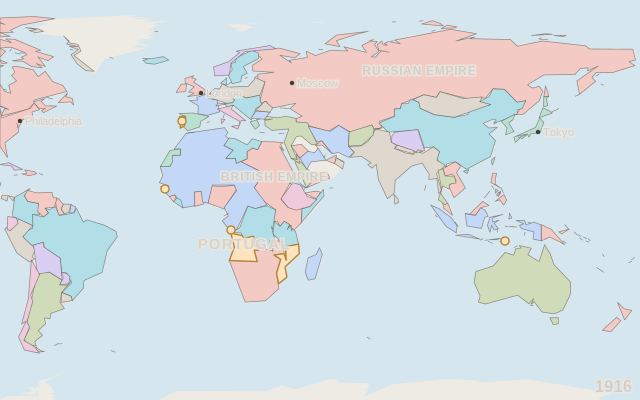
Its ground peaked in 1916 at 2.21 million km².↓ Its highest office was held by 20 rulers, covering 1911 – 2026, the median reign 3 years; 4 of 20 handovers were irregular.↓ Among them, Aníbal Cavaco Silva, Marcelo Rebelo de Sousa and Mário Soares are the best known.↓ The atlas files 96 rows under it, most of them people.↓

From Wikipedia’s article, retold · CC BY-SA 4.0

116 years

Longer than Nizhny Novgorod, shorter than the Maurya Empire

2.21 million km²

At its height in 1916 · about the size of Denmark

20 rulers

the President of Portugal

4 wars and battles

More per century than 90% of states · 96 entries in all

Map: Portugal in 1916, its borders in gold among its neighbours
Portuguese Colonial War, 1961 – 1974Indian annexation of Goa, 1961Carnation Revolution, 1974Lisbon Protocol, 1992192019401960198020002020
Beside it on the map in 1916: Russian Empire, British Empire, French Third Republic, Empire of China, Brazil and Australia.How far it reached, year by year: its ground inside the borders Cliopatria draws (CC BY 4.0), measured on an equal-area grid; the map shows it at its largest, with the cities of the year.

The story

Three acts, 1910 – present

Portugal in 1925, at the end of act I
I1910 – 1926

The First Republic

The monarchy falls in the revolution of 5 October 1910. Portugal fights on the Allied side in World War I, at Naulila and Ngomano, but the war deepens political instability and economic crisis. Coups come in 1915 and 1917, the Monarchy of the North rises in 1919, and the Bloody Night follows in 1921.

Watch this act on the live map, from 1910
II1926 – 1974

Salazar's Estado Novo

The coup of 28 May 1926 ends the republic. The military dictatorship, with Óscar Carmona as president until 1951, hardens into the Estado Novo, an authoritarian, nationalist and corporative regime under Salazar. Portugal stays neutral in World War II. India annexes Goa in 1961, the year the Portuguese Colonial War begins.

Watch this act on the live map, from 1926
III1974 – present

Carnation Revolution and democracy

A military coup in 1974 starts the Carnation Revolution, ending the dictatorship and beginning the dissolution of the empire, completed with the handover of Macau in 1999. Turmoil brings Portugal close to civil war until the coup of 25 November 1975 clears the way for a constitution and elections. Presidents from António Ramalho Eanes to Marcelo Rebelo de Sousa follow.

Watch this act on the live map, from 1974
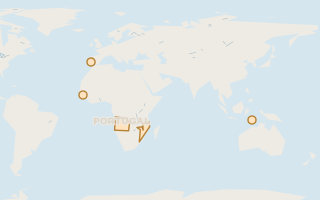
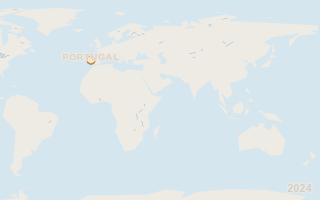
Portugal in 2024, last mappedPortugal in 1916, at its largest
The rise and the fall in one frame: drag across it from 1916, at its largest at 2.21 million km², to 2024, last mapped at 96,400 km². Open the live map in 1916 or 2024.

Before and after

Before it

Where it sits in time

3000 BCE2000 BCE1000 BCE110002000Portuguese Empire: 1415 – 1999Kingdom of Portugal: 1139 – 1910Portugal: 1910 – 2026

Five thousand years, 3000 BCE to 2026; the state in gold, what it replaced or followed and what replaced or followed it in grey.

Its people

Lives across Portugal

190019251950197520002025
Statesmen and generalsScientists and explorersAll its people on the timeline →

How it was governed

20 presidents

20 presidents on record, 1911 to 2026; a reign lasted 3 years at the median. Each bar is a reign, as long as it lasted.

Manuel de Arriaga · 1911 – 1915 · left office aliveTeófilo Braga · 1915 – 1915 · left office aliveBernardino Machado · 1915 – 1917 · left office aliveSidónio Pais · 1918 – 1918 · killedJoão do Canto e Castro · 1918 – 1919 · left office aliveAntónio José de Almeida · 1919 – 1923 · left office aliveManuel Teixeira Gomes · 1923 – 1925 · left office aliveBernardino Machado · 1925 – 1926 · left office aliveJosé Mendes Cabeçadas · 1926 – 1926 · resigned or stood down, the article saysManuel Gomes da Costa · 1926 – 1926 · left office aliveÓscar Carmona · 1926 – 1951 · died in office, manner not recordedFrancisco Craveiro Lopes · 1951 – 1958 · left office aliveAmérico Tomás · 1958 – 1974 · left office aliveAntónio de Spínola · 1974 – 1974 · resigned or stood down, the article saysFrancisco da Costa Gomes · 1974 – 1976 · left office aliveAntónio Ramalho Eanes · 1976 – 1986 · resigned or stood down, the article saysMário Soares · 1986 – 1996 · left office aliveJorge Sampaio · 1996 – 2006 · left office aliveAníbal Cavaco Silva · 2006 – 2016 · no death date to read the end againstMarcelo Rebelo de Sousa · 2016 – 2026 · no death date to read the end againstAntónio José Seguro · 2026 – … · resigned or stood down, the article says192019401960198020002020
How their terms ended, where it is known (19 of 21):Killed 1Died in office 1Left office alive 17Not on record 2
Every term, with how it ended and its source

Rulers

How 21 reigns ended - choose one to show only those

How they died, where the record says: died of natural causes 4 · killed 1.

RulerReignLengthHow it ended · sourceTo the ruler before
20th century · 18 reigns · 1 killed or removed
Manuel de Arriaga · aged 711911 – 19154 yearsleft office aliveread off the dates alone
Teófilo Braga · aged 721915 – 1915under a yearleft office aliveread off the dates alone
Bernardino Machado · aged 641915 – 19172 yearsleft office aliveread off the dates alone
Sidónio Pais · aged 461918 – 1918under a yearkilled in officeWikidata's manner of death
João do Canto e Castro · aged 561918 – 19191 yearleft office aliveread off the dates alone
António José de Almeida · aged 531919 – 19234 yearsleft office aliveread off the dates alonedied of natural causes
Manuel Teixeira Gomes · aged 631923 – 19252 yearsleft office aliveread off the dates alone
Bernardino Machado · aged 741925 – 19261 yearleft office aliveread off the dates alone
José Mendes Cabeçadas · aged 431926 – 1926under a yearresignedread from the ruler's own article
Manuel Gomes da Costa · aged 631926 – 1926under a yearleft office aliveread off the dates alone
Óscar Carmona · aged 571926 – 195125 yearsdied in officeread off the dates alone
Francisco Craveiro Lopes · aged 571951 – 19587 yearsleft office aliveread off the dates alone
Américo Tomás · aged 641958 – 197416 yearsleft office aliveread off the dates alone
António de Spínola · aged 641974 – 1974under a yearresignedread from the ruler's own articledied of natural causes
Francisco da Costa Gomes · aged 601974 – 19762 yearsleft office aliveread off the dates alone
António Ramalho Eanes · aged 411976 – 198610 yearsresignedread from the ruler's own article
Mário Soares · aged 621986 – 199610 yearsleft office aliveread off the dates alonedied of natural causes
Jorge Sampaio · aged 571996 – 200610 yearsleft office aliveread off the dates alonedied of natural causes
21st century · 3 reigns
Aníbal Cavaco Silva · aged 672006 – 201610 yearsending not on record
Marcelo Rebelo de Sousa · aged 682016 – 202610 yearsending not on record
António José Seguro · aged 642026 – in officein office since 2026resignedread from the ruler's own article

20 rulers, 20 with terms dated as terms, covering 1911 – 2026. Median reign 3 years. 4 of 20 handovers irregular - a killing, a deposition, a rival claimant, a rising or a coup beside it. The violent-handover count is withheld: power changed hands so often that any rising falls beside one (exposure 0.66, limit 0.6). A blank in the last column means no kin on record, which is coverage, never “unrelated”.

Heads of government

The line of Prime Minister of Portugal, drawn and never measured: a cabinet is not a reign.

Francisco da Veiga Beirãolived 1841 – 1916
Teófilo Braga1910 – 1911
João Pinheiro Chagas1911 – 1911
Augusto de Vasconcelos1911 – 1912
Duarte Leite1912 – 1913
Afonso Costa1913 – 1914
Victor Hugo de Azevedo Coutinho1914 – 1915
Joaquim Pimenta de Castro1915 – 1915
Afonso Costa1915 – 1916
José de Castro1915 – 1915
Sidónio Pais1917 – 1918
Afonso Costa1917 – 1917
João Tamagnini Barbosa1918 – 1919
Domingos Pereira1919 – 1919
Alfredo de Sá Cardoso1919 – 1920
José Relvas1919 – 1919
Álvaro de Castro1920 – 1920
Liberato Pinto1920 – 1921
José Ramos Preto1920 – 1920
António Maria Baptista1920 – 1920
Francisco José Fernandes Costa1920 – 1920
António Granjo1920 – 1920
António Maria da Silva1920 – 1920
Francisco Cunha Leal1921 – 1922
Tomé de Barros Queirós1921 – 1921
Carlos Maia Pinto1921 – 1921
Manuel Maria Coelho1921 – 1921
Bernardino Machado1921 – 1921
António Maria da Silva1922 – 1923
Álvaro de Castro1923 – 1924
António Ginestal Machado1923 – 1923
José Domingues dos Santos1924 – 1925
Alfredo Rodrigues Gaspar1924 – 1924
Domingos Pereira1925 – 1925
António Maria da Silva1925 – 1925
Vitorino Guimarães1925 – 1925
Óscar Carmona1926 – 1928
Manuel Gomes da Costa1926 – 1926
José Vicente de Freitas1928 – 1929
Artur Ivens Ferraz1929 – 1930
Domingos Oliveira1931 – 1932
António de Oliveira Salazar1932 – 1968
Marcello Caetano1968 – 1974
Adelino da Palma Carlos1974 – 1974
Vasco Gonçalves1974 – 1975
José Baptista Pinheiro de Azevedo1975 – 1976
Mário Soares1976 – 1978
Carlos Mota Pinto1978 – 1979
Alfredo Nobre da Costa1978 – 1978
Maria de Lourdes Pintasilgo1979 – 1980
Francisco Sá Carneiro1980 – 1980
Diogo Freitas do Amaral1980 – 1981
Francisco Pinto Balsemão1981 – 1983
Mário Soares1983 – 1985
Aníbal Cavaco Silva1985 – 1995
António Guterres1995 – 2002
José Manuel Barroso2002 – 2004
Pedro Santana Lopes2004 – 2005
José Sócrates2005 – 2011
Pedro Passos Coelho2011 – 2015
António Costa2015 – 2024
Luís Montenegro2024 – …

Flags and arms, in order

  • PortugueseFlag1095
    flag, 1095 – 1143PortugueseFlag1095 · Public domain
  • PortugueseFlag1143
    flag, 1143 – 1185PortugueseFlag1143 · CC BY-SA 4.0 · Nuno Tavares
  • PortugueseFlag1185
    flag, 1185 – 1248PortugueseFlag1185 · CC BY-SA 4.0 · Nuno Tavares
  • Flag of the Kingdom of Portugal (1248–1385)
    flag, 1248 – 1385Flag of the Kingdom of Portugal (1248–1385) · CC BY-SA 4.0 · FDRMRZUSA ( talk · contribs ). See sourced file for original author .
  • Flag of the Kingdom of Portugal (1385–1485)
    flag, 1385 – 1485Flag of the Kingdom of Portugal (1385–1485) · CC BY-SA 4.0 · FDRMRZUSA ( talk · contribs ). See sourced file for original author .
  • Flag of the Kingdom of Portugal (1485–mid-16th century)
    flag, 1485 – 1495Flag of the Kingdom of Portugal (1485–mid-16th century) · CC BY-SA 4.0 · Giro720
  • Flag of Portugal (1495)
    flag, 1495 – 1521Flag of Portugal (1495) · Public domain
  • Flag of Portugal (1521)
    flag, 1521 – 1578Flag of Portugal (1521) · Public domain
  • Flag of Portugal (1578)
    flag, 1578 – 1640Flag of Portugal (1578) · Public domain
  • Flag of Portugal (1640)
    flag, 1640 – 1667Flag of Portugal (1640) · Public domain
  • Flag of Portugal (1667)
    flag, 1667 – 1707Flag of Portugal (1667) · Public domain
  • Flag of Portugal (1707)
    flag, 1707 – 1750Flag of Portugal (1707) · Public domain

7 more in the atlas.

Its world

Rivals, and who else stood

Who it fought most

Wars and battles both took part in, on whichever side: the record names who took part, not who fought whom.

Meanwhile, elsewhere

The best-known states of other regions that stood while it did; the band is Portugal’s own years.

190019251950197520002025

How it compares

Among 3,073 states

Stood longer than 50% of 3,073 states
Portugal · 116 yearsNizhny NovgorodMaurya EmpireHow long it stood, among the states with a recorded end or still standing.
Held more ground at its peak than 92% of 1,464 states
Portugal · 2,209,400 km²IndonesiaDenmarkThe most ground it held, among the states with a border in Cliopatria.
Had more wars on record per century than 90% of 3,073 states
Portugal · 0.9Wars recorded per century, among the states, counting the wars the atlas hosts under each.

How it began

How did Portugal begin?

What led to it, and what came of it

Kingdom of Portugal · Linked · 1139 – 1910Kingdom of PortugalPortuguese Empire · Linked · 1415 – 1999Portuguese EmpireMelo · In the article · 1795 · “This condition was exacerbated by Sebastião José de Carvalho e Melo, 1st Marquis of Pombal, who emerged as the country's de facto ruler in the aftermath of th…”MeloPortuguese Restoration War · In the article · 1640 · “Following the Portuguese Restoration War, Spain recognised Afonso VI as king of Portugal.”Portuguese Restoration WarReconquista · In the article · 722 · “As a result of the Reconquista against them, Portugal was established as a county of the Kingdom of León in 868 and formally as a kingdom in 1179.”ReconquistaPortuguese Macau · Coincidence · 1557 – 1999Portuguese MacauPortugal · 1910 – 2026Portugal100015002000
in the articlelinkedcoincidence

Open the investigation: every row with its evidence, the conditions at the time, the theories condition by condition, and the succession analysed.

Its centuries in the record

1900 – 1999: 50 recorded — 4 wars and battles, 10 risings, regime changes and massacres, 36 other19002000 – 2099: 3 recorded — 0 wars and battles, 0 risings, regime changes and massacres, 3 other2000

Wars and battles in red, risings, coups and massacres beside them, everything else in grey, by the century each began in. A tall bar is partly a fact about Wikipedia: better-documented centuries hold more.

Each century’s own page:1900 – 19992000 – 2099

Keep exploring

Share this page
Copy link
Embed the map
Cite this page

How this page is made

Drawn from Wikidata (Q45, CC0), the opening and history of its English Wikipedia article retold by the atlas (CC BY-SA 4.0), borders from Cliopatria (CC BY 4.0), coast and rivers from Natural Earth, cities from Reba, Reitsma & Seto 2016 (CC BY 4.0), symbols from Wikimedia Commons, each under its own licence. Data built 2026-11-26 · Pastlas v2.47.1, by Oleh Voronko; the published atlas and its data are for non-commercial use.

How to read it

Areas are measured on an equal-area grid from borders simplified to about five kilometres. “c.” marks an approximate date, and a date known to the century is never printed to the year. Counts are what the atlas holds, and they follow Wikipedia’s coverage: a busy century is partly a fact about the record.

  • Wikidata records foundings in 868 and 1128 and 1139 and 1143 and 1179; the atlas draws the preferred founding.
  • Still standing: the span runs to the year of the build, 2026.

Something wrong?

Tell us and name the entry. We fix the data, not just this page.

Report a problem