State · Middle East and North Africa

Mauretania

301 BCE – 698 CE · 999 years

Came after Ancient Carthage · became Mauretania Tingitana and Mauretania Caesariensis

Mauretania began in the 4th century BCE, after Ancient Carthage.↓ When the borders dataset first draws it, in 212 BCE, it held 51,300 km².↓

Continue reading

At its largest, in 27 BCE, it held 215,300 km².↓ The record names 11 rulers in its line, covering 225 BCE – 225, the median reign 13.5 years; 3 of 11 handovers were irregular.↓ Among them, Cleopatra Selene II, Juba II and Ptolemy of Mauretania are the best known.↓ The atlas files 13 rows under it, most of them people.↓

In 698, after 999 years, it was replaced by Mauretania Tingitana and Mauretania Caesariensis.↓

999 years

Longer than the Holy Roman Empire, shorter than the Byzantine Empire

215,000 km²

At its height in 27 BCE · about the size of Uganda

11 rulers

the King of Mauretania

1 war or battle

13 entries in all

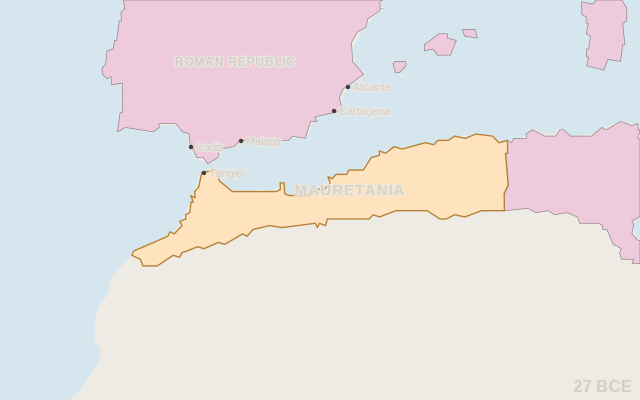
Map: Mauretania in 27 BCE, its borders in gold among its neighbours
200 BCE150 BCE100 BCE50 BCE1
Beside it on the map in 27 BCE: Roman Republic.How far it reached, year by year: its ground inside the borders Cliopatria draws (CC BY 4.0), measured on an equal-area grid; the map shows it at its largest, with the cities of the year.

The story

Its key moments

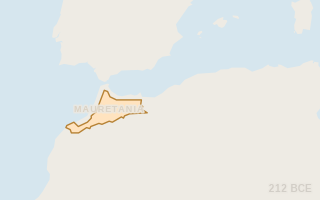
Mauretania in 27 BCE, at its largestMauretania in 212 BCE, first mapped
The rise and the fall in one frame: drag across it from 212 BCE, first mapped at 51,300 km², to 27 BCE, at its largest at 215,300 km². Open the live map in 212 BCE or 27 BCE.

Before and after

Before it

After it

  • Mauretania Tingitana · replaced by
  • Mauretania Caesariensis · replaced by

Where it sits in time

3000 BCE2000 BCE1000 BCE110002000Ancient Carthage: 814 BCE – 146 BCEMauretania: 301 BCE – 698

Five thousand years, 3000 BCE to 2026; the state in gold, what it replaced or followed and what replaced or followed it in grey.

Its people

Lives across Mauretania

200 BCE100 BCE1 CE100 CE200 CE
Statesmen and generalsAll its people on the timeline →

How it was governed

11 kings

11 kings on record, 225 BCE to 225; a reign lasted 13.5 years at the median. Each bar is a reign, as long as it lasted.

Baga · 225 BCE – 225 BCE · no death date to read the end againstBocchus I · 110 BCE – 80 BCE · no death date to read the end againstMastanesosus · 80 BCE – 49 BCE · no death date to read the end againstBogud · 49 BCE – 38 BCE · killed, the article saysBocchus II · 49 BCE – 33 BCE · no death date to read the end againstCleopatra Selene II · 25 BCE – 5 BCE · no death date to read the end againstJuba II · 25 BCE – 23 · no death date to read the end againstPtolemy of Mauretania · 21 – 40 · no death date to read the end againstAedemon · 40 – 42 · no death date to read the end againstSabalus · 42 – 44 · no death date to read the end againstLucceius Albinus · 69 – 69 · no death date to read the end againstBaga · 225 – 225 · no death date to read the end against200 BCE1200400600
a second row: a reign that began before the last had ended — rival claimants, or a shared throne
How their terms ended, where it is known (1 of 12):Killed 1Not on record 11
Every term, with how it ended and its source

Rulers

How 12 reigns ended - choose one to show only those

How they died, where the record says: executed 1.

RulerReignLengthHow it ended · sourceTo the ruler before
3rd century BCE · 1 reign
Baga225 BCE – 225 BCEunder a yearending not on record
2nd century BCE · 1 reign
Bocchus I110 BCE – 80 BCE30 yearsending not on recordanother recorded relative
1st century BCE · 5 reigns · 1 killed or removed
Mastanesosus80 BCE – 49 BCE31 yearsending not on recordchild
Bogud49 BCE – 38 BCE11 yearskilledread from the ruler's own articlechild
Bocchus II49 BCE – 33 BCE16 yearsending not on recordsibling
Cleopatra Selene II25 BCE – 5 BCE20 yearsending not on record
Juba II25 BCE – 2348 yearsending not on recordspouse
1st century · 4 reigns
Ptolemy of Mauretania21 – 4019 yearsending not on recordexecutedchild
Aedemon40 – 422 yearsending not on record
Sabalus42 – 442 yearsending not on record
Lucceius Albinus69 – 69under a yearending not on record
3rd century · 1 reign
Baga225 – 225under a yearending not on record

11 rulers, 11 with terms dated as terms, covering 225 BCE – 225. Median reign 13.5 years. 3 of 11 handovers irregular - a killing, a deposition, a rival claimant, a rising or a coup beside it. A blank in the last column means no kin on record, which is coverage, never “unrelated”.

Its world

Who else stood

Meanwhile, elsewhere

The best-known states of other regions that stood while it did; the band is Mauretania’s own years.

250 BCE1250500750

How it compares

Among 3,073 states

Stood longer than 97% of 3,073 states
Mauretania · 999 yearsHoly Roman EmpireByzantine EmpireHow long it stood, among the states with a recorded end or still standing.
Held more ground at its peak than 60% of 1,464 states
Mauretania · 215,300 km²UgandaLaosThe most ground it held, among the states with a border in Cliopatria.

Why it fell

Why did Mauretania fall?

Historians still argue. Here is what the atlas records about its last century:

What led to it, and what came of it

Ancient Carthage · Linked · 814 BCE – 146 BCEAncient CarthageMauretania · 301 BCE – 698MauretaniaMauretania Caesariensis · Linked · 50 – 700Mauretania Caesariensis500 BCE1500
linked

Open the investigation: every row with its evidence, the conditions at the time, the theories condition by condition, and the succession analysed.

Its centuries in the record

400 BCE – 301 BCE: 0 recorded — 0 wars and battles, 0 risings, regime changes and massacres, 0 other400 BCE300 BCE – 201 BCE: 3 recorded — 1 wars and battles, 0 risings, regime changes and massacres, 2 other300 BCE200 BCE – 101 BCE: 1 recorded — 0 wars and battles, 0 risings, regime changes and massacres, 1 other200 BCE100 BCE – 1 BCE: 5 recorded — 0 wars and battles, 0 risings, regime changes and massacres, 5 other100 BCE0 – 99: 4 recorded — 0 wars and battles, 0 risings, regime changes and massacres, 4 other0100 – 199: 0 recorded — 0 wars and battles, 0 risings, regime changes and massacres, 0 other100200 – 299: 0 recorded — 0 wars and battles, 0 risings, regime changes and massacres, 0 other200300 – 399: 0 recorded — 0 wars and battles, 0 risings, regime changes and massacres, 0 other300400 – 499: 0 recorded — 0 wars and battles, 0 risings, regime changes and massacres, 0 other400500 – 599: 0 recorded — 0 wars and battles, 0 risings, regime changes and massacres, 0 other500600 – 699: 0 recorded — 0 wars and battles, 0 risings, regime changes and massacres, 0 other600

Wars and battles in red, risings, coups and massacres beside them, everything else in grey, by the century each began in. A tall bar is partly a fact about Wikipedia: better-documented centuries hold more.

Each century’s own page:400 BCE – 301 BCE300 BCE – 201 BCE200 BCE – 101 BCE100 BCE – 1 BCE0 – 99100 – 199200 – 299300 – 399400 – 499500 – 599600 – 699

Keep exploring

Share this page
Copy link
Embed the map
Cite this page

How this page is made

Drawn from Wikidata (Q309272, CC0), borders from Cliopatria (CC BY 4.0), coast and rivers from Natural Earth, cities from Reba, Reitsma & Seto 2016 (CC BY 4.0). Data built 2026-11-26 · Pastlas v2.47.1, by Oleh Voronko; the published atlas and its data are for non-commercial use.

How to read it

Areas are measured on an equal-area grid from borders simplified to about five kilometres. “c.” marks an approximate date, and a date known to the century is never printed to the year. Counts are what the atlas holds, and they follow Wikipedia’s coverage: a busy century is partly a fact about the record.

Something wrong?

Tell us and name the entry. We fix the data, not just this page.

Report a problem