State · East and Southeast Asia

Han dynasty

206 BCE – 220 CE · 426 years

Came after Qin dynasty · became Eastern Wu and Cao Wei

The dynasty remembered as China's golden age, which sponsored Confucianism, fought the Xiongnu and gave the Han people their name.

Liu Bang founded the Han dynasty in 202 BCE after the short-lived Qin, and it ruled China until 220 CE, broken only by Wang Mang's Xin dynasty from 9 CE to 23 CE. Counted a golden age, it sponsored Confucianism, minted a coinage that stayed standard until the Tang dynasty, and saw papermaking, ship rudders and seismometers invented. China's majority ethnic group still calls itself the Han people. The Three Kingdoms followed it.

What the record holds

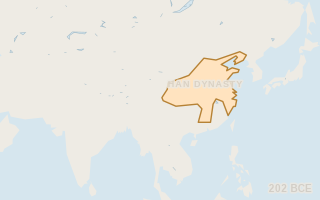
The Han dynasty began in 206 BCE, replacing the Qin dynasty.↓ In 202 BCE, the first year its borders are mapped, it covered 2.04 million km².↓

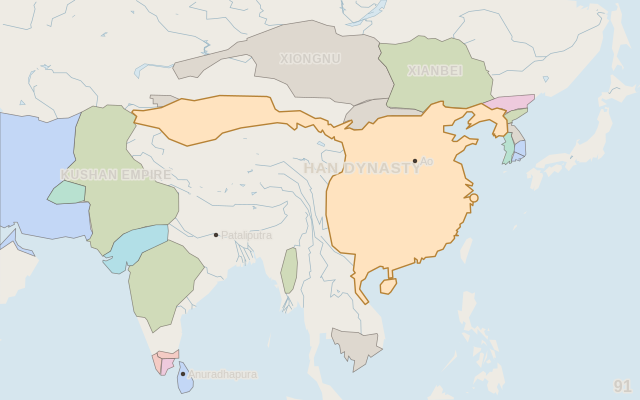
It reached its greatest extent in 91: 4.59 million km².↓ The record names 31 rulers in its line, covering 202 BCE – 220, the median reign 10 years; 8 of 31 handovers were irregular.↓ The best known of them are Emperor Wu of Han, Emperor Gaozu of Han and Emperor Hui of Han.↓ Most of the 100 rows the atlas files under it are people.↓

In 220, after 426 years, it was followed by Eastern Wu and Cao Wei.↓

From Wikipedia’s article, retold · CC BY-SA 4.0

426 years

Longer than the Roman Empire, shorter than the Sasanian Empire

4.59 million km²

At its height in 91

31 rulers

the Emperor of China

17 wars and battles

More per century than 87% of states · 100 entries in all

Map: Han dynasty in 91, its borders in gold among its neighbours
Rebellion of the Seven States, 154 BCEYellow Turban Rebellion, 184 – 205Battle of Guandu, 200Battle of Red Cliffs, 208100 BCE1100200
Beside it on the map in 91: Xiongnu, Kushan Empire, Parthian Empire, Xianbei, Satavahana dynasty and Western Satraps.How far it reached, year by year: its ground inside the borders Cliopatria draws (CC BY 4.0), measured on an equal-area grid; the map shows it at its largest, with the cities of the year.

The story

Five acts, 206 BCE – 220 CE

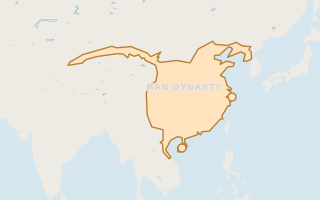
Han dynasty in 142 BCE, at the end of act I
I206 – 141 BCE

Liu Bang's new dynasty

After the Qin collapses, Liu Bang of Han defeats his rival Xiang Yu of Chu at Gaixia in 202 BCE and takes the imperial title. Beaten by the Xiongnu in 200 BCE, the Han buy peace with marriage alliances and payments; after the Rebellion of the Seven States the kingdoms lose their autonomy.

Watch this act on the live map, from 206 BCE
Han dynasty in 8, at the end of act II
II141 BCE – 9 CE2.04 million → 100 km²

Emperor Wu and the Western Han

Emperor Wu, on the throne from 141 BCE to 87 BCE, makes Confucianism the court's official learning. His government mints a standard coinage in 119 BCE and in 117 BCE takes over the salt and iron industries to pay for wars and frontier settlement. Later the regency passes among kinsmen of Wang Zhengjun, ending with her nephew Wang Mang.

Watch this act on the live map, from 141 BCE
III9 – 25

Wang Mang's Xin interlude

Made acting emperor for the child heir Ruzi Ying, Wang Mang promises to hand power back but instead proclaims his own Xin dynasty. He renews war with the Xiongnu, and a widespread rebellion rises against him, while Goguryeo raids the Korean commanderies. In 25 CE Liu Xiu restores the Han as Emperor Guangwu.

Watch this act on the live map, from 9
Han dynasty in 219, at the end of act V
V184 – 2203.82 million → 1.67 million km²

Rebellion and the fall

In 184 CE the Taoist Yellow Turbans of Zhang Jue and the Five Pecks of Rice of Zhang Lu rise. Han forces crush Zhang Jue's revolt within a year, but the fighting goes on: Cao Cao wars with Zhang Xiu, Liu Bei takes Yi Province, and battles are fought at Guandu in 200 CE and Red Cliffs in 208 CE.

Watch this act on the live map, from 184
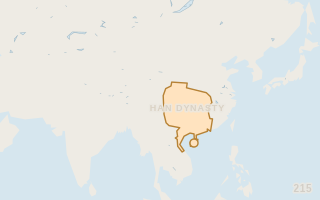
Han dynasty in 215, last mappedHan dynasty in 202 BCE, first mapped
The rise and the fall in one frame: drag across it from 202 BCE, first mapped at 2.04 million km², to 215, last mapped at 1.67 million km². Open the live map in 202 BCE or 215.

Before and after

Before it

After it

Where it sits in time

3000 BCE2000 BCE1000 BCE110002000Qin dynasty: 221 BCE – 206 BCEEastern Wu: 221 – 280Shu Han: 221 – 263Cao Wei: 220 – 265Han dynasty: 206 BCE – 220

Five thousand years, 3000 BCE to 2026; the state in gold, what it replaced or followed and what replaced or followed it in grey.

Its people

Lives across the Han dynasty

200 BCE100 BCE1 CE100 CE200 CE
Statesmen and generalsScientists and explorersLived on after it endedAll its people on the timeline →

How it was governed

31 emperors

31 emperors on record, 202 BCE to 220; a reign lasted 10 years at the median. Each bar is a reign, as long as it lasted.

Emperor Gaozu of Han · 202 BCE – 195 BCE · died in office, manner not recordedEmperor Hui of Han · 195 BCE – 188 BCE · died in office, manner not recordedEmperor Qianshao of Han · 188 BCE – 184 BCE · killedEmperor Houshao of Han · 184 BCE – 180 BCE · executedEmperor Wen of Han · 180 BCE – 157 BCE · died in office, manner not recordedEmperor Jing of Han · 157 BCE – 141 BCE · died in office, manner not recordedEmperor Wu of Han · 141 BCE – 87 BCE · died in office, manner not recordedEmperor Zhao of Han · 87 BCE – 74 BCE · died in office, manner not recordedMarquis of Haihun · 74 BCE – 74 BCE · left office aliveEmperor Xuan of Han · 74 BCE – 48 BCE · died in office, manner not recordedEmperor Yuan of Han · 48 BCE – 33 BCE · died in office, manner not recordedEmperor Cheng of Han · 33 BCE – 7 BCE · died in office, manner not recordedEmperor Ai of Han · 7 BCE – 1 BCE · died in office, manner not recordedEmperor Ping of Han · 1 BCE – 6 · killedRuzi Ying · 6 – 9 · abdicatedGengshi Emperor · 23 – 25 · abdicatedRuzi Ying · 24 – 25 · died in office, manner not recordedLiu Penzi · 25 – 27 · left office aliveEmperor Guangwu of Han · 25 – 57 · died in office, manner not recordedEmperor Ming of Han · 57 – 75 · died in office, manner not recordedEmperor Zhang of Han · 75 – 88 · died in office, manner not recordedEmperor He of Han · 88 – 106 · died in office, manner not recordedEmperor Shang of Han · 106 – 106 · died in office, manner not recordedEmperor An of Han · 106 – 125 · died in office, manner not recordedMarquess of Beixiang · 125 – 125 · died in office, manner not recordedEmperor Shun of Han · 125 – 144 · died in office, manner not recordedEmperor Chong of Han · 144 – 145 · died in office, manner not recordedEmperor Zhi of Han · 145 – 146 · killedEmperor Huan of Han · 146 – 168 · died in office, manner not recordedEmperor Ling of Han · 168 – 189 · died in office, manner not recordedLiu Bian · 189 – 189 · killed, the article saysEmperor Xian of Han · 189 – 220 · ended by a named event200 BCE100 BCE1100200
a second row: a reign that began before the last had ended — rival claimants, or a shared throne
How their terms ended, where it is known (32 of 32):Killed 5Deposed or removed 2Died in office 22Left office alive 3
Every term, with how it ended and its source

Rulers

How 32 reigns ended - choose one to show only those

How they died, where the record says: killed 4 · executed 1 · died by suicide 1.

RulerReignLengthHow it ended · sourceTo the ruler before
3rd century BCE · 1 reign
Emperor Gaozu of Han · aged 54202 BCE – 195 BCE7 yearsdied in officeWikidata's end cause on the term
2nd century BCE · 6 reigns · 2 killed or removed
Emperor Hui of Han · aged 18195 BCE – 188 BCE7 yearsdied in officeread off the dates alonechild
Emperor Qianshao of Han · aged 5188 BCE – 184 BCE4 yearskilled in officeWikidata's manner of deathchild
Emperor Houshao of Han · aged 12184 BCE – 180 BCE4 yearsexecutedWikidata's manner of deathsibling
Emperor Wen of Han · aged 23180 BCE – 157 BCE23 yearsdied in officeread off the dates alone
Emperor Jing of Han · aged 31157 BCE – 141 BCE16 yearsdied in officeread off the dates alonechild
Emperor Wu of Han · aged 15141 BCE – 87 BCE54 yearsdied in officeread off the dates alonechild
1st century BCE · 7 reigns · 1 killed or removed
Emperor Zhao of Han · aged 787 BCE – 74 BCE13 yearsdied in officeread off the dates alonechild
Marquis of Haihun · aged 1874 BCE – 74 BCEunder a yearleft office aliveread off the dates alonenephew or niece
Emperor Xuan of Han · aged 1774 BCE – 48 BCE26 yearsdied in officeread off the dates alone
Emperor Yuan of Han · aged 2748 BCE – 33 BCE15 yearsdied in officeread off the dates alonechild
Emperor Cheng of Han · aged 1833 BCE – 7 BCE26 yearsdied in officeread off the dates alonechild
Emperor Ai of Han · aged 177 BCE – 1 BCE6 yearsdied in officeread off the dates alonenephew or niece
Emperor Ping of Han · aged 81 BCE – 67 yearskilled in officeWikidata's manner of death
1st century · 8 reigns · 2 killed or removed
Ruzi Ying · aged 16 – 93 yearsabdicatedWikidata's end cause on the term
Gengshi Emperor23 – 252 yearsabdicatedWikidata's end cause on the termkilled
Ruzi Ying · aged 1924 – 251 yeardied in officeWikidata's end cause on the term
Liu Penzi · aged 1425 – 272 yearsleft office aliveread off the dates alone
Emperor Guangwu of Han · aged 3025 – 5732 yearsdied in officeread off the dates alone
Emperor Ming of Han · aged 2957 – 7518 yearsdied in officeread off the dates alonechild
Emperor Zhang of Han · aged 1875 – 8813 yearsdied in officeread off the dates alonechild
Emperor He of Han · aged 988 – 10618 yearsdied in officeread off the dates alonechild
2nd century · 10 reigns · 2 killed or removed
Emperor Shang of Han · aged 1106 – 106under a yeardied in officeread off the dates alonechild
Emperor An of Han · aged 12106 – 12519 yearsdied in officeread off the dates alone
Marquess of Beixiang · aged 75125 – 125under a yeardied in officeread off the dates alone
Emperor Shun of Han · aged 10125 – 14419 yearsdied in officeread off the dates alone
Emperor Chong of Han · aged 1144 – 1451 yeardied in officeread off the dates alonechild
Emperor Zhi of Han · aged 7145 – 1461 yearkilled in officeWikidata's manner of death
Emperor Huan of Han · aged 14146 – 16822 yearsdied in officeread off the dates alone
Emperor Ling of Han · aged 12168 – 18921 yearsdied in officeread off the dates alone
Liu Bian · aged 13189 – 189under a yearkilledread from the ruler's own articlechild
Emperor Xian of Han · aged 8189 – 22031 yearsended by an eventWikidata's end cause on the termsibling

31 rulers, 31 with terms dated as terms, covering 202 BCE – 220. Median reign 10 years. 8 of 31 handovers irregular - a killing, a deposition, a rival claimant, a rising or a coup beside it. A blank in the last column means no kin on record, which is coverage, never “unrelated”.

Its world

Rivals, and who else stood

Who it fought most

Wars and battles both took part in, on whichever side: the record names who took part, not who fought whom.

Meanwhile, elsewhere

The best-known states of other regions that stood while it did; the band is the Han dynasty’s own years.

200 BCE100 BCE1100200

How it compares

Among 3,073 states

Stood longer than 82% of 3,073 states
Han dynasty · 426 yearsRoman EmpireSasanian EmpireHow long it stood, among the states with a recorded end or still standing.
Held more ground at its peak than 97% of 1,464 states
Han dynasty · 4,585,200 km²IndiaAustraliaThe most ground it held, among the states with a border in Cliopatria.
Had more wars on record per century than 87% of 3,073 states
Han dynasty · 0.2Wars recorded per century, among the states, counting the wars the atlas hosts under each.

Why it fell

Why did the Han dynasty fall?

Historians still argue. Here is what the atlas records about its last century:

9

wars and battles in its last century, more than in any before it

÷2.3

its land, between 120 and 219

189

Liu Bian, killed in office

How it ended, as its article says

Replaced by Three Kingdoms, 220. Read from the article's section “lead” by its grammar; the claim is only that the article says so.

It was succeeded by the Three Kingdoms period (220–280 AD) and also briefly interrupted by the Xin dynasty (9–23 AD) established by the usurping regent Wang Mang.

One sentence of the English Wikipedia article, CC BY-SA 4.0.

What led to it, and what came of it

Qin dynasty · Linked · 221 BCE – 206 BCEQin dynastyChen Ping · Coincidence · 250 BCE – 178 BCEChen PingHan dynasty · 206 BCE – 220Han dynastyCao Wei · Linked · 220 – 265Cao WeiEastern Wu · Linked · 221 – 280Eastern WuShu Han · Linked · 221 – 263Shu Han200 BCE100 BCE1100200300
linkedcoincidence

Open the investigation: every row with its evidence, the conditions at the time, the theories condition by condition, and the succession analysed.

Its centuries in the record

300 BCE – 201 BCE: 5 recorded — 1 wars and battles, 0 risings, regime changes and massacres, 4 other300 BCE200 BCE – 101 BCE: 15 recorded — 3 wars and battles, 1 risings, regime changes and massacres, 11 other200 BCE100 BCE – 1 BCE: 10 recorded — 0 wars and battles, 0 risings, regime changes and massacres, 10 other100 BCE0 – 99: 12 recorded — 0 wars and battles, 0 risings, regime changes and massacres, 12 other0100 – 199: 42 recorded — 4 wars and battles, 2 risings, regime changes and massacres, 36 other100200 – 299: 16 recorded — 9 wars and battles, 0 risings, regime changes and massacres, 7 other200

Wars and battles in red, risings, coups and massacres beside them, everything else in grey, by the century each began in. A tall bar is partly a fact about Wikipedia: better-documented centuries hold more.

Each century’s own page:300 BCE – 201 BCE200 BCE – 101 BCE100 BCE – 1 BCE0 – 99100 – 199200 – 299

Keep exploring

Share this page
Copy link
Embed the map
Cite this page

How this page is made

Drawn from Wikidata (Q7209, CC0), the opening and history of its English Wikipedia article retold by the atlas (CC BY-SA 4.0), borders from Cliopatria (CC BY 4.0), coast and rivers from Natural Earth, cities from Reba, Reitsma & Seto 2016 (CC BY 4.0), and one sentence of the article, quoted. Data built 2026-11-26 · Pastlas v2.47.1, by Oleh Voronko; the published atlas and its data are for non-commercial use.

How to read it

Areas are measured on an equal-area grid from borders simplified to about five kilometres. “c.” marks an approximate date, and a date known to the century is never printed to the year. Counts are what the atlas holds, and they follow Wikipedia’s coverage: a busy century is partly a fact about the record.

Something wrong?

Tell us and name the entry. We fix the data, not just this page.

Report a problem