State · East and Southeast Asia

Qin dynasty

221 – 206 BCE · 15 years

Came after Zhou dynasty and Warring States period · became Han dynasty and Nanyue

China's first imperial dynasty: it unified the rival states, standardised currency, weights and writing, and collapsed soon after its founder died.

The Qin dynasty grew from the state of Qin, a fief of the Zhou dynasty, whose king Ying Zheng conquered every rival state from 230 BCE and unified China in 221 BCE, taking the title Qin Shi Huang. Building on Shang Yang's reforms, it ruled the peasants directly and raised great works, from linked northern walls to a mausoleum guarded by the Terracotta Army. It collapsed in 206 BCE, the shortest-lived of China's major dynasties.

What the record holds

It was founded in 221 BCE, replacing the Zhou dynasty and the State of Chu.↓ Its borders are first mapped in 218 BCE, around 1.63 million km².↓

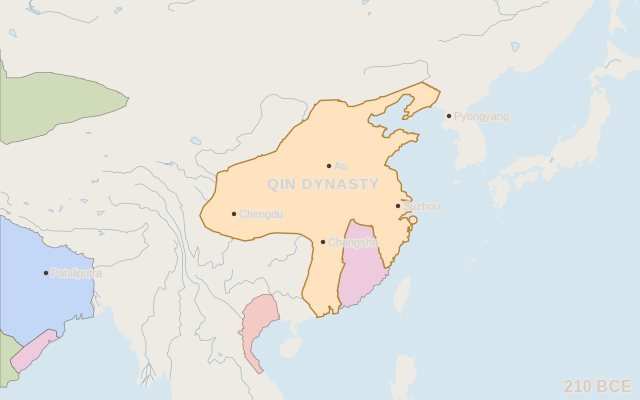
It reached its greatest extent in 210 BCE: 2.13 million km².↓ Its line counts 2 rulers, covering 221 BCE – 207 BCE; its one handover was regular.↓ Among them, Qin Shi Huang and Qin Er Shi are the best known.↓ The atlas files 4 rows under it, most of them people.↓

By 206 BCE it had been dissolved, as its article puts it.↓ It was replaced by the Han dynasty and Nanyue in 206 BCE, 15 years after it began.↓

From Wikipedia’s article, retold · CC BY-SA 4.0

15 years

Longer than Nazi Germany, shorter than South Vietnam

2.13 million km²

At its height in 210 BCE · about the size of Indonesia

2 rulers

the Emperor of China

1 war or battle

4 entries in all

Map: Qin dynasty in 210 BCE, its borders in gold among its neighbours
216 BCE214 BCE212 BCE210 BCE208 BCE206 BCE
Beside it on the map in 210 BCE: Maurya Empire, Yuezhi, Minyue, Âu Lạc and Satavahana dynasty.How far it reached, year by year: its ground inside the borders Cliopatria draws (CC BY 4.0), measured on an equal-area grid; the map shows it at its largest, with the cities of the year.

The story

Its key moments

Before and after

Before it

After it

  • Jiujiang · replaced by
  • Dai · replaced by
  • Sai · replaced by
  • Changshan · replaced by
  • Yin · replaced by
  • Kingdom of Henan · replaced by
  • Qi (209–203 BC) · replaced by
  • Western Chu · replaced by
  • Zhai · replaced by
  • Yong · replaced by
  • Liaodong · replaced by
  • Han (208BC-200BC) · replaced by
  • Jiaodong Kingdom · replaced by
  • Linjiang · replaced by
  • Yan (Zang Tu) · replaced by
  • Western Wei · replaced by
  • Hengshan · replaced by
  • Han dynasty · replaced by · 206 BCE – 220 CE
  • Nanyue · replaced by · 204 – 111 BCE

Where it sits in time

3000 BCE2000 BCE1000 BCE110002000State of Wey: 1041 BCE – 209 BCEWarring States period: 476 BCE – 221 BCEState of Qin: 905 BCE – 221 BCEHan dynasty: 206 BCE – 220Nanyue: 204 BCE – 111 BCEQin dynasty: 221 BCE – 206 BCE

Five thousand years, 3000 BCE to 2026; the state in gold, what it replaced or followed and what replaced or followed it in grey.

Its people

Lives across the Qin dynasty

Notable figures

How it was governed

2 emperors

2 emperors on record, 221 BCE to 207 BCE. Each bar is a reign, as long as it lasted.

Qin Shi Huang · 221 BCE – 210 BCE · died in office of natural causesQin Er Shi · 210 BCE – 207 BCE · executed220 BCE215 BCE210 BCE
How their terms ended, where it is known (2 of 2):Killed 1Died in office 1
Every term, with how it ended and its source

Rulers

How 2 reigns ended - choose one to show only those

How they died, where the record says: died of natural causes 1 · executed 1.

RulerReignLengthHow it ended · sourceTo the ruler before
3rd century BCE · 2 reigns · 1 killed or removed
Qin Shi Huang · aged 38221 BCE – 210 BCE11 yearsdied in officeWikidata's manner of deathdied of natural causes
Qin Er Shi · aged 20210 BCE – 207 BCE3 yearsexecutedWikidata's manner of deathchild

2 rulers, 2 with terms dated as terms, covering 221 BCE – 207 BCE. Only 14 years of the line are dated - too short for a median. 0 of 1 handovers irregular - a killing, a deposition, a rival claimant, a rising or a coup beside it. A blank in the last column means no kin on record, which is coverage, never “unrelated”.

Its world

Who else stood

Meanwhile, elsewhere

The best-known states of other regions that stood while it did; the band is the Qin dynasty’s own years.

230 BCE220 BCE210 BCE200 BCE

How it compares

Among 3,073 states

Stood longer than 20% of 3,073 states
Qin dynasty · 15 yearsNazi GermanySouth VietnamHow long it stood, among the states with a recorded end or still standing.
Held more ground at its peak than 92% of 1,464 states
Qin dynasty · 2,133,900 km²IndonesiaDenmarkThe most ground it held, among the states with a border in Cliopatria.

Why it fell

Why did the Qin dynasty fall?

Historians still argue. Here is what the atlas records about its last century:

207 BCE

Qin Er Shi, killed in office

How it ended, as its article says

Dissolved, -0206. Read from the article's section “lead” by its grammar; the claim is only that the article says so.

This state of affairs lasted until 206 BC, when the dynasty collapsed in the years following Qin Shi Huang's death.

One sentence of the English Wikipedia article, CC BY-SA 4.0.

What led to it, and what came of it

State of Chu · Linked · 722 BCE – 223 BCEState of ChuZhou dynasty · Linked · 1046 BCE – 256 BCEZhou dynastyState of Wey · Linked · 1045 BCE – 209 BCEState of WeyState of Qin · Linked · 905 BCE – 221 BCEState of QinWarring States period · Linked · 476 BCE – 221 BCEWarring States periodEastern Zhou · In the article · 771 BCE · “In 770 BC, Zhuang's son Duke Xiang helped escort the Zhou court under King Ping in their emergency evacuation from Fenghao to Chengzhou under threat from the …”Eastern ZhouQin dynasty · 221 BCE – 206 BCEQin dynastyHan dynasty · Linked · 206 BCE – 220Han dynastyWestern Chu · Linked · 206 BCE – 202 BCEWestern ChuJiaodong Kingdom · Linked · 206 BCE – 8Jiaodong KingdomDai · Linked · 206 BCE – 114 BCEDaiJiujiang · Linked · 206 BCE – 204 BCEJiujiangSai · Linked · 206 BCESai1000 BCE500 BCE1
in the articlelinked

Open the investigation: every row with its evidence, the conditions at the time, the theories condition by condition, and the succession analysed.

In the record

4 entries the atlas files under it, all in 300 BCE – 201 BCE.

Keep exploring

Share this page
Copy link
Embed the map
Cite this page

How this page is made

Drawn from Wikidata (Q7183, CC0), the opening and history of its English Wikipedia article retold by the atlas (CC BY-SA 4.0), borders from Cliopatria (CC BY 4.0), coast and rivers from Natural Earth, cities from Reba, Reitsma & Seto 2016 (CC BY 4.0), and one sentence of the article, quoted. Data built 2026-11-26 · Pastlas v2.47.1, by Oleh Voronko; the published atlas and its data are for non-commercial use.

How to read it

Areas are measured on an equal-area grid from borders simplified to about five kilometres. “c.” marks an approximate date, and a date known to the century is never printed to the year. Counts are what the atlas holds, and they follow Wikipedia’s coverage: a busy century is partly a fact about the record.

Something wrong?

Tell us and name the entry. We fix the data, not just this page.

Report a problem