State · Europe

Luxembourg

1815 – present · 211 years · still standing

Came after German Confederation

The last sovereign grand duchy on earth: a fortress state twice overrun by Germany, then a founder of the European Union.

The Congress of Vienna restored Luxembourg in 1815, after Napoleon's defeat, as a member of the German Confederation bound in personal union to the Netherlands under William I. It regained full independence after the Luxembourg Crisis of 1867. Germany invaded the neutral grand duchy in both world wars; afterwards it helped found the United Nations, NATO and the European Communities. With fewer than 700,000 people, nearly half foreign, it ranked among the richest countries per head.

What the record holds

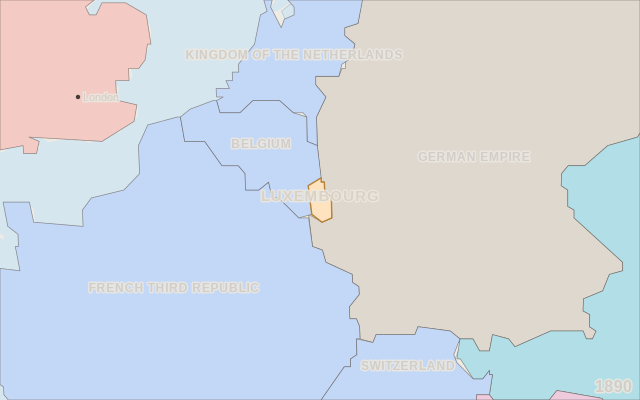
Its record opens in 1815, replacing the German Confederation.↓ In 1890, the first year its borders are mapped, it covered 2,400 km².↓

Its line counts 8 rulers, covering 1815 – 2025, the median reign 25 years; none of its 7 handovers was irregular.↓ Among them, Henri, Grand Duke of Luxembourg, William I of the Netherlands and William III of the Netherlands are the best known.↓ The atlas files 38 rows under it, most of them people.↓

From Wikipedia’s article, retold · CC BY-SA 4.0

211 years

Longer than Greenland, shorter than the Achaemenid Empire

2,400 km²

At its height in 1890

8 rulers

the Grand Duke of Luxembourg

2 wars and battles

More per century than 88% of states · 38 entries in all

Map: Luxembourg in 1890, its borders in gold among its neighbours
German occupation of Luxembourg during World War I, 1914 – 1918German invasion of Luxembourg, 1940Saar Treaty, 1956Luxembourg compromise, 1966Schengen Agreement, 1985190019201940196019802000
Beside it on the map in 1890: German Empire, French Third Republic, Austria-Hungary, United Kingdom of Great Britain and Ireland, Kingdom of the Netherlands and Belgium.How far it reached, year by year: its ground inside the borders Cliopatria draws (CC BY 4.0), measured on an equal-area grid; the map shows it at its largest, with the cities of the year.

The story

Four acts, 1815 – present

II1867 – 1945

Neutral and twice invaded

Independent and neutral under its constitution, the grand duchy is invaded by Imperial Germany in August 1914 in its drive against France. Under occupation it keeps most of its independence and holds to strict neutrality, though about 1,000 Luxembourgers serve in the French army, honoured by the Gëlle Fra. Germany invades again in 1940.

Watch this act on the live map, from 1867
Luxembourg in 1999, at the end of act III
III1945 – 20002,300 → 2,400 km²

A founder of NATO and Europe

Luxembourg helps found the United Nations in 1945, ends its constitutional neutrality in 1948 and joins NATO as a founder in April 1949; a small contingent fights in Korea. It is one of the six founders of the European Communities in the 1950s, and in 1994 its capital's fortifications and old quarters become a UNESCO World Heritage Site.

Watch this act on the live map, from 1945
IV2000 – present

The last grand duchy

Henri reigns as grand duke from 2000 until 2025, when Guillaume V succeeds him. Luxembourg City, one of the European Union's four seats, houses its Court of Justice, and the country first sits on the UN Security Council in 2013–2014. By 2026 it counts 693,916 people, nearly half of them foreign nationals.

Watch this act on the live map, from 2000

Before and after

Before it

Where it sits in time

3000 BCE2000 BCE1000 BCE110002000German Confederation: 1815 – 1866Luxembourg: 1815 – 2026

Five thousand years, 3000 BCE to 2026; the state in gold, what it replaced or followed and what replaced or followed it in grey.

Its people

Lives across Luxembourg

1850190019502000
Statesmen and generalsWriters, artists and thinkersAll its people on the timeline →

How it was governed

8 dukes

8 dukes on record, 1815 to 2025; a reign lasted 25 years at the median. Each bar is a reign, as long as it lasted.

William I of the Netherlands · 1815 – 1840 · left office aliveWilliam III of the Netherlands · 1849 – 1890 · died in office, manner not recordedAdolphe, Grand Duke of Luxembourg · 1890 – 1905 · died in office, manner not recordedWilliam IV of Luxembourg · 1905 – 1912 · died in office, manner not recordedMarie-Adélaïde, Grand Duchess of Luxembourg · 1912 – 1919 · abdicated, the article saysCharlotte, Grand Duchess of Luxembourg · 1919 – 1964 · abdicated, the article saysHenri, Grand Duke of Luxembourg · 2000 – 2025 · abdicated, the article saysGuillaume V of Luxembourg · 2025 – … · still in office1850190019502000
How their terms ended, where it is known (8 of 8):Deposed or removed 3Died in office 3Left office alive 1In office 1
Every term, with how it ended and its source

Rulers

How 8 reigns ended - choose one to show only those

How they died, where the record says: died of natural causes 2.

RulerReignLengthHow it ended · sourceTo the ruler before
19th century · 3 reigns
William I of the Netherlands · aged 431815 – 184025 yearsleft office aliveread off the dates alone
William III of the Netherlands · aged 321849 – 189041 yearsdied in officeread off the dates alonegrandchild
Adolphe, Grand Duke of Luxembourg · aged 731890 – 190515 yearsdied in officeread off the dates alone
20th century · 4 reigns · 3 killed or removed
William IV of Luxembourg · aged 531905 – 19127 yearsdied in officeread off the dates alonechild
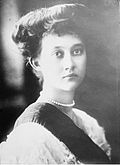
Marie-Adélaïde, Grand Duchess of Luxembourg · aged 181912 – 19197 yearsabdicatedread from the ruler's own articledied of natural causeschild
Charlotte, Grand Duchess of Luxembourg · aged 231919 – 196445 yearsabdicatedread from the ruler's own articledied of natural causessibling
Henri, Grand Duke of Luxembourg · aged 452000 – 202525 yearsabdicatedread from the ruler's own article
21st century · 1 reign
Guillaume V of Luxembourg · aged 442025 – in officein office since 2025still in officechild

8 rulers, 8 with terms dated as terms, covering 1815 – 2025. Median reign 25 years. 0 of 7 handovers irregular - a killing, a deposition, a rival claimant, a rising or a coup beside it. A blank in the last column means no kin on record, which is coverage, never “unrelated”.

Heads of government

The line of Prime Minister of Luxembourg, drawn and never measured: a cabinet is not a reign.

Gaspard-Théodore-Ignace de la Fontaine1848 – 1848
Jean-Jacques Willmar1848 – 1853
Charles-Mathias Simons1853 – 1860
Victor de Tornaco1860 – 1867
Emmanuel Servais1867 – 1874
Félix de Blochausen1874 – 1885
Édouard Thilges1885 – 1888
Paul Eyschen1888 – 1915
Mathias Mongenast1915 – 1915
Hubert Loutsch1915 – 1916
Victor Thorn1916 – 1917
Léon Kauffman1917 – 1918
Émile Reuter1918 – 1925
Pierre Prüm1925 – 1926
Joseph Bech1926 – 1937
Pierre Dupong1937 – 1953
Joseph Bech1953 – 1958
Pierre Frieden1958 – 1959
Pierre Werner1959 – 1974
Gaston Thorn1974 – 1979
Pierre Werner1979 – 1984
Jacques Santer1984 – 1995
Jean-Claude Juncker1995 – 2013
Xavier Bettel2013 – 2023
Luc Frieden2023 – …

Flags and arms, in order

  • Flag of Luxembourg
    flag, from 1972Flag of Luxembourg · Public domain
  • Greater coat of arms of the grand-duchy of Luxembourg
    coat of arms, from 1972Greater coat of arms of the grand-duchy of Luxembourg · CC BY-SA 3.0 · Katepanomegas

Its world

Rivals, and who else stood

Who it fought most

Wars and battles both took part in, on whichever side: the record names who took part, not who fought whom.

Meanwhile, elsewhere

The best-known states of other regions that stood while it did; the band is Luxembourg’s own years.

18001850190019502000

How it compares

Among 3,073 states

Stood longer than 63% of 3,073 states
Luxembourg · 211 yearsGreenlandAchaemenid EmpireHow long it stood, among the states with a recorded end or still standing.
Held more ground at its peak than 6% of 1,464 states
Luxembourg · 2,400 km²BahrainCyprusThe most ground it held, among the states with a border in Cliopatria.
Had more wars on record per century than 88% of 3,073 states
Luxembourg · 0.5Wars recorded per century, among the states, counting the wars the atlas hosts under each.

How it began

How did Luxembourg begin?

What led to it, and what came of it

German Confederation · Linked · 1815 – 1866German ConfederationLuxembourg · 1815 – 2026Luxembourg1850190019502000
linked

Open the investigation: every row with its evidence, the conditions at the time, the theories condition by condition, and the succession analysed.

Its centuries in the record

1800 – 1899: 20 recorded — 0 wars and battles, 1 risings, regime changes and massacres, 19 other18001900 – 1999: 15 recorded — 2 wars and battles, 0 risings, regime changes and massacres, 13 other19002000 – 2099: 1 recorded — 0 wars and battles, 0 risings, regime changes and massacres, 1 other2000

Wars and battles in red, risings, coups and massacres beside them, everything else in grey, by the century each began in. A tall bar is partly a fact about Wikipedia: better-documented centuries hold more.

Each century’s own page:1800 – 18991900 – 19992000 – 2099

Keep exploring

Share this page
Copy link
Embed the map
Cite this page

How this page is made

Drawn from Wikidata (Q32, CC0), the opening and history of its English Wikipedia article retold by the atlas (CC BY-SA 4.0), borders from Cliopatria (CC BY 4.0), coast and rivers from Natural Earth, cities from Reba, Reitsma & Seto 2016 (CC BY 4.0), symbols from Wikimedia Commons, each under its own licence. Data built 2026-11-26 · Pastlas v2.47.1, by Oleh Voronko; the published atlas and its data are for non-commercial use.

How to read it

Areas are measured on an equal-area grid from borders simplified to about five kilometres. “c.” marks an approximate date, and a date known to the century is never printed to the year. Counts are what the atlas holds, and they follow Wikipedia’s coverage: a busy century is partly a fact about the record.

  • Still standing: the span runs to the year of the build, 2026.

Something wrong?

Tell us and name the entry. We fix the data, not just this page.

Report a problem