State · Europe

Belgium

1830 – present · 196 years · still standing

Came after United Kingdom of the Netherlands

A kingdom carved from the Netherlands, twice a battlefield of Europe's wars, now split by language and host to the European Union.

Belgium broke away from the United Kingdom of the Netherlands in the revolution of 1830, as a Catholic, officially French-speaking and neutral state, and installed Leopold I as its king in 1831. A constitutional monarchy, it was invaded by Germany in both world wars. Today it is a federation of Flanders, Wallonia and Brussels, with Dutch- and French-speaking communities, and a founder of the European Union, whose main institutions sit in its capital.

What the record holds

Its record opens in 1830, replacing the United Kingdom of the Netherlands.↓ In 1830, the first year its borders are mapped, it covered 25,000 km².↓

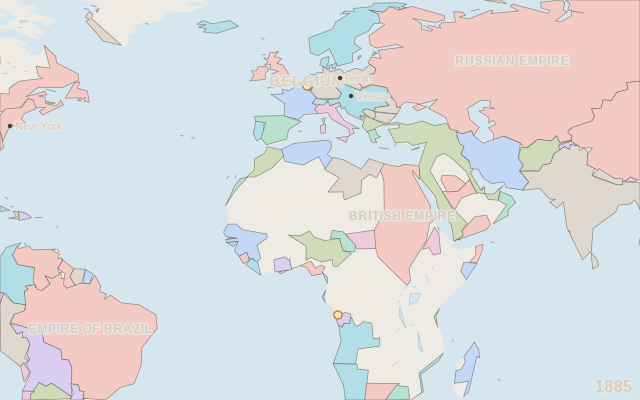
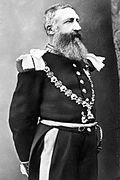
It reached its greatest extent in 1885: 46,300 km².↓ The record names 9 rulers in its line, covering 1831 – 2013, the median reign 22.5 years; 2 of 8 handovers were irregular.↓ The best known of them are Leopold II of Belgium, Philippe of Belgium and Albert II of Belgium.↓ Most of the 146 rows the atlas files under it are people.↓

From Wikipedia’s article, retold · CC BY-SA 4.0

196 years

Longer than the Mongol Empire, shorter than Greenland

46,300 km²

At its height in 1885 · about the size of Estonia

9 rulers

the King of the Belgians

39 wars and battles

146 entries in all

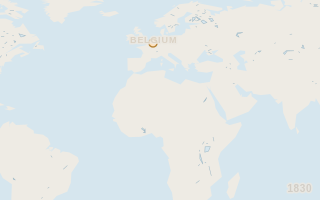
Map: Belgium in 1885, its borders in gold among its neighbours
Battle of Liège, 1914Second Battle of Ypres, 1915Battle of Passchendaele, 1917German invasion of Belgium (1940), 19402016 Brussels bombings, 20161850190019502000
Beside it on the map in 1885: Russian Empire, Empire of Brazil, British Empire, British Raj, Qing dynasty and Ottoman Empire.How far it reached, year by year: its ground inside the borders Cliopatria draws (CC BY 4.0), measured on an equal-area grid; the map shows it at its largest, with the cities of the year.

The story

Three acts, 1830 – present

II1914 – 1945

Battlefield of Europe

Germany invades neutral Belgium in 1914; battles follow at Liège, Antwerp, the Yser and Ypres, and in 1917 at Messines and Passchendaele. Albert I reigns through the war. Germany invades again in 1940, with battle at Fort Ében-Émael, while Leopold III is king; 1944 brings the Malmedy massacre and the siege of Bastogne.

Watch this act on the live map, from 1914
III1945 – present

Federal state, European capital

Belgium signs the Treaty of Brussels in 1948; women vote from 1949. Baudouin reigns from 1951 to 1993, then Albert II and Philippe. A founder of the European Union, it sees Brussels become home to its main institutions and to NATO, and builds its language divides into a federal system. Bombings strike Brussels in 2016.

Watch this act on the live map, from 1945
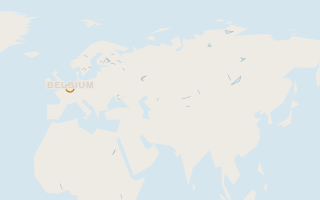
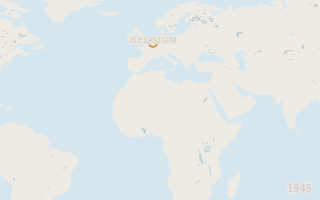
Belgium in 1945, last mappedBelgium in 1830, first mapped
The rise and the fall in one frame: drag across it from 1830, first mapped at 25,000 km², to 1945, last mapped at 31,100 km². Open the live map in 1830 or 1945.

Before and after

Before it

Where it sits in time

3000 BCE2000 BCE1000 BCE110002000United Kingdom of the Netherlands: 1815 – 1839Belgium: 1830 – 2026

Five thousand years, 3000 BCE to 2026; the state in gold, what it replaced or followed and what replaced or followed it in grey.

Its people

Lives across Belgium

18001850190019502000
Statesmen and generalsWriters, artists and thinkersScientists and explorersAll its people on the timeline →

How it was governed

9 kings

9 kings on record, 1831 to 2013; a reign lasted 22.5 years at the median. Each bar is a reign, as long as it lasted.

Érasme-Louis Surlet de Chokier · 1831 – 1831 · left office aliveLeopold I of Belgium · 1831 – 1865 · died in office, manner not recordedLeopold II of Belgium · 1865 – 1909 · died in office of natural causesAlbert I of Belgium · 1909 – 1934 · died by accidentLeopold III of Belgium · 1934 – 1951 · left office alivePrince Charles, Count of Flanders · 1944 – 1950 · left office aliveBaudouin of Belgium · 1951 – 1993 · died in office of natural causesAlbert II of Belgium · 1993 – 2013 · no death date to read the end againstPhilippe of Belgium · 2013 – … · still in office1850190019502000
a second row: a reign that began before the last had ended — rival claimants, or a shared throne
How their terms ended, where it is known (8 of 9):Died in office 4Left office alive 3In office 1Not on record 1
Every term, with how it ended and its source

Rulers

How 9 reigns ended - choose one to show only those

How they died, where the record says: died of natural causes 3 · died by accident 1.

RulerReignLengthHow it ended · sourceTo the ruler before
19th century · 3 reigns
Érasme-Louis Surlet de Chokier · aged 621831 – 1831under a yearleft office aliveread off the dates alone
Leopold I of Belgium · aged 411831 – 186534 yearsdied in officeread off the dates alone
Leopold II of Belgium · aged 301865 – 190944 yearsdied in officeWikidata's manner of deathdied of natural causeschild
20th century · 5 reigns
Albert I of Belgium · aged 341909 – 193425 yearsdied by accidentWikidata's manner of deathdied by accidentnephew or niece
Leopold III of Belgium · aged 331934 – 195117 yearsleft office aliveread off the dates alonedied of natural causeschild
Prince Charles, Count of Flanders · aged 411944 – 19506 yearsleft office aliveread off the dates alonesibling
Baudouin of Belgium · aged 211951 – 199342 yearsdied in officeWikidata's manner of deathdied of natural causesnephew or niece
Albert II of Belgium · aged 591993 – 201320 yearsending not on recordsibling
21st century · 1 reign
Philippe of Belgium · aged 532013 – in officein office since 2013still in officechild

9 rulers, 9 with terms dated as terms, covering 1831 – 2013. Median reign 22.5 years. 2 of 8 handovers irregular - a killing, a deposition, a rival claimant, a rising or a coup beside it. A blank in the last column means no kin on record, which is coverage, never “unrelated”.

Heads of government

The line of Prime Minister of Belgium, drawn and never measured: a cabinet is not a reign.

Étienne Constantin de Gerlache1831 – 1831
Joseph Lebeau1831 – 1831
Félix de Muelenaere1831 – 1832
Albert Joseph Goblet d'Alviella1832 – 1834
Barthélémy de Theux de Meylandt1834 – 1840
Joseph Lebeau1840 – 1841
Jean-Baptiste Nothomb1841 – 1845
Sylvain Van de Weyer1845 – 1846
Barthélémy de Theux de Meylandt1846 – 1847
Charles Rogier1847 – 1852
Henri de Brouckère1852 – 1855
Pierre de Decker1855 – 1857
Charles Rogier1857 – 1868
Walthère Frère-Orban1868 – 1870
Jules d'Anethan1870 – 1871
Barthélémy de Theux de Meylandt1871 – 1874
Jules Malou1874 – 1878
Walthère Frère-Orban1878 – 1884
Auguste Beernaert1884 – 1894
Jules Malou1884 – 1884
Jules de Burlet1894 – 1896
Paul de Smet de Naeyer1896 – 1899
Jules Vandenpeereboom1899 – 1899
Paul de Smet de Naeyer1899 – 1907
Jules de Trooz1907 – 1907
Frans Schollaert1908 – 1911
Charles de Broqueville1911 – 1918
Léon Delacroix1918 – 1920
Gérard Cooreman1918 – 1918
Henry Carton de Wiart1920 – 1921
Georges Theunis1921 – 1925
Aloys Van de Vyvere1925 – 1925
Prosper Poullet1925 – 1926
Henri Jaspar1926 – 1931
Jules Renkin1931 – 1932
Charles de Broqueville1932 – 1934
Georges Theunis1934 – 1935
Paul van Zeeland1935 – 1937
Paul-Émile Janson1937 – 1938
Paul-Henri Spaak1938 – 1939
Hubert Pierlot1939 – 1945
Achille Van Acker1945 – 1946
Camille Huysmans1946 – 1947
Paul-Henri Spaak1947 – 1949
Gaston Eyskens1949 – 1950
Jean Duvieusart1950 – 1950
Joseph Pholien1950 – 1952
Jean Van Houtte1952 – 1954
Achille Van Acker1954 – 1958
Gaston Eyskens1958 – 1961
Théo Lefèvre1961 – 1965
Pierre Harmel1965 – 1966
Paul Vanden Boeynants1966 – 1968
Gaston Eyskens1968 – 1973
Edmond Leburton1973 – 1974
Leo Tindemans1974 – 1978
Paul Vanden Boeynants1978 – 1979
Wilfried Martens1979 – 1981
Wilfried Martens1981 – 1992
Mark Eyskens1981 – 1981
Jean-Luc Dehaene1992 – 1999
Guy Verhofstadt1999 – 2008
Herman Van Rompuy2008 – 2009
Yves Leterme2009 – 2011
Elio Di Rupo2011 – 2014
Charles Michel2014 – 2019
Sophie Wilmès2019 – 2020
Alexander De Croo2020 – 2025
Bart De Wever2025 – …

Flags and arms, in order

  • Middle coat of arms of Belgium
    coat of arms, undatedMiddle coat of arms of Belgium · CC BY-SA 3.0 · Sodacan
  • State Coat of Arms of Belgium
    coat of arms, undatedState Coat of Arms of Belgium · CC BY-SA 3.0 · Sodacan
  • Arms of Belgium (with crown)
    coat of arms, undatedArms of Belgium (with crown) · CC BY-SA 4.0 · Sodacan
  • Flag of Belgium (civil)
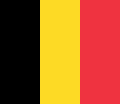
    flag, from 1831Flag of Belgium (civil) · Public domain
  • Flag of Belgium
    flag, from 1831Flag of Belgium · Public domain
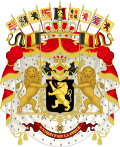
  • Great coat of arms of Belgium
    coat of arms, from 1837Great coat of arms of Belgium · CC BY-SA 3.0 · Sodacan , with some elements by Katepanomegas

Its world

Rivals, and who else stood

Who it fought most

Wars and battles both took part in, on whichever side: the record names who took part, not who fought whom.

Meanwhile, elsewhere

The best-known states of other regions that stood while it did; the band is Belgium’s own years.

1850190019502000

How it compares

Among 3,073 states

Stood longer than 61% of 3,073 states
Belgium · 196 yearsMongol EmpireGreenlandHow long it stood, among the states with a recorded end or still standing.
Held more ground at its peak than 34% of 1,464 states
Belgium · 46,300 km²ArmeniaEstoniaThe most ground it held, among the states with a border in Cliopatria.

How it began

How did Belgium begin?

What led to it, and what came of it

United Kingdom of the Netherlands · Linked · 1815 – 1839United Kingdom of the NetherlandsJ. M. W. Turner · Coincidence · 1775 – 1851J. M. W. TurnerLeonard du Bus de Gisignies · Coincidence · 1780 – 1849Leonard du Bus de GisigniesÉtienne Constantin de Gerlache · Coincidence · 1785 – 1871Étienne Constantin de GerlacheLouis de Potter · Coincidence · 1786 – 1859Louis de PotterAlbert Joseph Goblet d'Alviella · Coincidence · 1790 – 1873Albert Joseph Goblet d'AlviellaBelgium · 1830 – 2026Belgium18001850190019502000
linkedcoincidence

Open the investigation: every row with its evidence, the conditions at the time, the theories condition by condition, and the succession analysed.

Its centuries in the record

1800 – 1899: 48 recorded — 4 wars and battles, 0 risings, regime changes and massacres, 44 other18001900 – 1999: 84 recorded — 35 wars and battles, 3 risings, regime changes and massacres, 46 other19002000 – 2099: 7 recorded — 0 wars and battles, 2 risings, regime changes and massacres, 5 other2000

Wars and battles in red, risings, coups and massacres beside them, everything else in grey, by the century each began in. A tall bar is partly a fact about Wikipedia: better-documented centuries hold more.

Each century’s own page:1800 – 18991900 – 19992000 – 2099

Keep exploring

Share this page
Copy link
Embed the map
Cite this page

How this page is made

Drawn from Wikidata (Q31, CC0), the opening and history of its English Wikipedia article retold by the atlas (CC BY-SA 4.0), borders from Cliopatria (CC BY 4.0), coast and rivers from Natural Earth, cities from Reba, Reitsma & Seto 2016 (CC BY 4.0), symbols from Wikimedia Commons, each under its own licence. Data built 2026-11-26 · Pastlas v2.47.1, by Oleh Voronko; the published atlas and its data are for non-commercial use.

How to read it

Areas are measured on an equal-area grid from borders simplified to about five kilometres. “c.” marks an approximate date, and a date known to the century is never printed to the year. Counts are what the atlas holds, and they follow Wikipedia’s coverage: a busy century is partly a fact about the record.

  • Still standing: the span runs to the year of the build, 2026.

Something wrong?

Tell us and name the entry. We fix the data, not just this page.

Report a problem