State · Americas and Oceania

Canada

1867 – present · 159 years · still standing

Came after Province of Canada

A federation of former British colonies that grew from the Atlantic to the Pacific and won full sovereignty from Britain by statute.

Canada was formed on 1 July 1867, when Confederation joined three British colonies in North America into a federal dominion with four provinces. It expanded to the Pacific and into the Arctic, displacing Indigenous peoples as it grew, and gained sovereignty from Britain by stages, from the Statute of Westminster of 1931 to the Canada Act of 1982. A constitutional monarchy and parliamentary democracy, it is officially bilingual in English and French.

What the record holds

Canada began in 1867, replacing the Province of Canada.↓ Its borders are first mapped in 1932, around 9.58 million km².↓

Its ground peaked in 1973 at 10.09 million km².↓ Its highest office was held by 7 rulers, covering 1867 – 2022, the median reign 21 years; 1 of 6 handovers was irregular.↓ Among them, Elizabeth II, Queen Victoria and Charles III are the best known.↓ The atlas files 98 rows under it, most of them people.↓

From Wikipedia’s article, retold · CC BY-SA 4.0

159 years

Longer than the Maurya Empire, shorter than the Mongol Empire

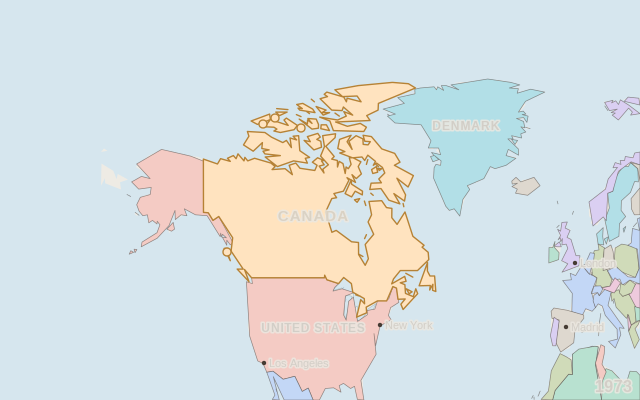
10.1 million km²

At its height in 1973 · about the size of the United States

7 rulers

the monarch of Canada

3 wars and battles

More per century than 89% of states · 98 entries in all

Map: Canada in 1973, its borders in gold among its neighbours
Montreal Protocol, 1987Ottawa Treaty, 1997Anti-Counterfeiting Trade Agreement, 20061940196019802000
Beside it on the map in 1973: United States, Denmark, French Fifth Republic, Algeria, Sweden and Norway.How far it reached, year by year: its ground inside the borders Cliopatria draws (CC BY 4.0), measured on an equal-area grid; the map shows it at its largest, with the cities of the year.

The story

Four acts, 1867 – present

I1867 – 1914

Confederation and expansion

Four provinces confederate in 1867. Canada acquires the vast North-Western Territory and Rupert's Land; Métis grievances spark the Red River Rebellion, and Manitoba becomes a province in 1870. British Columbia joins in 1871, promised a railway across the continent, and Prince Edward Island in 1873; the North-West Rebellion breaks out in 1885.

Watch this act on the live map, from 1867
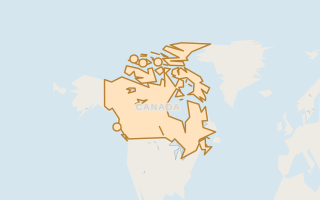
Canada in 1944, at the end of act II
II1914 – 1945

War and autonomy

Britain's declaration of war in 1914 carries Canada into the First World War, where the Canadian Corps fights at Vimy Ridge; conscription in 1917 meets fierce opposition from French-speaking Quebecers. Canada joins the League of Nations in its own right in 1919, and the Statute of Westminster of 1931 widens its sovereignty. Newfoundland gives up self-government in 1934.

Watch this act on the live map, from 1914
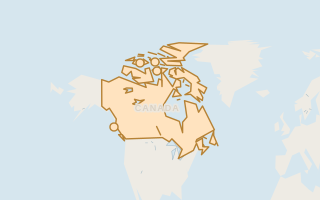
Canada in 1981, at the end of act III
III1945 – 19829.58 million → 9.97 million km²

A new Canadian identity

Newfoundland votes to join Canada in 1949. Post-war growth and Liberal governments shape a new identity: the maple leaf flag in 1965, official bilingualism in 1969, multiculturalism in 1971, and programmes such as Medicare and the Canada Pension Plan. The Canada Act of 1982 ends the last legal dependence on the British Parliament.

Watch this act on the live map, from 1945

Before and after

Before it

Where it sits in time

3000 BCE2000 BCE1000 BCE110002000Province of Canada: 1841 – 1867Canada: 1867 – 2026

Five thousand years, 3000 BCE to 2026; the state in gold, what it replaced or followed and what replaced or followed it in grey.

Its people

Lives across Canada

1850190019502000
Statesmen and generalsWriters, artists and thinkersScientists and explorersAll its people on the timeline →

How it was governed

7 monarchs

7 monarchs on record, 1867 to 2022; a reign lasted 21 years at the median. Each bar is a reign, as long as it lasted.

Queen Victoria · 1867 – 1901 · died in office of natural causesEdward VII · 1901 – 1910 · died in office of natural causesGeorge V · 1910 – 1936 · died by suicideEdward VIII · 1936 – 1936 · left office aliveGeorge VI · 1936 – 1952 · died in office of natural causesElizabeth II · 1952 – 2022 · died in office, manner not recordedCharles III · 2022 – … · still in office190019502000
How their terms ended, where it is known (7 of 7):Died in office 5Left office alive 1In office 1
Every term, with how it ended and its source

Rulers

How 7 reigns ended - choose one to show only those

How they died, where the record says: died of natural causes 4 · died by suicide 1.

RulerReignLengthHow it ended · sourceTo the ruler before
19th century · 1 reign
Queen Victoria · aged 481867 – 190134 yearsdied in officeWikidata's manner of deathdied of natural causes
20th century · 5 reigns
Edward VII · aged 601901 – 19109 yearsdied in officeWikidata's manner of deathdied of natural causeschild
George V · aged 451910 – 193626 yearsdied by suicideWikidata's manner of deathdied by suicidechild
Edward VIII · aged 421936 – 1936under a yearleft office aliveread off the dates alonedied of natural causeschild
George VI · aged 411936 – 195216 yearsdied in officeWikidata's manner of deathdied of natural causessibling
Elizabeth II · aged 261952 – 202270 yearsdied in officeread off the dates alonechild
21st century · 1 reign
Charles III · aged 742022 – in officein office since 2022still in officechild

7 rulers, 7 with terms dated as terms, covering 1867 – 2022. Median reign 21 years. 1 of 6 handovers irregular - a killing, a deposition, a rival claimant, a rising or a coup beside it. A blank in the last column means no kin on record, which is coverage, never “unrelated”.

Heads of government

The line of Prime Minister of Canada, drawn and never measured: a cabinet is not a reign.

John A. Macdonald1867 – 1873
Alexander Mackenzie1873 – 1878
John A. Macdonald1878 – 1891
John Abbott1891 – 1892
John Sparrow David Thompson1892 – 1894
Mackenzie Bowell1894 – 1896
Wilfrid Laurier1896 – 1911
Charles Tupper1896 – 1896
Robert Borden1911 – 1920
Arthur Meighen1920 – 1921
William Lyon Mackenzie King1921 – 1926
William Lyon Mackenzie King1926 – 1930
Arthur Meighen1926 – 1926
R. B. Bennett1930 – 1935
William Lyon Mackenzie King1935 – 1948
Louis St. Laurent1948 – 1957
John Diefenbaker1957 – 1963
Lester B. Pearson1963 – 1968
Pierre Trudeau1968 – 1979
Joe Clark1979 – 1980
Pierre Trudeau1980 – 1984
Brian Mulroney1984 – 1993
John Turner1984 – 1984
Jean Chrétien1993 – 2003
Kim Campbell1993 – 1993
Paul Martin2003 – 2006
Stephen Harper2006 – 2015
Justin Trudeau2015 – 2025
Mark Carney2025 – …

Flags and arms, in order

  • Flag of Canada (1868–1921)
    flag, 1868 – 1921Flag of Canada (1868–1921) · Public domain
  • Royal Coat of arms of Canada
    coat of arms, from 1921Royal Coat of arms of Canada · CC BY-SA 4.0
  • Flag of Canada (1921–1957)
    flag, 1921 – 1957Flag of Canada (1921–1957) · Public domain
  • Flag of Canada (1957–1965)
    flag, 1957 – 1965Flag of Canada (1957–1965) · Public domain
  • Flag of Canada (1964)
    flag, 1964 – 1965Flag of Canada (1964) · Public domain
  • Flag of Canada (Pantone)
    flag, from 1965Flag of Canada (Pantone) · Public domain

Its world

Rivals, and who else stood

Who it fought most

Wars and battles both took part in, on whichever side: the record names who took part, not who fought whom.

Meanwhile, elsewhere

The best-known states of other regions that stood while it did; the band is Canada’s own years.

1850190019502000

How it compares

Among 3,073 states

Stood longer than 56% of 3,073 states
Canada · 159 yearsMaurya EmpireMongol EmpireHow long it stood, among the states with a recorded end or still standing.
Held more ground at its peak than 99% of 1,464 states
Canada · 10,086,500 km²United StatesRussiaThe most ground it held, among the states with a border in Cliopatria.
Had more wars on record per century than 89% of 3,073 states
Canada · 0.6Wars recorded per century, among the states, counting the wars the atlas hosts under each.

How it began

How did Canada begin?

What led to it, and what came of it

American Indian Wars · Linked · 1609 – 1924American Indian WarsProvince of Canada · Linked · 1841 – 1867Province of CanadaFenian raids · Linked · 1866 – 1871Fenian raidsLaura Secord · Coincidence · 1775 – 1868Laura SecordLouis-Joseph Papineau · Coincidence · 1786 – 1871Louis-Joseph PapineauJohn A. Macdonald · Coincidence · 1815 – 1891John A. MacdonaldCanada · 1867 – 2026Canada16001700180019002000
linkedcoincidence

Open the investigation: every row with its evidence, the conditions at the time, the theories condition by condition, and the succession analysed.

Its centuries in the record

1800 – 1899: 23 recorded — 1 wars and battles, 2 risings, regime changes and massacres, 20 other18001900 – 1999: 64 recorded — 1 wars and battles, 0 risings, regime changes and massacres, 63 other19002000 – 2099: 10 recorded — 1 wars and battles, 4 risings, regime changes and massacres, 5 other2000

Wars and battles in red, risings, coups and massacres beside them, everything else in grey, by the century each began in. A tall bar is partly a fact about Wikipedia: better-documented centuries hold more.

Each century’s own page:1800 – 18991900 – 19992000 – 2099

Keep exploring

Share this page
Copy link
Embed the map
Cite this page

How this page is made

Drawn from Wikidata (Q16, CC0), the opening and history of its English Wikipedia article retold by the atlas (CC BY-SA 4.0), borders from Cliopatria (CC BY 4.0), coast and rivers from Natural Earth, cities from Reba, Reitsma & Seto 2016 (CC BY 4.0), symbols from Wikimedia Commons, each under its own licence. Data built 2026-11-26 · Pastlas v2.47.1, by Oleh Voronko; the published atlas and its data are for non-commercial use.

How to read it

Areas are measured on an equal-area grid from borders simplified to about five kilometres. “c.” marks an approximate date, and a date known to the century is never printed to the year. Counts are what the atlas holds, and they follow Wikipedia’s coverage: a busy century is partly a fact about the record.

  • Still standing: the span runs to the year of the build, 2026.

Something wrong?

Tell us and name the entry. We fix the data, not just this page.

Report a problem