State · Europe

German Confederation

1815 – 1866 · 51 years

Came after Kingdom of Prussia and Confederation of the Rhine · became Luxembourg and Liechtenstein

A league of German states that replaced the Holy Roman Empire, hobbled by unanimity and broken by Austria's rivalry with Prussia.

From 1815 to 1866 the German Confederation bound together thirty-nine mostly German-speaking states of Central Europe. The Congress of Vienna created it to replace the Holy Roman Empire, dissolved in 1806. Its one organ, the Federal Convention, was chaired by Austria and decided its weightiest questions unanimously, and it worked only when Austria and Prussia agreed. The revolutions of 1848 failed to turn it into a federal state, and Prussia's victory over Austria in 1866 ended it.

What the record holds

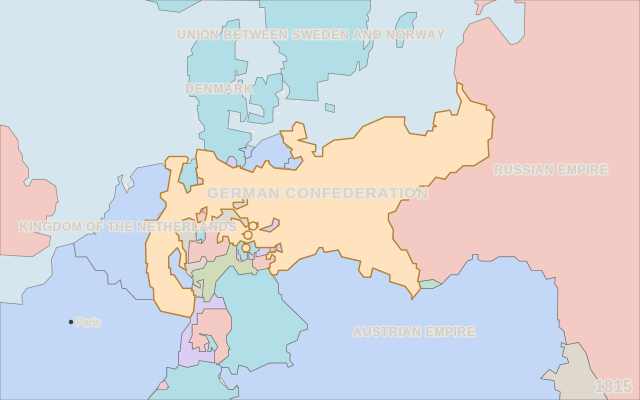
Its record opens in 1815, replacing the Confederation of the Rhine and the German Empire.↓ When the borders dataset first draws it, in 1815, it held 341,300 km².↓

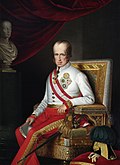
Its line counts 3 rulers, covering 1815 – 1866, the median reign 16 years; 1 of 2 handovers was irregular.↓ Among them, Franz Joseph I, Francis II, Holy Roman Emperor and Ferdinand I of Austria are the best known.↓ The atlas files 25 rows under it, most of them people.↓

In 1866, after 51 years, it was replaced by Luxembourg and Liechtenstein.↓

From Wikipedia’s article, retold · CC BY-SA 4.0

Best known for

51 years

Longer than the German Empire, shorter than Hungarians

341,000 km²

At its height in 1815 · about the size of Vietnam

3 rulers

the Head of the Präsidialmacht Austria

Map: German Confederation in 1815, its borders in gold among its neighbours
Constitution of the German Confederation, 1815Hep-Hep riots, 1819Frankfurter Wachensturm, 18331820183018401850
Beside it on the map in 1815: Russian Empire, Austrian Empire, Bourbon Restoration in France, Union between Sweden and Norway, Denmark and Kingdom of the Netherlands.How far it reached, year by year: its ground inside the borders Cliopatria draws (CC BY 4.0), measured on an equal-area grid; the map shows it at its largest, with the cities of the year.

The story

Three acts, 1815 – 1866

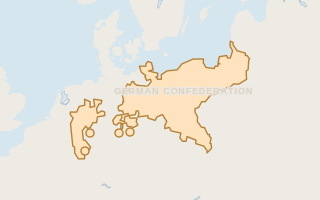
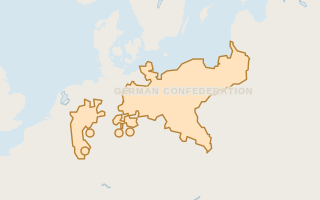
German Confederation in 1849, at the end of act II
II1848 – 1850281,000 → 281,000 km²

Revolution in Frankfurt

Revolutions driven by liberal, democratic, socialist and nationalist hopes try to make the Confederation a unified federal state under the Frankfurt Constitution. The Federal Convention is dissolved in July 1848, but Austria, Prussia and other states crush the revolution, and the Convention returns in 1850.

Watch this act on the live map, from 1848
III1850 – 1866

Austria against Prussia

Restored, the Confederation again depends on Austria and Prussia, its two most populous members, and the two are often at odds. Their contest over which will lead the German states ends in war in 1866, when Prussia defeats the Austrian Empire.

Watch this act on the live map, from 1850

Before and after

Before it

After it

Where it sits in time

3000 BCE2000 BCE1000 BCE110002000Confederation of the Rhine: 1806 – 1813German Empire (1848–1849): 1848 – 1849Kingdom of Prussia: 1701 – 1918North German Confederation: 1867 – 1870Kingdom of Bavaria: 1806 – 1918Kingdom of Württemberg: 1806 – 1918German Confederation: 1815 – 1866

Five thousand years, 3000 BCE to 2026; the state in gold, what it replaced or followed and what replaced or followed it in grey.

Its people

Lives across the German Confederation

18601880190019201940
Statesmen and generalsWriters, artists and thinkersScientists and explorersLived on after it endedAll its people on the timeline →

How it was governed

3 heads

3 heads on record, 1815 to 1866; a reign lasted 16 years at the median. Each bar is a reign, as long as it lasted.

Francis II, Holy Roman Emperor · 1815 – 1835 · no death date to read the end againstFerdinand I of Austria · 1835 – 1848 · no death date to read the end againstFranz Joseph I · 1850 – 1866 · no death date to read the end against18201830184018501860
How their terms ended, where it is known (0 of 3):Not on record 3
Every term, with how it ended and its source

Rulers

RulerReignLengthHow it ended · sourceTo the ruler before
19th century · 3 reigns
Francis II, Holy Roman Emperor1815 – 183520 yearsending not on record
Ferdinand I of Austria1835 – 184813 yearsending not on recordchild
Franz Joseph I1850 – 186616 yearsending not on recorddied of natural causesnephew or niece

3 rulers, 3 with terms dated as terms, covering 1815 – 1866. Median reign 16 years. 1 of 2 handovers irregular - a killing, a deposition, a rival claimant, a rising or a coup beside it. A blank in the last column means no kin on record, which is coverage, never “unrelated”.

Flags and arms, in order

  • War ensign of the German Empire Navy 1848-1852
    flag, undatedWar ensign of the German Empire Navy 1848-1852 · Public domain
  • Wappen Deutscher Bund
    coat of arms, undatedWappen Deutscher Bund · Attribution · Drawing created by David Liuzzo

Its world

Who else stood

Meanwhile, elsewhere

The best-known states of other regions that stood while it did; the band is the German Confederation’s own years.

182018401860

How it compares

Among 3,073 states

Stood longer than 34% of 3,073 states
German Confederation · 51 yearsGerman EmpireHungariansHow long it stood, among the states with a recorded end or still standing.
Held more ground at its peak than 68% of 1,464 states
German Confederation · 341,300 km²VietnamPhilippinesThe most ground it held, among the states with a border in Cliopatria.

Why it fell

Why did the German Confederation fall?

Historians still argue. Here is what the atlas records about its last century:

What led to it, and what came of it

Confederation of the Rhine · Linked · 1806 – 1813Confederation of the RhinePrincipality of Hohenzollern-Sigmaringen · Linked · 1576 – 1850Principality of Hohenzollern-Sig…Kingdom of Prussia · Linked · 1701 – 1918Kingdom of PrussiaNapoleon · In the article · 1769 · “In the aftermath of the Treaty of Pressburg Napoleon created the Confederation of the Rhine in July 1806, joining 16 of France's allies among the German state…”NapoleonAnhalt-Bernburg · Coincidence · 1252 – 1863Anhalt-BernburgAnhalt-Dessau · Coincidence · 1396 – 1853Anhalt-DessauGerman Confederation · 1815 – 1866German ConfederationNorth German Confederation · Linked · 1867 – 1870North German ConfederationLuxembourg · Linked · 1815 – 2026LuxembourgLiechtenstein · Linked · 1806 – 2026LiechtensteinKingdom of Bavaria · Linked · 1806 – 1918Kingdom of BavariaKingdom of Württemberg · Linked · 1806 – 1918Kingdom of WürttembergGrand Duchy of Baden · Linked · 1806 – 1918Grand Duchy of Baden1400160018002000
in the articlelinkedcoincidence

Open the investigation: every row with its evidence, the conditions at the time, the theories condition by condition, and the succession analysed.

In the record

25 entries the atlas files under it, all in 1800 – 1899.

Keep exploring

Share this page
Copy link
Embed the map
Cite this page

How this page is made

Drawn from Wikidata (Q151624, CC0), the opening and history of its English Wikipedia article retold by the atlas (CC BY-SA 4.0), borders from Cliopatria (CC BY 4.0), coast and rivers from Natural Earth, cities from Reba, Reitsma & Seto 2016 (CC BY 4.0), symbols from Wikimedia Commons, each under its own licence. Data built 2026-11-26 · Pastlas v2.47.1, by Oleh Voronko; the published atlas and its data are for non-commercial use.

How to read it

Areas are measured on an equal-area grid from borders simplified to about five kilometres. “c.” marks an approximate date, and a date known to the century is never printed to the year. Counts are what the atlas holds, and they follow Wikipedia’s coverage: a busy century is partly a fact about the record.

Something wrong?

Tell us and name the entry. We fix the data, not just this page.

Report a problem