State · Europe

Kingdom of the Netherlands

1815 – present · 211 years · still standing

A constitutional monarchy that saw the Belgians secede, abolished slavery in its colonies, and now unites four countries under one crown.

The Kingdom of the Netherlands is a constitutional monarchy of four constituent countries, the Netherlands, Aruba, Curaçao and Sint Maarten, each with its own parliament and all equal partners under one monarch. The Netherlands itself, mostly in Northwestern Europe, holds nearly all the land and people and handles foreign policy and defence for the whole. Founded in 1815, the kingdom lost the Belgians, who seceded in 1830, and Luxembourg in 1839.

What the record holds

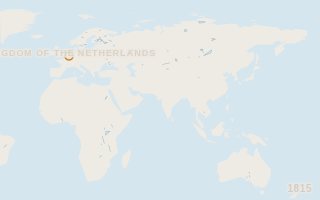
Its record opens in 1815.↑ Its borders are first mapped in 1815, around 70,900 km².↓

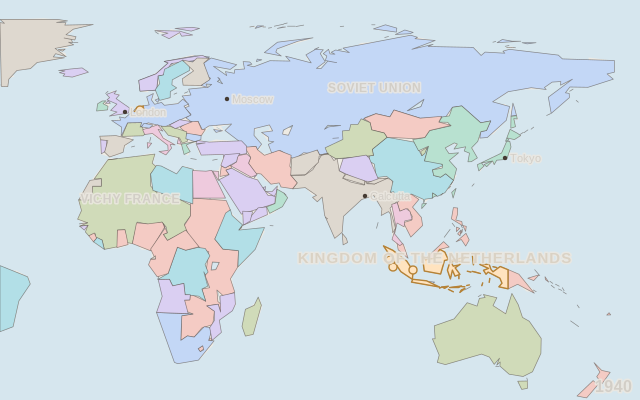
Its ground peaked in 1940 at 2.07 million km².↓ Its line counts 8 rulers, covering 1815 – 2013, the median reign 32 years; 2 of 7 handovers were irregular.↓ The best known of them are Willem-Alexander of the Netherlands, Beatrix of the Netherlands and Wilhelmina of the Netherlands.↓ Most of the 107 rows the atlas files under it are people.↓

From Wikipedia’s article, retold · CC BY-SA 4.0

211 years

Longer than Greenland, shorter than the Achaemenid Empire

2.07 million km²

At its height in 1940 · about the size of Indonesia

8 rulers

the King of the Netherlands

10 wars and battles

More per century than 88% of states · 107 entries in all

Map: Kingdom of the Netherlands in 1940, its borders in gold among its neighbours
First International Opium Convention, 1912German invasion of the Netherlands, 1940Operation Market Garden, 1944Georgian uprising on Texel, 1945Western Allied invasion of Germany, 19451850190019502000
Beside it on the map in 1940: Soviet Union, Vichy France, British Empire, Australia, British Raj and Greenland.How far it reached, year by year: its ground inside the borders Cliopatria draws (CC BY 4.0), measured on an equal-area grid; the map shows it at its largest, with the cities of the year.

The story

Four acts, 1815 – present

Kingdom of the Netherlands in 1838, at the end of act I
I1815 – 183970,900 → 37,000 km²

The Belgians break away

William I of the Netherlands takes the throne in 1815, the year of the Waterloo campaign. In 1830 the southerners secede as Belgians, a break the kingdom accepts only in the Treaty of London of 1839. Luxembourg leaves the same year, though as a grand duchy it shares the Dutch monarch until 1890.

Watch this act on the live map, from 1815
Kingdom of the Netherlands in 1939, at the end of act II
II1839 – 194037,000 → 37,400 km²

Kings, colonies and emancipation

A law of 1 July 1863 ends slavery in Suriname and the Caribbean colonies, though in Suriname many freed people must keep working the plantations under state supervision until 1873. The personal union with Luxembourg ends in 1890, when Wilhelmina of the Netherlands begins a reign that lasts until 1948.

Watch this act on the live map, from 1839
Kingdom of the Netherlands in 1953, at the end of act III
III1940 – 19542.07 million → 38,100 km²

War and the Atlantic Charter

The German invasion of 1940 is followed by Operation Market Garden in 1944 and the Liberation of Arnhem in 1945. On 1 January 1942 the Netherlands signs the Atlantic Charter, which upholds the right of peoples to choose their government, and in a radio speech that December Queen Wilhelmina proposes changes that lead to the 1954 reform.

Watch this act on the live map, from 1940
IV1954 – present

Four countries, one crown

Juliana reigns until 1980, Beatrix until 2013, then Willem-Alexander, and the Kingdom marks its bicentennial from 2013 to 2015. It now joins four autonomous countries, each with its own parliament, while Bonaire, Saba and Sint Eustatius are special municipalities of the Netherlands in the Caribbean.

Watch this act on the live map, from 1954
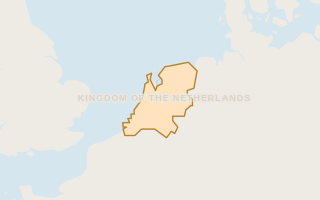
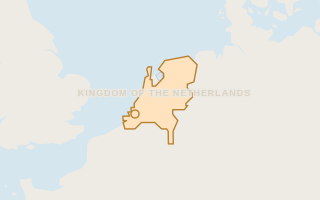
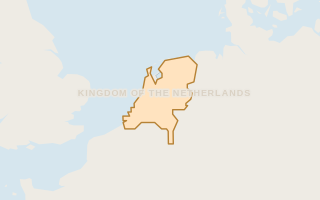
Kingdom of the Netherlands in 1940, at its largestKingdom of the Netherlands in 1815, first mapped
The rise and the fall in one frame: drag across it from 1815, first mapped at 70,900 km², to 1940, at its largest at 2.07 million km². Open the live map in 1815 or 1940.

Where it sits in time

3000 BCE2000 BCE1000 BCE110002000Kingdom of the Netherlands: 1815 – 2026

Five thousand years, 3000 BCE to 2026; the state in gold.

Its people

Lives across the Kingdom of the Netherlands

1850190019502000
Scientists and explorersWriters, artists and thinkersStatesmen and generalsAll its people on the timeline →

How it was governed

8 kings

8 kings on record, 1815 to 2013; a reign lasted 32 years at the median. Each bar is a reign, as long as it lasted.

William I of the Netherlands · 1815 – 1840 · left office aliveWilliam II of the Netherlands · 1840 – 1849 · died in office of natural causesWilliam III of the Netherlands · 1849 – 1890 · died in office, manner not recordedEmma of Waldeck and Pyrmont · 1890 – 1898 · left office aliveWilhelmina of the Netherlands · 1890 – 1948 · abdicated, the article saysJuliana of the Netherlands · 1948 – 1980 · abdicated, the article saysBeatrix of the Netherlands · 1980 – 2013 · abdicated, the article saysWillem-Alexander of the Netherlands · 2013 – … · still in office1850190019502000
a second row: a reign that began before the last had ended — rival claimants, or a shared throne
How their terms ended, where it is known (8 of 8):Deposed or removed 3Died in office 2Left office alive 2In office 1
Every term, with how it ended and its source

Rulers

How 8 reigns ended - choose one to show only those

How they died, where the record says: died of natural causes 3.

RulerReignLengthHow it ended · sourceTo the ruler before
19th century · 5 reigns · 1 killed or removed
William I of the Netherlands · aged 431815 – 184025 yearsleft office aliveread off the dates alone
William II of the Netherlands · aged 481840 – 18499 yearsdied in officeWikidata's manner of deathdied of natural causeschild
William III of the Netherlands · aged 321849 – 189041 yearsdied in officeread off the dates alonechild
Emma of Waldeck and Pyrmont · aged 321890 – 18988 yearsleft office aliveread off the dates alonedied of natural causesspouse
Wilhelmina of the Netherlands · aged 101890 – 194858 yearsabdicatedread from the ruler's own articlechild
20th century · 2 reigns · 2 killed or removed
Juliana of the Netherlands · aged 391948 – 198032 yearsabdicatedread from the ruler's own articledied of natural causeschild
Beatrix of the Netherlands · aged 421980 – 201333 yearsabdicatedread from the ruler's own articlechild
21st century · 1 reign
Willem-Alexander of the Netherlands · aged 462013 – in officein office since 2013still in officechild

8 rulers, 8 with terms dated as terms, covering 1815 – 2013. Median reign 32 years. 2 of 7 handovers irregular - a killing, a deposition, a rival claimant, a rising or a coup beside it. A blank in the last column means no kin on record, which is coverage, never “unrelated”.

Heads of government

The line of Prime Minister of the Netherlands, drawn and never measured: a cabinet is not a reign.

Jacob de Kempenaer1848 – 1849
Gerrit Schimmelpenninck1848 – 1848
Johan Rudolph Thorbecke1849 – 1853
Floris Adriaan van Hall1853 – 1856
Justinus van der Brugghen1856 – 1858
Jan Jacob Rochussen1858 – 1860
Floris Adriaan van Hall1860 – 1861
Schelto van Heemstra1861 – 1862
Jacob van Zuylen van Nijevelt1861 – 1861
Johan Rudolph Thorbecke1862 – 1866
Julius van Zuylen van Nijevelt1866 – 1868
Isaäc Dignus Fransen van de Putte1866 – 1866
Pieter Philip van Bosse1868 – 1871
Johan Rudolph Thorbecke1871 – 1872
Gerrit de Vries1872 – 1874
Jan Heemskerk1874 – 1877
Jan Kappeyne van de Coppello1877 – 1879
Theo van Lynden van Sandenburg1879 – 1883
Jan Heemskerk1883 – 1888
Æneas Mackay Jr.1888 – 1891
Gijsbert van Tienhoven1891 – 1894
Joan Röell1894 – 1897
Nicolaas Pierson1897 – 1901
Abraham Kuyper1901 – 1905
Theo de Meester1905 – 1908
Theo Heemskerk1908 – 1913
Pieter Cort van der Linden1913 – 1918
Charles Ruijs de Beerenbrouck1918 – 1925
Hendrikus Colijn1925 – 1926
Dirk Jan de Geer1926 – 1929
Charles Ruijs de Beerenbrouck1929 – 1933
Hendrikus Colijn1933 – 1939
Dirk Jan de Geer1939 – 1940
Pieter Sjoerds Gerbrandy1940 – 1945
Willem Schermerhorn1945 – 1946
Louis Beel1946 – 1948
Willem Drees1948 – 1958
Louis Beel1958 – 1959
Jan de Quay1959 – 1963
Victor Marijnen1963 – 1965
Jo Cals1965 – 1966
Jelle Zijlstra1966 – 1967
Piet de Jong1967 – 1971
Barend Biesheuvel1971 – 1973
Joop den Uyl1973 – 1977
Dries van Agt1977 – 1982
Ruud Lubbers1982 – 1994
Wim Kok1994 – 2002
Jan Peter Balkenende2002 – 2010
Mark Rutte2010 – 2024
Dick Schoof2024 – 2026
Rob Jetten2026 – …

Flags and arms, in order

  • State coat of arms of the Netherlands
    coat of arms, undatedState coat of arms of the Netherlands · CC BY-SA 3.0 · Sodacan
  • Flag of the Netherlands
    flag, from 1690Flag of the Netherlands · Public domain
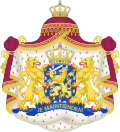
  • Royal coat of arms of the Netherlands
    coat of arms, from 1980Royal coat of arms of the Netherlands · CC BY-SA 3.0 · Sodacan

Its world

Rivals, and who else stood

Who it fought most

Wars and battles both took part in, on whichever side: the record names who took part, not who fought whom.

Meanwhile, elsewhere

The best-known states of other regions that stood while it did; the band is the Kingdom of the Netherlands’s own years.

18001850190019502000

How it compares

Among 3,073 states

Stood longer than 63% of 3,073 states
Kingdom of the Netherlands · 211 yearsGreenlandAchaemenid EmpireHow long it stood, among the states with a recorded end or still standing.
Held more ground at its peak than 91% of 1,464 states
Kingdom of the Netherlands · 2,069,400 km²IndonesiaDenmarkThe most ground it held, among the states with a border in Cliopatria.
Had more wars on record per century than 88% of 3,073 states
Kingdom of the Netherlands · 0.5Wars recorded per century, among the states, counting the wars the atlas hosts under each.

How it began

How did the Kingdom of the Netherlands begin?

What led to it, and what came of it

Dutch colonial empire · Coincidence · 1624 – 1975Dutch colonial empireRutger Jan Schimmelpenninck · Coincidence · 1761 – 1825Rutger Jan SchimmelpenninckHerman Willem Daendels · Coincidence · 1762 – 1818Herman Willem DaendelsDavid Hendrik Chassé · Coincidence · 1765 – 1849David Hendrik ChasséJan Willem Pieneman · Coincidence · 1779 – 1853Jan Willem PienemanJohannes van den Bosch · Coincidence · 1780 – 1844Johannes van den BoschKingdom of the Netherlands · 1815 – 2026Kingdom of the Netherlands1700180019002000
coincidence

Open the investigation: every row with its evidence, the conditions at the time, the theories condition by condition, and the succession analysed.

Its centuries in the record

1800 – 1899: 50 recorded — 4 wars and battles, 0 risings, regime changes and massacres, 46 other18001900 – 1999: 46 recorded — 6 wars and battles, 3 risings, regime changes and massacres, 37 other19002000 – 2099: 4 recorded — 0 wars and battles, 1 risings, regime changes and massacres, 3 other2000

Wars and battles in red, risings, coups and massacres beside them, everything else in grey, by the century each began in. A tall bar is partly a fact about Wikipedia: better-documented centuries hold more.

Each century’s own page:1800 – 18991900 – 19992000 – 2099

Keep exploring

Share this page
Copy link
Embed the map
Cite this page

How this page is made

Drawn from Wikidata (Q29999, CC0), the opening and history of its English Wikipedia article retold by the atlas (CC BY-SA 4.0), borders from Cliopatria (CC BY 4.0), coast and rivers from Natural Earth, cities from Reba, Reitsma & Seto 2016 (CC BY 4.0), symbols from Wikimedia Commons, each under its own licence. Data built 2026-11-26 · Pastlas v2.47.1, by Oleh Voronko; the published atlas and its data are for non-commercial use.

How to read it

Areas are measured on an equal-area grid from borders simplified to about five kilometres. “c.” marks an approximate date, and a date known to the century is never printed to the year. Counts are what the atlas holds, and they follow Wikipedia’s coverage: a busy century is partly a fact about the record.

  • Wikidata records foundings in 1815 and 1954; the atlas draws the preferred founding.
  • Still standing: the span runs to the year of the build, 2026.

Something wrong?

Tell us and name the entry. We fix the data, not just this page.

Report a problem