State · Europe

Kingdom of León

910 – 1833 · 923 years

Came after Kingdom of Asturias and Almohad Caliphate · became Crown of Castile

The Christian kingdom of northwestern Iberia, heir to Asturias, that outlasted civil wars, Moorish and Viking attacks, and took Toledo.

The Kingdom of León was born in 910, when Asturias's Christian princes moved their capital from Oviedo to León. Its kings survived civil wars, wars with neighbours, and invasions by Moors and Vikings. For a time it was the foremost kingdom of the Iberian Peninsula; in 1037 Fernando of Castile won its crown, and in 1085 Alfonso VI took Toledo, the first great Andalusi city to fall to Christians.

What the record holds

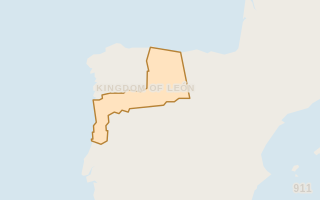
It was founded in 910, replacing the Kingdom of Asturias.↓ When the borders dataset first draws it, in 911, it held 59,600 km².↓

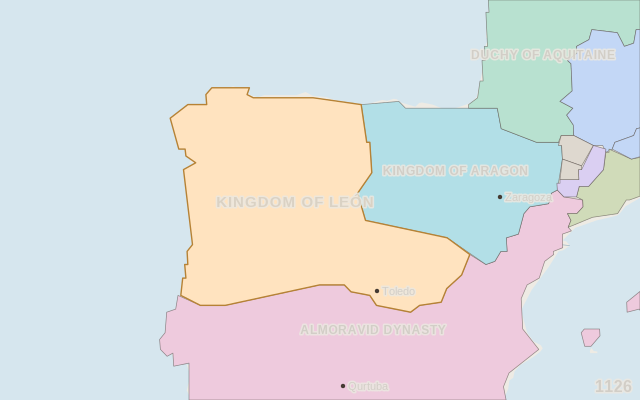
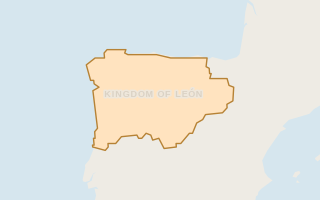
Its ground peaked in 1126 at 192,200 km².↓ Its line counts 17 rulers, covering 910 – 1188, the median reign 10 years; 3 of 17 handovers were irregular.↓ The best known of them are Alfonso VI of León and Castile, Alfonso VII of León and Castile and Sancho II of Castile and León.↓ Most of the 17 rows the atlas files under it are people.↓

The Crown of Castile replaced it in 1833, after 923 years.↓

From Wikipedia’s article, retold · CC BY-SA 4.0

923 years

Longer than the Holy Roman Empire, shorter than the Byzantine Empire

192,000 km²

At its height in 1126 · about the size of Kyrgyzstan

17 rulers

the Monarch of the Kingdom of León

4 wars and battles

17 entries in all

Map: Kingdom of León in 1126, its borders in gold among its neighbours
Battle of Simancas, 939Battle of Atapuerca, 1054Battle of Uclés (1108), 1108Battle of São Mamede, 112895010001050110011501200
Beside it on the map in 1126: Almoravid dynasty, Kingdom of Aragon, Duchy of Aquitaine, County of Toulouse, County of Barcelona and County of Urgell.How far it reached, year by year: its ground inside the borders Cliopatria draws (CC BY 4.0), measured on an equal-area grid; the map shows it at its largest, with the cities of the year.

The story

Four acts, 910 – 1833

Kingdom of León in 950, at the end of act I
I910 – 951

The sons of Alfonso III

The old Asturian kingdom is shared among Alfonso III's sons: García takes León, Ordoño Galicia, Fruela Asturias. García dies in 914 and Ordoño II rules León and Galicia together; after Fruela II's death in 925 civil war brings Alfonso IV to the throne. In 932 his younger brother Ramiro seizes the crown, capturing Alfonso and Fruela II's three sons.

Watch this act on the live map, from 910
II951 – 1037

Regents and Viking raids

Ordoño III dies young and his half-brother Sancho I the Fat follows; Sancho's son Ramiro III is crowned at five, with Sancho's sister Elvira Ramírez, a nun, as regent. In 968 Gunrod's Viking fleet lands in Galicia and kills Bishop Sisnando, until Count Gonzalo Sánchez destroys it. In the 1020s Sancho III of Navarre takes Castile and later runs León.

Watch this act on the live map, from 951
III1037 – 1157

León and Castile together

In 1037 Fernando of Castile defeats the king of León, who dies in battle, and, married to his sister, takes León and Galicia; as Ferdinand I he rules León and Castile until 1065. Alfonso VI takes Toledo in 1085, turning tribute-taking into outright conquest. Urraca and then Alfonso VII follow, and the kingdom's mapped extent peaks in 1126.

Watch this act on the live map, from 1037
Kingdom of León in 1126, at its largestKingdom of León in 911, first mapped
The rise and the fall in one frame: drag across it from 911, first mapped at 59,600 km², to 1126, at its largest at 192,200 km². Open the live map in 911 or 1126.

Before and after

Before it

After it

Where it sits in time

3000 BCE2000 BCE1000 BCE110002000Kingdom of Asturias: 718 – 924Almohad Caliphate: 1121 – 1269Crown of Castile: 1230 – 1715Kingdom of León: 910 – 1833

Five thousand years, 3000 BCE to 2026; the state in gold, what it replaced or followed and what replaced or followed it in grey.

Its people

Lives across the Kingdom of León

900100011001200
Statesmen and generalsWriters, artists and thinkersAll its people on the timeline →

How it was governed

17 monarchs

17 monarchs on record, 910 to 1188; a reign lasted 10 years at the median. Each bar is a reign, as long as it lasted.

García I of León · 910 – 914 · died in office, manner not recordedOrdoño II of León · 914 – 924 · died in office, manner not recordedElvira Menéndez · 914 – … · no end recordedFruela II of Asturias · 924 – 925 · died in office of natural causesAlfonso Fróilaz · 925 – 926 · left office aliveAlfonso IV of León · 926 – 931 · died in office of natural causesRamiro II of León · 931 – 951 · died in office, manner not recordedOrdoño III of León · 951 – 956 · died in office, manner not recordedBermudo II of León · 985 – 999 · died in office, manner not recordedAlfonso V of León · 999 – 1028 · killed, the article saysBermudo III of León · 1028 – 1037 · ended otherwise, as coded — neither deposed nor a natural deathSancha of León · 1037 – 1065 · ended otherwise, as coded — neither deposed nor a natural deathAlfonso VI of León and Castile · 1065 – 1071 · died a natural deathSancho II of Castile and León · 1071 – 1072 · killedAlfonso VI of León and Castile · 1072 – 1109 · died a natural deathUrraca of León and Castile · 1109 – 1126 · died a natural deathAlfonso VII of León and Castile · 1126 – 1157 · ended otherwise, as coded — neither deposed nor a natural deathFerdinand II of León · 1157 – 1188 · died a natural death10001200140016001800
a second row: a reign that began before the last had ended — rival claimants, or a shared throne
How their terms ended, where it is known (17 of 18):Killed 2Died in office 11Left office alive 4Not on record 1
Every term, with how it ended and its source

Rulers

How 18 reigns ended - choose one to show only those

How they died, where the record says: died of natural causes 3 · died in battle 1 · killed 1.

RulerReignLengthHow it ended · sourceTo the ruler before
10th century · 10 reigns · 1 killed or removed
García I of León · aged 40910 – 9144 yearsdied in officeread off the dates alone
Ordoño II of León · aged 43914 – 92410 yearsdied in officeread off the dates alonesibling
Elvira Menéndez · aged 44914 – —no end recordedending not on recordspouse
Fruela II of Asturias · aged 50924 – 9251 yeardied in officeWikidata's manner of deathdied of natural causes
Alfonso Fróilaz · aged 14925 – 9261 yearleft office aliveread off the dates alonechild
Alfonso IV of León · aged 27926 – 9315 yearsdied in officeWikidata's manner of deathdied of natural causes
Ramiro II of León · aged 33931 – 95120 yearsdied in officeread off the dates alonesibling
Ordoño III of León · aged 26951 – 9565 yearsdied in officeread off the dates alonechild
Bermudo II of León · aged 37985 – 99914 yearsdied in officeread off the dates alonechild
Alfonso V of León · aged 5999 – 102829 yearskilledread from the ruler's own articlechild
11th century · 5 reigns · 1 killed or removed
Bermudo III of León · aged 111028 – 10379 yearsended otherwisecoded by Kokkonen & Sundelldied in battlechild
Sancha of León · aged 191037 – 106528 yearsended otherwisecoded by Kokkonen & Sundellsibling
Alfonso VI of León and Castile · aged 251065 – 10716 yearsnatural deathcoded by Kokkonen & Sundellchild
Sancho II of Castile and León · aged 351071 – 10721 yearkilled in officeWikidata's manner of deathsibling
Alfonso VI of León and Castile · aged 321072 – 110937 yearsnatural deathcoded by Kokkonen & Sundellsibling
12th century · 3 reigns
Urraca of León and Castile · aged 281109 – 112617 yearsnatural deathcoded by Kokkonen & Sundelldied of natural causeschild
Alfonso VII of León and Castile · aged 211126 – 115731 yearsended otherwisecoded by Kokkonen & Sundellchild
Ferdinand II of León · aged 201157 – 118831 yearsnatural deathcoded by Kokkonen & Sundellchild

17 rulers, 17 with terms dated as terms, covering 910 – 1188. Median reign 10 years. 3 of 17 handovers irregular - a killing, a deposition, a rival claimant, a rising or a coup beside it. A blank in the last column means no kin on record, which is coverage, never “unrelated”.

Flags and arms, in order

  • Coat of Arms of León (1390-15th Century)
    coat of arms, undatedCoat of Arms of León (1390-15th Century) · CC BY-SA 3.0 · Heralder
  • Royal Banner of Leon (Variant)
    flag, undatedRoyal Banner of Leon (Variant) · CC BY-SA 3.0 · Heralder
  • Flag of Early Medieval Kingdom of Leon
    flag, 1200 – 1300Flag of Early Medieval Kingdom of Leon · CC BY-SA 3.0 · SanchoPanzaXXI

Its world

Rivals, and who else stood

Who it fought most

Wars and battles both took part in, on whichever side: the record names who took part, not who fought whom.

Meanwhile, elsewhere

The best-known states of other regions that stood while it did; the band is the Kingdom of León’s own years.

80010001200140016001800

How it compares

Among 3,073 states

Stood longer than 97% of 3,073 states
Kingdom of León · 923 yearsHoly Roman EmpireByzantine EmpireHow long it stood, among the states with a recorded end or still standing.
Held more ground at its peak than 57% of 1,464 states
Kingdom of León · 192,200 km²CambodiaKyrgyzstanThe most ground it held, among the states with a border in Cliopatria.

Why it fell

Why did the Kingdom of León fall?

Historians still argue. Here is what the atlas records about its last century:

What led to it, and what came of it

Kingdom of Asturias · Linked · 718 – 924Kingdom of AsturiasReconquista · Linked · 722 – 1492ReconquistaCounty of Portugal · Coincidence · 868 – 1139County of PortugalKingdom of León · 910 – 1833Kingdom of León10001500
linkedcoincidence

Open the investigation: every row with its evidence, the conditions at the time, the theories condition by condition, and the succession analysed.

Its centuries in the record

900 – 999: 4 recorded — 1 wars and battles, 0 risings, regime changes and massacres, 3 other9001000 – 1099: 6 recorded — 1 wars and battles, 0 risings, regime changes and massacres, 5 other10001100 – 1199: 4 recorded — 2 wars and battles, 0 risings, regime changes and massacres, 2 other11001200 – 1299: 0 recorded — 0 wars and battles, 0 risings, regime changes and massacres, 0 other12001300 – 1399: 0 recorded — 0 wars and battles, 0 risings, regime changes and massacres, 0 other13001400 – 1499: 0 recorded — 0 wars and battles, 0 risings, regime changes and massacres, 0 other14001500 – 1599: 0 recorded — 0 wars and battles, 0 risings, regime changes and massacres, 0 other15001600 – 1699: 0 recorded — 0 wars and battles, 0 risings, regime changes and massacres, 0 other16001700 – 1799: 0 recorded — 0 wars and battles, 0 risings, regime changes and massacres, 0 other17001800 – 1899: 0 recorded — 0 wars and battles, 0 risings, regime changes and massacres, 0 other1800

Wars and battles in red, risings, coups and massacres beside them, everything else in grey, by the century each began in. A tall bar is partly a fact about Wikipedia: better-documented centuries hold more.

Each century’s own page:900 – 9991000 – 10991100 – 11991200 – 12991300 – 13991400 – 14991500 – 15991600 – 16991700 – 17991800 – 1899

Keep exploring

Share this page
Copy link
Embed the map
Cite this page

How this page is made

Drawn from Wikidata (Q175276, CC0), the opening and history of its English Wikipedia article retold by the atlas (CC BY-SA 4.0), borders from Cliopatria (CC BY 4.0), coast and rivers from Natural Earth, cities from Reba, Reitsma & Seto 2016 (CC BY 4.0), symbols from Wikimedia Commons, each under its own licence. Data built 2026-11-26 · Pastlas v2.47.1, by Oleh Voronko; the published atlas and its data are for non-commercial use.

How to read it

Areas are measured on an equal-area grid from borders simplified to about five kilometres. “c.” marks an approximate date, and a date known to the century is never printed to the year. Counts are what the atlas holds, and they follow Wikipedia’s coverage: a busy century is partly a fact about the record.

  • Wikidata's English label: Kingdom of Leon.

Something wrong?

Tell us and name the entry. We fix the data, not just this page.

Report a problem