State · Europe

Kingdom of Asturias

718 – 924 · 206 years

Came after Kingdom of Toledo · became Kingdom of León and Kingdom of Galicia

The first Christian state founded in the Iberian Peninsula after its Umayyad conquest; its win at Covadonga is called the Reconquista's start.

Founded by the nobleman Pelagius, the Kingdom of Asturias was the first Christian state in the peninsula after Visigothic Hispania fell to the Umayyad conquest; his victory over an Umayyad army at Covadonga in 722 came to be seen as the start of the Reconquista. Under Alfonso II, recognised by Charlemagne and the Pope, the kingdom grew firm, and pilgrims came to the bones of St James the Great at Compostela. Alfonso III later enlarged it considerably.

What the record holds

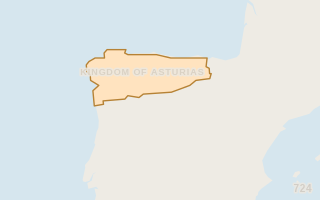
Its record opens in 718, replacing the Kingdom of Toledo.↓ In 724, the first year its borders are mapped, it covered 78,200 km².↓

Its ground peaked in 878 at 128,500 km².↓ Its line counts 13 rulers, covering 718 – 924, the median reign 11 years; 2 of 12 handovers were irregular.↓ The best known of them are Pelagius of Asturias, Alfonso III of Asturias and Alfonso II of Asturias.↓ Most of the 23 rows the atlas files under it are people.↓

The Kingdom of León and the Kingdom of Galicia replaced it in 924, after 206 years.↓

From Wikipedia’s article, retold · CC BY-SA 4.0

206 years

Longer than the Russian Empire, shorter than the Achaemenid Empire

129,000 km²

At its height in 878 · about the size of Eritrea

13 rulers

the Monarch of the Kingdom of Asturias

9 wars and battles

More per century than 88% of states · 23 entries in all

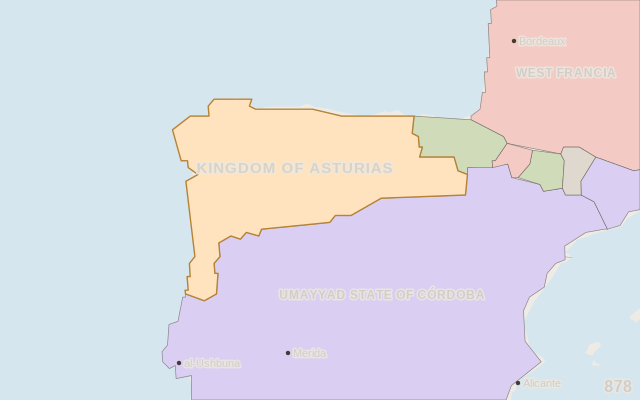
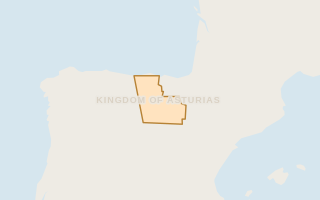
Map: Kingdom of Asturias in 878, its borders in gold among its neighbours
Battle of the Burbia River, 791Battle of Lutos, 794Battle of Pancorbo, 816Battle of Clavijo, 844750800850900
Beside it on the map in 878: Emirate of Córdoba, West Francia, County of Ribagorza, County of Urgell, County of Pallars and County of Aragon.How far it reached, year by year: its ground inside the borders Cliopatria draws (CC BY 4.0), measured on an equal-area grid; the map shows it at its largest, with the cities of the year.

The story

Four acts, 718 – 924

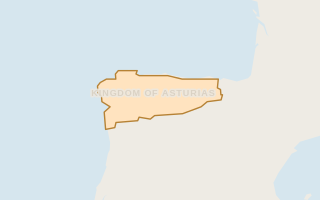
Kingdom of Asturias in 841, at the end of act II
II791 – 84278,600 → 123,000 km²

Alfonso II and Compostela

Recognised as king by Charlemagne and the Pope, Alfonso II conquers Galicia and the Basques. The bones of St James the Great are declared found at Compostela, and pilgrims link Asturias to the Carolingian lands. Muslim raids reach the capital, Oviedo, each summer from 792 to 794, but Alfonso routs one in the marshes of Lutos.

Watch this act on the live map, from 791
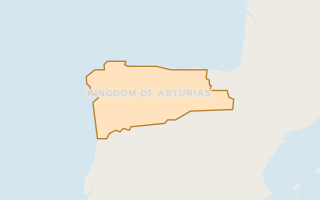
Kingdom of Asturias in 865, at the end of act III
III842 – 866123,000 → 123,000 km²

Ramiro I and the Vikings

On Alfonso II's death Ramiro I overthrows Nepotian, the Count of the Palace, who had taken the throne; Nepotian is caught, blinded and sent to a monastery. In 844 Ramiro routs a Viking raid at Farum Brecantium, burning their ships, and in 859 Count Pedro slaughters a second Viking fleet off Galicia.

Watch this act on the live map, from 842
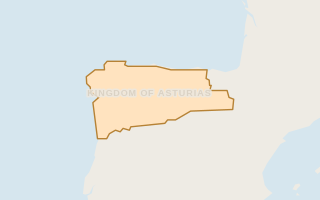
Kingdom of Asturias in 878, at its largestKingdom of Asturias in 724, first mapped
The rise and the fall in one frame: drag across it from 724, first mapped at 78,200 km², to 878, at its largest at 128,500 km². Open the live map in 724 or 878.

Before and after

Before it

  • Kingdom of Toledo · replaces

After it

Where it sits in time

3000 BCE2000 BCE1000 BCE110002000Kingdom of León: 910 – 1833Kingdom of Galicia: 910 – 1833Kingdom of Asturias: 718 – 924

Five thousand years, 3000 BCE to 2026; the state in gold, what it replaced or followed and what replaced or followed it in grey.

Its people

Lives across the Kingdom of Asturias

700750800850900950
Statesmen and generalsLived on after it endedAll its people on the timeline →

How it was governed

13 monarchs

13 monarchs on record, 718 to 924; a reign lasted 11 years at the median. Each bar is a reign, as long as it lasted.

Pelagius of Asturias · 718 – 737 · died in office, manner not recordedFavila of Asturias · 737 – 739 · died by accidentAlfonso I of Asturias · 739 – 757 · died in office, manner not recordedFruela I of Asturias · 757 – 768 · died in office, manner not recordedAurelius of Asturias · 768 – 774 · died in office, manner not recordedSilo of Asturias · 774 – 783 · died in office, manner not recordedMauregatus · 783 – 788 · died in office, manner not recordedBermudo I of Asturias · 788 – 791 · left office aliveAlfonso II of Asturias · 791 – 842 · died in office, manner not recordedRamiro I of Asturias · 842 – 850 · died in office, manner not recordedOrdoño I of Asturias · 850 – 866 · died in office of natural causesAlfonso III of Asturias · 866 – 910 · died in office, manner not recordedFruela II of Asturias · 910 – 924 · left office alive750800850900
How their terms ended, where it is known (13 of 13):Died in office 11Left office alive 2
Every term, with how it ended and its source

Rulers

How 13 reigns ended - choose one to show only those

How they died, where the record says: died of natural causes 2 · died by accident 1.

RulerReignLengthHow it ended · sourceTo the ruler before
8th century · 9 reigns
Pelagius of Asturias · aged 33718 – 73719 yearsdied in officeread off the dates alone
Favila of Asturias · aged 37737 – 7392 yearsdied by accidentWikidata's manner of deathdied by accidentchild
Alfonso I of Asturias · aged 34739 – 75718 yearsdied in officeread off the dates alone
Fruela I of Asturias · aged 35757 – 76811 yearsdied in officeread off the dates alonechild
Aurelius of Asturias · aged 28768 – 7746 yearsdied in officeread off the dates alone
Silo of Asturias774 – 7839 yearsdied in officeread off the dates alone
Mauregatus783 – 7885 yearsdied in officeread off the dates alone
Bermudo I of Asturias · aged 38788 – 7913 yearsleft office aliveread off the dates alone
Alfonso II of Asturias · aged 32791 – 84251 yearsdied in officeread off the dates alone
9th century · 3 reigns
Ramiro I of Asturias · aged 51842 – 8508 yearsdied in officeread off the dates alone
Ordoño I of Asturias · aged 29850 – 86616 yearsdied in officeWikidata's manner of deathdied of natural causeschild
Alfonso III of Asturias · aged 14866 – 91044 yearsdied in officeread off the dates alonechild
10th century · 1 reign
Fruela II of Asturias · aged 36910 – 92414 yearsleft office aliveread off the dates alonedied of natural causeschild

13 rulers, 13 with terms dated as terms, covering 718 – 924. Median reign 11 years. 2 of 12 handovers irregular - a killing, a deposition, a rival claimant, a rising or a coup beside it. A blank in the last column means no kin on record, which is coverage, never “unrelated”.

Flags and arms, in order

  • Cruz de Asturias
    coat of arms, undatedCruz de Asturias · Public domain
  • Royal flag of Ramiro I of Asturies
    flag, from 842Royal flag of Ramiro I of Asturies · Public domain

Its world

Rivals, and who else stood

Who it fought most

Wars and battles both took part in, on whichever side: the record names who took part, not who fought whom.

Meanwhile, elsewhere

The best-known states of other regions that stood while it did; the band is the Kingdom of Asturias’s own years.

700750800850900950

How it compares

Among 3,073 states

Stood longer than 63% of 3,073 states
Kingdom of Asturias · 206 yearsRussian EmpireAchaemenid EmpireHow long it stood, among the states with a recorded end or still standing.
Held more ground at its peak than 51% of 1,464 states
Kingdom of Asturias · 128,500 km²EritreaTajikistanThe most ground it held, among the states with a border in Cliopatria.
Had more wars on record per century than 88% of 3,073 states
Kingdom of Asturias · 0.5Wars recorded per century, among the states, counting the wars the atlas hosts under each.

Why it fell

Why did the Kingdom of Asturias fall?

Historians still argue. Here is what the atlas records about its last century:

÷2.7

its land, between 824 and 923

What led to it, and what came of it

Kingdom of Toledo · Linked · 549 – 711Kingdom of ToledoKingdom of Asturias · 718 – 924Kingdom of AsturiasKingdom of León · Linked · 910 – 1833Kingdom of LeónKingdom of Galicia · Linked · 910 – 1833Kingdom of Galicia50010001500
linked

Open the investigation: every row with its evidence, the conditions at the time, the theories condition by condition, and the succession analysed.

Its centuries in the record

700 – 799: 14 recorded — 5 wars and battles, 0 risings, regime changes and massacres, 9 other700800 – 899: 7 recorded — 4 wars and battles, 0 risings, regime changes and massacres, 3 other800900 – 999: 1 recorded — 0 wars and battles, 0 risings, regime changes and massacres, 1 other900

Wars and battles in red, risings, coups and massacres beside them, everything else in grey, by the century each began in. A tall bar is partly a fact about Wikipedia: better-documented centuries hold more.

Each century’s own page:700 – 799800 – 899900 – 999

Keep exploring

Share this page
Copy link
Embed the map
Cite this page

How this page is made

Drawn from Wikidata (Q231392, CC0), the opening and history of its English Wikipedia article retold by the atlas (CC BY-SA 4.0), borders from Cliopatria (CC BY 4.0), coast and rivers from Natural Earth, cities from Reba, Reitsma & Seto 2016 (CC BY 4.0), symbols from Wikimedia Commons, each under its own licence. Data built 2026-11-26 · Pastlas v2.47.1, by Oleh Voronko; the published atlas and its data are for non-commercial use.

How to read it

Areas are measured on an equal-area grid from borders simplified to about five kilometres. “c.” marks an approximate date, and a date known to the century is never printed to the year. Counts are what the atlas holds, and they follow Wikipedia’s coverage: a busy century is partly a fact about the record.

  • ends in 910 and 924; the atlas draws the article's infobox.

Something wrong?

Tell us and name the entry. We fix the data, not just this page.

Report a problem