State · Middle East and North Africa

Lebanon

1943 – present · 83 years · still standing

Came after French Mandate for Syria and the Lebanon and Lebanese Republic under French mandate

A small Levantine republic built on a balance of religious communities, shattered by civil war and repeatedly caught in wars with Israel.

Lebanon is a small republic on the Levantine coast between Syria and Israel, with Beirut as its capital. Once part of Phoenicia, then of the Roman Empire, Arab caliphates and the Ottoman Empire, it won independence from Free France by 1943 under a confessional system dividing power among its religious groups. Relative stability ended in the civil war of 1975–1990; Syria and Israel both occupied it, and Israel has invaded four times since 1978.

What the record holds

Lebanon began in 1943, replacing the French Mandate for Syria and the Lebanon and the Lebanese Republic under French mandate.↓ When the borders dataset first draws it, in 1944, it held 9,800 km².↓ The 1948 Palestine war, 1947 – 1949, began with it holding 9,900 km² and ended with 9,800 km².↓

It reached its greatest extent in 1946: 9,900 km².↓ The record names 20 rulers in its line, covering 1936 – 2025, the median reign 6 years; 3 of 20 handovers were irregular.↓ The best known of them are Michel Aoun, Michel Suleiman and Joseph Aoun.↓ Most of the 119 rows the atlas files under it are people.↓

From Wikipedia’s article, retold · CC BY-SA 4.0

83 years

Longer than the Western Roman Empire, shorter than the Kingdom of Italy

9,900 km²

At its height in 1946 · about the size of Cape Verde

20 rulers

the President of Lebanon

30 wars and battles

More per century than 99% of states · 119 entries in all

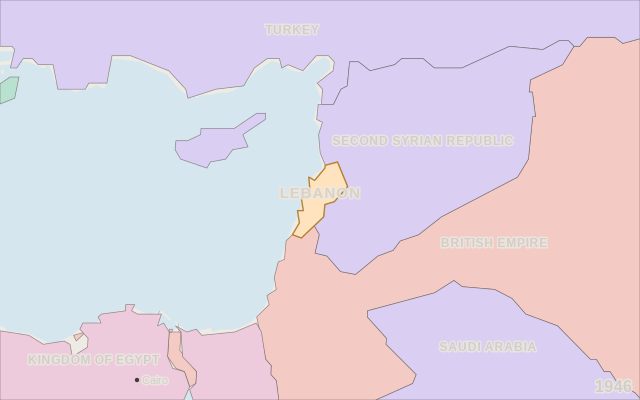
Map: Lebanon in 1946, its borders in gold among its neighbours
Lebanese Civil War, 1975 – 1990Sabra and Shatila massacre, 1982Israeli–Lebanese conflict, 20001960198020002020
Beside it on the map in 1946: British Empire, Turkey, Second Syrian Republic, Saudi Arabia, Kingdom of Egypt and United Kingdom.How far it reached, year by year: its ground inside the borders Cliopatria draws (CC BY 4.0), measured on an equal-area grid; the map shows it at its largest, with the cities of the year.

The story

Four acts, 1943 – present

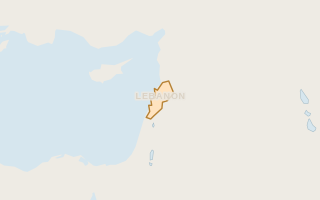
Lebanon in 1974, at the end of act I
I1943 – 1975

Independence and a fragile balance

The new state shares power among its religious communities and stays relatively stable through the 1948 Palestine war and the crisis of 1958. Driven from Jordan, Palestinian militants move to Lebanon in 1970 and step up attacks on Israel, setting Palestinians against Maronites and other Lebanese factions.

Watch this act on the live map, from 1943
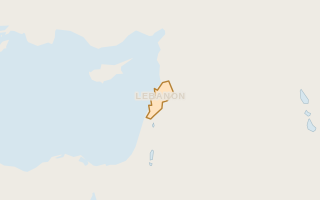
Lebanon in 1989, at the end of act II
II1975 – 19909,800 → 9,800 km²

Civil war and occupation

Civil war breaks out in 1975: a Christian coalition against the PLO and left-wing Druze and Muslim militias. The Arab League sends a mainly Syrian force in 1976 to restore calm, and Syria stays until 2005. Israel invades in 1978; 1982 brings the siege of Beirut and the Sabra and Shatila massacre, and from 1985 Israel occupies the south.

Watch this act on the live map, from 1975
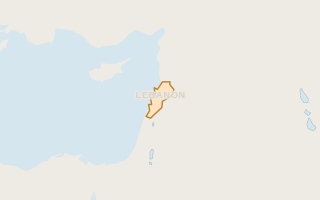
Lebanon in 2018, at the end of act III
III1990 – 20199,800 → 9,700 km²

Occupations end, wars go on

Israel leaves in 2000 and Syria in 2005, the year of the Cedar Revolution. On 12 July 2006 Hezbollah raids Israel, killing three soldiers and seizing two; Israel answers with air strikes and a ground invasion, and UN Resolution 1701 ends the war on 14 August. The Syrian war spills over from 2011.

Watch this act on the live map, from 1990
IV2019 – present

National crisis

Protests begin on 17 October 2019 over planned taxes on fuel, tobacco and WhatsApp calls, then widen into an outcry against sectarian rule and corruption; Saad Hariri resigns. A liquidity crisis and the 2020 Beirut explosion help sink the currency, in a collapse the World Bank ranks among the worst since the 19th century. Israel invades a fourth time.

Watch this act on the live map, from 2019

Before and after

Before it

Where it sits in time

3000 BCE2000 BCE1000 BCE110002000French Mandate for Syria and the Lebanon: 1923 – 1946Lebanon: 1943 – 2026

Five thousand years, 3000 BCE to 2026; the state in gold, what it replaced or followed and what replaced or followed it in grey.

Its people

Lives across Lebanon

19401960198020002020
Statesmen and generalsWriters, artists and thinkersAll its people on the timeline →

How it was governed

20 presidents

20 presidents on record, 1936 to 2025; a reign lasted 6 years at the median. Each bar is a reign, as long as it lasted.

Émile Eddé · 1936 – 1941 · left office aliveAlfred Naqqache · 1941 – 1943 · left office aliveÉmile Eddé · 1943 – 1943 · left office aliveAyoub Tabet · 1943 – 1943 · left office alivePetro Trad · 1943 – 1943 · left office aliveBechara El Khoury · 1943 – 1952 · left office aliveCamille Chamoun · 1952 – 1958 · left office aliveFouad Chehab · 1958 – 1964 · left office aliveCharles Helou · 1964 – 1970 · left office aliveSuleiman Frangieh · 1970 – 1976 · left office aliveÉlias Sarkis · 1976 – 1982 · left office aliveAmine Gemayel · 1982 – 1988 · no death date to read the end againstMichel Aoun · 1988 – 1990 · no death date to read the end againstRené Moawad · 1989 – 1989 · killedElias Hrawi · 1989 – 1998 · left office aliveÉmile Lahoud · 1998 – 2007 · no death date to read the end againstFouad Siniora · 2007 – 2008 · no death date to read the end againstMichel Suleiman · 2008 – 2014 · no death date to read the end againstTammam Salam · 2014 – 2016 · no death date to read the end againstMichel Aoun · 2016 – 2022 · no death date to read the end againstJoseph Aoun · 2025 – … · still in office1960198020002020
a second row: a reign that began before the last had ended — rival claimants, or a shared throne
How their terms ended, where it is known (14 of 21):Killed 1Left office alive 12In office 1Not on record 7
Every term, with how it ended and its source

Rulers

How 21 reigns ended - choose one to show only those

How they died, where the record says: died of natural causes 3 · killed 1.

RulerReignLengthHow it ended · sourceTo the ruler before
20th century · 16 reigns · 1 killed or removed
Émile Eddé · aged 531936 – 19415 yearsleft office aliveread off the dates alone
Alfred Naqqache · aged 541941 – 19432 yearsleft office aliveread off the dates alone
Émile Eddé · aged 601943 – 1943under a yearleft office aliveread off the dates alone
Ayoub Tabet · aged 691943 – 1943under a yearleft office aliveread off the dates alone
Petro Trad · aged 671943 – 1943under a yearleft office aliveread off the dates alone
Bechara El Khoury · aged 531943 – 19529 yearsleft office aliveread off the dates alone
Camille Chamoun · aged 521952 – 19586 yearsleft office aliveread off the dates alone
Fouad Chehab · aged 561958 – 19646 yearsleft office aliveread off the dates alone
Charles Helou · aged 511964 – 19706 yearsleft office aliveread off the dates alonedied of natural causes
Suleiman Frangieh · aged 601970 – 19766 yearsleft office aliveread off the dates alone
Élias Sarkis · aged 521976 – 19826 yearsleft office aliveread off the dates alonedied of natural causes
Amine Gemayel · aged 401982 – 19886 yearsending not on record
Michel Aoun · aged 551988 – 19902 yearsending not on record
René Moawad · aged 641989 – 1989under a yearkilled in officeWikidata's manner of death
Elias Hrawi · aged 631989 – 19989 yearsleft office aliveread off the dates alonedied of natural causes
Émile Lahoud · aged 621998 – 20079 yearsending not on record
21st century · 5 reigns
Fouad Siniora · aged 642007 – 20081 yearending not on record
Michel Suleiman · aged 602008 – 20146 yearsending not on record
Tammam Salam · aged 692014 – 20162 yearsending not on record
Michel Aoun · aged 832016 – 20226 yearsending not on record
Joseph Aoun · aged 612025 – in officein office since 2025still in office

20 rulers, 19 with terms dated as terms, covering 1936 – 2025. Median reign 6 years. 3 of 20 handovers irregular - a killing, a deposition, a rival claimant, a rising or a coup beside it. The violent-handover count is withheld: power changed hands so often that any rising falls beside one (exposure 0.92, limit 0.6). A blank in the last column means no kin on record, which is coverage, never “unrelated”.

Heads of government

The line of Prime Minister of Lebanon, drawn and never measured: a cabinet is not a reign.

Abdallah Beyhumlived 1879 – 1962
Sami Solhlived 1887 – 1968
Abdul Hamid Karamilived 1890 – 1950
Saadi Al Munlalived 1890 – 1975
Ahmad Daouklived 1892 – 1979
Khaled Chehablived 1892 – 1978
Khayreddin al-Ahdablived 1894 – 1941
Nureddine El-Rifailived 1899 – 1980
Hussein Al Oweinilived 1900 – 1971
Khalil al-Hibrilived 1904 – 1979
Saeb Salamlived 1905 – 2000
Abderrahman El Kouchlived 1913 – 1980
Abdallah El-Yafi1938 – 1939
Alfred Naqqache1941 – 1941
Ayoub Tabet1943 – 1943
Petro Trad1943 – 1943
Riad Al Solh1943 – 1945
Riad Al Solh1946 – 1951
Abdallah El-Yafi1952 – 1952
Nazem Akkari1952 – 1952
Rashid Karami1955 – 1956
Abdallah El-Yafi1956 – 1958
Rashid Karami1958 – 1960
Rashid Karami1961 – 1964
Rashid Karami1965 – 1966
Abdallah El-Yafi1966 – 1966
Abdallah El-Yafi1968 – 1969
Rashid Karami1969 – 1970
Takieddin el-Solh1973 – 1974
Amin al-Hafez (Lebanon)1973 – 1973
Rachid Solh1974 – 1975
Rashid Karami1975 – 1976
Salim Al-Huss1976 – 1980
Shafik Wazzan1980 – 1984
Rashid Karami1984 – 1987
Salim Al-Huss1987 – 1990
Michel Aoun1988 – 1990
Omar Karami1990 – 1992
Rafic Hariri1992 – 1998
Rachid Solh1992 – 1992
Salim Al-Huss1998 – 2000
Rafic Hariri2000 – 2004
Omar Karami2004 – 2005
Fouad Siniora2005 – 2009
Najib Mikati2005 – 2005
Saad Hariri2009 – 2011
Najib Mikati2011 – 2014
Tammam Salam2014 – 2016
Saad Hariri2016 – 2019
Hassan Diab2020 – 2021
Najib Mikati2021 – 2025
Nawaf Salam2025 – …

Flags and arms, in order

  • Flag of Lebanon
    flag, from 1943Flag of Lebanon · Public domain
  • Coat of arms of Lebanon
    coat of arms, from 1991Coat of arms of Lebanon · CC BY-SA 3.0 · Zscout370

Its world

Rivals, and who else stood

Who it fought most

Wars and battles both took part in, on whichever side: the record names who took part, not who fought whom.

Meanwhile, elsewhere

The best-known states of other regions that stood while it did; the band is Lebanon’s own years.

19401960198020002020

How it compares

Among 3,073 states

Stood longer than 43% of 3,073 states
Lebanon · 83 yearsWestern Roman EmpireKingdom of ItalyHow long it stood, among the states with a recorded end or still standing.
Held more ground at its peak than 14% of 1,464 states
Lebanon · 9,900 km²Cape VerdeThe GambiaThe most ground it held, among the states with a border in Cliopatria.
Had more wars on record per century than 99% of 3,073 states
Lebanon · 15.0Wars recorded per century, among the states, counting the wars the atlas hosts under each.

How it began

How did Lebanon begin?

What led to it, and what came of it

French Mandate for Syria and the Lebanon · Linked · 1923 – 1946French Mandate for Syria and the…Lebanese Republic under French mandate · Linked · 1926 – 1943Lebanese Republic under French m…Règlement Organique · In the article · 1860 · “Shortly afterwards, the Emirate of Mount Lebanon, which lasted about 400 years, was replaced by the Mount Lebanon Mutasarrifate, as a result of a European-Ott…”Règlement OrganiqueMurad IV · In the article · 1612 · “Expanding his influence extensively, he even constructed a fort in Palmyra. This expansion raised concerns for Ottoman Sultan Murad IV, leading to a punitive …”Murad IVWorld War II · In the article · 1939 · “Following the end of World War II in Europe the French mandate may be said to have been terminated without any formal action on the part of the League of Nati…”World War IIAhmad Nami · Coincidence · 1873 – 1962Ahmad NamiLebanon · 1943 – 2026Lebanon16001700180019002000
in the articlelinkedcoincidence

Open the investigation: every row with its evidence, the conditions at the time, the theories condition by condition, and the succession analysed.

Its centuries in the record

1900 – 1999: 81 recorded — 15 wars and battles, 10 risings, regime changes and massacres, 56 other19002000 – 2099: 24 recorded — 15 wars and battles, 8 risings, regime changes and massacres, 1 other2000

Wars and battles in red, risings, coups and massacres beside them, everything else in grey, by the century each began in. A tall bar is partly a fact about Wikipedia: better-documented centuries hold more.

Each century’s own page:1900 – 19992000 – 2099

Keep exploring

Share this page
Copy link
Embed the map
Cite this page

How this page is made

Drawn from Wikidata (Q822, CC0), the opening and history of its English Wikipedia article retold by the atlas (CC BY-SA 4.0), borders from Cliopatria (CC BY 4.0), coast and rivers from Natural Earth, cities from Reba, Reitsma & Seto 2016 (CC BY 4.0), symbols from Wikimedia Commons, each under its own licence. Data built 2026-11-26 · Pastlas v2.47.1, by Oleh Voronko; the published atlas and its data are for non-commercial use.

How to read it

Areas are measured on an equal-area grid from borders simplified to about five kilometres. “c.” marks an approximate date, and a date known to the century is never printed to the year. Counts are what the atlas holds, and they follow Wikipedia’s coverage: a busy century is partly a fact about the record.

  • Still standing: the span runs to the year of the build, 2026.

Something wrong?

Tell us and name the entry. We fix the data, not just this page.

Report a problem