State · Middle East and North Africa

Ilkhanate

1256 – 1335 · 79 years

Came after Abbasid Caliphate

Hülegü's Mongol khanate, which called its realm the Land of Iran and cast its khans as heirs to the Sasanian Empire.

The Ilkhanate was the Mongol khanate founded by Hülegü, a grandson of Genghis Khan through Tolui, who took the empire's West Asian lands after his brother Möngke died in 1259. Centred on today's Iran, Azerbaijan and Turkey, it styled itself the Land of Iran, and from Ghazan's reign in 1295 its khans followed Islam. When the last ilkhan, Abu Sa'id, died in 1335, it broke apart.

What the record holds

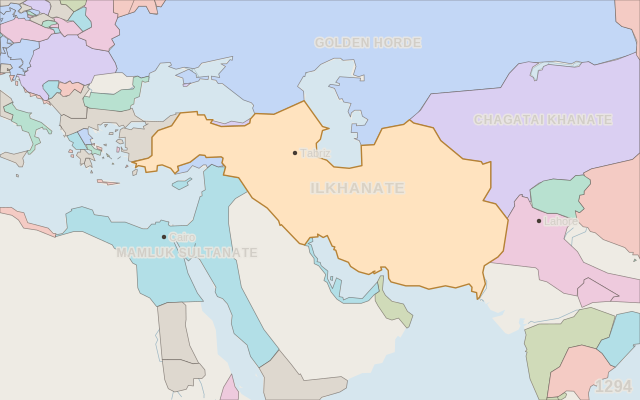
Its record opens in 1256, after the Abbasid Caliphate.↓ In 1294, the first year its borders are mapped, it covered 3.94 million km².↓

The record names 12 rulers in its line, covering 1265 – 1344, the median reign 4.5 years; 4 of 11 handovers were irregular.↓ The best known of them are Ghazan I, Abaqa Khan and Arghun.↓ Most of the 13 rows the atlas files under it are people.↓ Its record closes in 1335, after 79 years.↑

From Wikipedia’s article, retold · CC BY-SA 4.0

79 years

Longer than Yugoslavia, shorter than the Western Roman Empire

3.94 million km²

At its height in 1294 · a little larger than India

12 rulers

the khan

2 wars and battles

More per century than 92% of states · 13 entries in all

Map: Ilkhanate in 1294, its borders in gold among its neighbours
1300131013201330
Beside it on the map in 1294: Golden Horde, Chagatai Khanate, Mamluk Sultanate, Khalji dynasty, Yuan dynasty and Seuna (Yadava) dynasty.How far it reached, year by year: its ground inside the borders Cliopatria draws (CC BY 4.0), measured on an equal-area grid; the map shows it at its largest, with the cities of the year.

The story

Four acts, 1256 – 1335

I1256 – 1265

Hülegü takes the west

Sent by his brother Möngke with a fifth of the Mongol army to conquer the Abbasid Caliphate, Hülegü, grandson of Genghis Khan, brings his sons Abaqa and Yoshmut and many Chinese scholars. When Möngke dies in 1259, Hülegü inherits the empire's West and Central Asian lands and rules them as the first khan.

Watch this act on the live map, from 1256
II1265 – 1291

Wars on every frontier

Abaqa succeeds and must at once face Berke of the Golden Horde, whose invasion ends only with his death. He drives off the Chagatai Khanate in 1270, but the Mamluks beat the Mongols at Elbistan in 1277 and at Homs in 1281. Abaqa's death in 1282 pits his son Arghun against his brother Tekuder.

Watch this act on the live map, from 1265
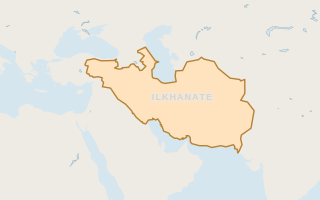
Ilkhanate in 1315, at the end of act III
III1291 – 1316

Ghazan and the turn to Islam

Under Gaykhatu the realm starts to crumble: he buys support and ruins the finances, and his vizir's paper money, copied from the Yuan dynasty, fails. Overthrown in 1295, he gives way to his cousin Baydu, who within a year falls to Gaykhatu's officer Ghazan. Ghazan brings the throne to Islam, which most Mongols had already embraced, and Öljaitü succeeds him.

Watch this act on the live map, from 1291
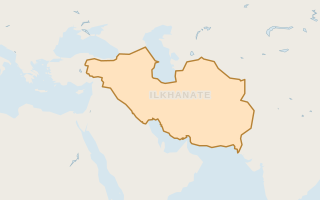
Ilkhanate in 1334, at the end of act IV
IV1316 – 13353.71 million → 3.58 million km²

Abu Sa'id and the break-up

Öljaitü's son Abu Sa'id, the last ilkhan, is enthroned in 1316 and meets rebellion in Khorasan, a Golden Horde invasion and an Anatolian emir's revolt, which Chupan crushes in 1319. Under Chupan's sway the realm makes peace with the Chagatais and the Mamluks, but in 1327 Abu Sa'id replaces him. The Black Death ravages the Ilkhanate in the 1330s.

Watch this act on the live map, from 1316

Before and after

Before it

Where it sits in time

3000 BCE2000 BCE1000 BCE110002000Abbasid Caliphate: 750 – 1258Ilkhanate: 1256 – 1335

Five thousand years, 3000 BCE to 2026; the state in gold, what it replaced or followed and what replaced or followed it in grey.

Its people

Lives across Ilkhanate

12401260128013001320
Statesmen and generalsAll its people on the timeline →

How it was governed

12 khans

12 khans on record, 1265 to 1344; a reign lasted 4.5 years at the median. Each bar is a reign, as long as it lasted.

Abaqa Khan · 1265 – 1282 · died in office, manner not recordedArghun · 1284 – 1291 · executedGaykhatu · 1291 – 1295 · killedBaydu · 1295 – 1295 · killed, the article saysGhazan I · 1295 – 1304 · died in office, manner not recordedÖljaitü · 1304 – 1316 · died in office, manner not recordedAbu Sa'id Bahadur Khan · 1316 – 1335 · died in office of natural causesArpa Ke'un · 1335 – 1336 · died in office, manner not recordedMusa · 1336 – 1336 · exiled, imprisoned or confined, the article saysMuhammad Khan (Ilkhan) · 1336 – 1338 · left office aliveTogha Temür · 1338 – 1339 · left office aliveSuleiman Khan · 1339 – 1344 · left office alive1260128013001320
How their terms ended, where it is known (12 of 12):Killed 3Deposed or removed 1Died in office 5Left office alive 3
Every term, with how it ended and its source

Rulers

How 12 reigns ended - choose one to show only those

How they died, where the record says: executed 1 · killed 1 · died of natural causes 1.

RulerReignLengthHow it ended · sourceTo the ruler before
13th century · 5 reigns · 3 killed or removed
Abaqa Khan · aged 311265 – 128217 yearsdied in officeread off the dates alone
Arghun · aged 261284 – 12917 yearsexecutedWikidata's manner of deathchild
Gaykhatu · aged 321291 – 12954 yearskilled in officeWikidata's manner of deathsibling
Baydu1295 – 1295under a yearkilledread from the ruler's own article
Ghazan I · aged 241295 – 13049 yearsdied in officeread off the dates alone
14th century · 7 reigns · 1 killed or removed
Öljaitü · aged 241304 – 131612 yearsdied in officeread off the dates alonesibling
Abu Sa'id Bahadur Khan · aged 111316 – 133519 yearsdied in officeWikidata's manner of deathdied of natural causeschild
Arpa Ke'un1335 – 13361 yeardied in officeread off the dates alone
Musa1336 – 1336under a yearexiledread from the ruler's own article
Muhammad Khan (Ilkhan)1336 – 13382 yearsleft office aliveread off the dates alone
Togha Temür1338 – 13391 yearleft office aliveread off the dates alone
Suleiman Khan1339 – 13445 yearsleft office aliveread off the dates alone

12 rulers, 12 with terms dated as terms, covering 1265 – 1344. Median reign 4.5 years. 4 of 11 handovers irregular - a killing, a deposition, a rival claimant, a rising or a coup beside it. A blank in the last column means no kin on record, which is coverage, never “unrelated”.

Flag or arms

  • Flag of Ilkhanate
    flag, undatedFlag of Ilkhanate · Public domain

Its world

Rivals, and who else stood

Who it fought most

Wars and battles both took part in, on whichever side: the record names who took part, not who fought whom.

Meanwhile, elsewhere

The best-known states of other regions that stood while it did; the band is Ilkhanate’s own years.

12601280130013201340

How it compares

Among 3,073 states

Stood longer than 42% of 3,073 states
Ilkhanate · 79 yearsYugoslaviaWestern Roman EmpireHow long it stood, among the states with a recorded end or still standing.
Held more ground at its peak than 96% of 1,464 states
Ilkhanate · 3,942,100 km²IndiaAustraliaThe most ground it held, among the states with a border in Cliopatria.
Had more wars on record per century than 92% of 3,073 states
Ilkhanate · 1.0Wars recorded per century, among the states, counting the wars the atlas hosts under each.

Why it fell

Why did Ilkhanate fall?

Historians still argue. Here is what the atlas records about its last century:

1

wars and battles in its last century

1336

Musa, deposed or removed in office

What led to it, and what came of it

Abbasid Caliphate · Linked · 750 – 1258Abbasid CaliphateAnushtegin dynasty · In the article · 1077 · “When Muhammad II of Khwarazm ordered a contingent of merchants, dispatched by the Mongols, to be killed, Genghis Khan declared war on the Anushtegin dynasty i…”Anushtegin dynastyNasir al-Din al-Tusi · Coincidence · 1201 – 1274Nasir al-Din al-TusiHulegu Khan · Coincidence · 1217 – 1265Hulegu KhanAl-Adil Kitbugha · Coincidence · 1245 – 1303Al-Adil KitbughaRashid al-Din Hamadani · Coincidence · 1247 – 1318Rashid al-Din HamadaniIlkhanate · 1256 – 1335Ilkhanate80010001200
in the articlelinkedcoincidence

Open the investigation: every row with its evidence, the conditions at the time, the theories condition by condition, and the succession analysed.

Its centuries in the record

1200 – 1299: 10 recorded — 1 wars and battles, 0 risings, regime changes and massacres, 9 other12001300 – 1399: 3 recorded — 1 wars and battles, 0 risings, regime changes and massacres, 2 other1300

Wars and battles in red, risings, coups and massacres beside them, everything else in grey, by the century each began in. A tall bar is partly a fact about Wikipedia: better-documented centuries hold more.

Each century’s own page:1200 – 12991300 – 1399

Keep exploring

Share this page
Copy link
Embed the map
Cite this page

How this page is made

Drawn from Wikidata (Q178084, CC0), the opening and history of its English Wikipedia article retold by the atlas (CC BY-SA 4.0), borders from Cliopatria (CC BY 4.0), coast and rivers from Natural Earth, cities from Reba, Reitsma & Seto 2016 (CC BY 4.0), symbols from Wikimedia Commons, each under its own licence. Data built 2026-11-26 · Pastlas v2.47.1, by Oleh Voronko; the published atlas and its data are for non-commercial use.

How to read it

Areas are measured on an equal-area grid from borders simplified to about five kilometres. “c.” marks an approximate date, and a date known to the century is never printed to the year. Counts are what the atlas holds, and they follow Wikipedia’s coverage: a busy century is partly a fact about the record.

Something wrong?

Tell us and name the entry. We fix the data, not just this page.

Report a problem