State · Middle East and North Africa

Georgian Soviet Socialist Republic

1921 – 1991 · 70 years

Came after Transcaucasian Socialist Federative Soviet Republic and Socialist Soviet Republic of Georgia · became Georgia

Georgia as a republic of the Soviet Union, from Red Army occupation through the Great Purges to independence before the Union dissolved.

The Georgian Soviet Socialist Republic was a republic of the Soviet Union from the Red Army's occupation in 1921 until 1991. It covered present-day Georgia, Abkhazia and South Ossetia included, and until 1936 formed part of the Transcaucasian federation with the Azerbaijan SSR and the Armenian SSR. It declared sovereignty over Soviet laws in 1989, took the name Republic of Georgia in 1990 and was independent before the Soviet Union dissolved.

What the record holds

It was founded in 1921, replacing the Transcaucasian Socialist Federative Soviet Republic.↓ Its line counts 2 rulers, covering 1921 – 1990, the median reign 1 year; its one handover was regular.↓ Among them, Mamia Orakhelashvili and Givi Gumbaridze are the best known.↓ It was replaced by Georgia in 1991, 70 years after it began.↓

From Wikipedia’s article, retold · CC BY-SA 4.0

70 years

Longer than the Soviet Union, shorter than the Azerbaijan Soviet Socialist Republic

2 rulers

the First Secretary

Its borders aren’t on record

The borders dataset does not draw the Georgian Soviet Socialist Republic. The live map still shows where it stood among the states of its years.

Find it on the live map

The story

Four acts, 1921 – 1991

I1921 – 1936

Within the Transcaucasian federation

The Red Army ends the Democratic Republic of Georgia, and a Soviet republic takes its place, joining the Soviet Union in 1922. It belongs to the Transcaucasian SFSR, beside the Azerbaijan SSR and the Armenian SSR, and Lavrentiy Beria leads its Communist Party as first secretary.

Watch this act on the live map, from 1921
II1936 – 1956

Purges and war

The federation is dissolved in 1936. In the Great Purges eminent writers, scholars and Bolsheviks such as Mamia Orakhelashvili are executed or sent to the Gulag. In World War II the Axis never reaches Georgia, which sends great numbers of fighters to the Red Army and supplies textiles and munitions.

Watch this act on the live map, from 1936
III1956 – 1985

After Stalin

In 1956 about a hundred Georgian students are killed while protesting against Khrushchev's de-Stalinization. Local party officials use his decentralisation to build their own power bases, and a thriving shadow economy grows beside the state-owned one.

Watch this act on the live map, from 1956
IV1985 – 1991

Toward independence

When Shevardnadze becomes Soviet Foreign Minister in 1985, the weak Jumber Patiashvili replaces him. Clashes grow between the authorities, Georgian nationalists and minority movements, above all in South Ossetia. In April 1989 Soviet troops kill twenty at a peaceful demonstration in Tbilisi, and Georgian politics turns radical.

Watch this act on the live map, from 1985

Before and after

Before it

After it

  • Georgia · replaced by · 1991 – present

Where it sits in time

3000 BCE2000 BCE1000 BCE110002000Transcaucasian Socialist Federative Soviet Republic: 1922 – 1936Georgia: 1991 – 2026Georgian Soviet Socialist Republic: 1921 – 1991

Five thousand years, 3000 BCE to 2026; the state in gold, what it replaced or followed and what replaced or followed it in grey.

How it was governed

2 secretaries

2 secretaries on record, 1921 to 1990; a reign lasted 1 years at the median. Each bar is a reign, as long as it lasted.

Mamia Orakhelashvili · 1921 – 1922 · no death date to read the end againstGivi Gumbaridze · 1989 – 1990 · no death date to read the end against194019601980
How their terms ended, where it is known (0 of 2):Not on record 2
Every term, with how it ended and its source

Rulers

RulerReignLengthHow it ended · sourceTo the ruler before
20th century · 2 reigns
Mamia Orakhelashvili1921 – 19221 yearending not on record
Givi Gumbaridze1989 – 19901 yearending not on record

2 rulers, 2 with terms dated as terms, covering 1921 – 1990. Median reign 1 years. 0 of 1 handovers irregular - a killing, a deposition, a rival claimant, a rising or a coup beside it. A blank in the last column means no kin on record, which is coverage, never “unrelated”.

Flags and arms, in order

  • Flag of the Georgian Soviet Socialist Republic (1922–1937)
    flag, to 1937Flag of the Georgian Soviet Socialist Republic (1922–1937) · CC BY-SA 3.0 · Zscout370
  • Emblem of the Georgian SSR (1921-1937)
    coat of arms, 1921 – 1937Emblem of the Georgian SSR (1921-1937) · Public domain
  • Flag of the Georgian Soviet Socialist Republic (1937–1951)
    flag, 1937 – 1951Flag of the Georgian Soviet Socialist Republic (1937–1951) · CC BY-SA 3.0 · Дмитрий-5-Аверин
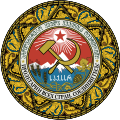
  • Emblem of the Georgian SSR (1937-1981)
    coat of arms, 1937 – 1981Emblem of the Georgian SSR (1937-1981) · Public domain
  • Flag of the Georgian Soviet Socialist Republic (1951–1990)
    flag, 1951 – 1990Flag of the Georgian Soviet Socialist Republic (1951–1990) · Public domain
  • Emblem of the Georgian SSR
    coat of arms, 1981 – 1990Emblem of the Georgian SSR · Public domain

Its world

Who else stood

Meanwhile, elsewhere

The best-known states of other regions that stood while it did; the band is the Georgian Soviet Socialist Republic’s own years.

19201940196019802000

How it compares

Among 3,073 states

Stood longer than 39% of 3,073 states
Georgian Soviet Socialist Republic · 70 yearsSoviet UnionAzerbaijan Soviet Socialist RepublicHow long it stood, among the states with a recorded end or still standing.

Why it fell

Why did the Georgian Soviet Socialist Republic fall?

Historians still argue. Here is what the atlas records about its last century:

How it ended, as its article says

Replaced, 1990-11-14. Read from the article's section “lead” by its grammar; the claim is only that the article says so.

The republic was renamed the Republic of Georgia on November 14, 1990, and subsequently became independent before the dissolution of the Soviet Union on April 9, 1991, whereupon each former SSR became a sovereign state.

One sentence of the English Wikipedia article, CC BY-SA 4.0.

What led to it, and what came of it

Transcaucasian Socialist Federative Soviet Republic · Linked · 1922 – 1936Transcaucasian Socialist Federat…Socialist Soviet Republic of Georgia · Linked · 1921 – 1936Socialist Soviet Republic of Geo…Ivane Javakhishvili · Coincidence · 1876 – 1940Ivane JavakhishviliAlexander Svanidze · Coincidence · 1886 – 1941Alexander SvanidzeGeorgian Soviet Socialist Republic · 1921 – 1991Georgian Soviet Socialist RepublicGeorgia · Linked · 1991 – 2026Georgia190019502000
linkedcoincidence

Open the investigation: every row with its evidence, the conditions at the time, the theories condition by condition, and the succession analysed.

In the record

2 entries the atlas files under it, all in 1900 – 1999.

Keep exploring

Share this page
Copy link
Cite this page

How this page is made

Drawn from Wikidata (Q130229, CC0), the opening and history of its English Wikipedia article retold by the atlas (CC BY-SA 4.0), symbols from Wikimedia Commons, each under its own licence, and one sentence of the article, quoted. Data built 2026-11-26 · Pastlas v2.47.1, by Oleh Voronko; the published atlas and its data are for non-commercial use.

How to read it

Areas are measured on an equal-area grid from borders simplified to about five kilometres. “c.” marks an approximate date, and a date known to the century is never printed to the year. Counts are what the atlas holds, and they follow Wikipedia’s coverage: a busy century is partly a fact about the record.

  • Wikidata's English label: Georgian SSR.

Something wrong?

Tell us and name the entry. We fix the data, not just this page.

Report a problem