State · East and Southeast Asia

Ming dynasty

1368 – 1644 · 276 years

Came after Mongol Empire and Yuan dynasty · became Qing dynasty and Southern Ming

China's last Han-ruled imperial dynasty, remembered for the Forbidden City, the Great Wall in its modern form and Zheng He's voyages.

The Ming dynasty ruled China from 1368 to 1644, after the fall of the Mongol-led Yuan, and was the last imperial house of China drawn from the Han people. Its founder, the Hongwu Emperor, kept a standing army above a million men; the Yongle Emperor moved the capital to Beijing, built the Forbidden City and sent Zheng He's fleets as far as Arabia and Africa. In 1644 Beijing fell to Li Zicheng's rebels.

What the record holds

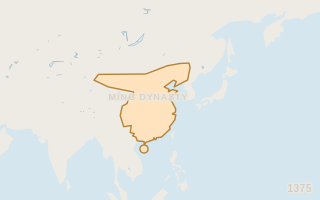
Its record opens in 1368, replacing the Mongol Empire and the Yuan dynasty.↓ When the borders dataset first draws it, in 1375, it held 4.55 million km².↓ Between the start and the end of the Jingnan campaign, 1399 – 1402, it went from 4.94 million km² to 5.45 million km².↓

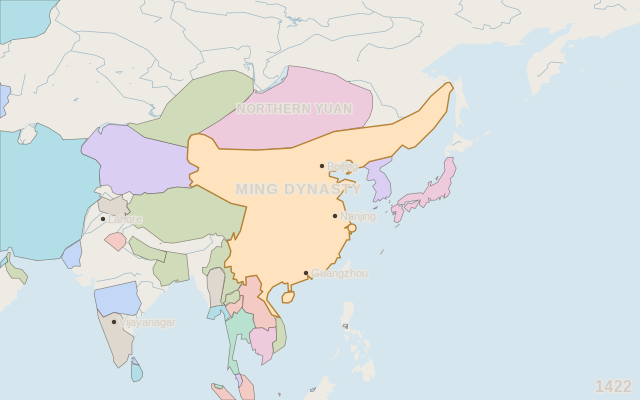
It reached its greatest extent in 1422: 6.27 million km².↓ Its line counts 16 rulers, covering 1368 – 1644, the median reign 14 years; 5 of 16 handovers were irregular.↓ Among them, Hongwu Emperor, Yongle Emperor and Chongzhen Emperor are the best known.↓ The atlas files 35 rows under it, most of them people.↓

In 1644, after 276 years, it was replaced by the Qing dynasty and Southern Ming.↓

From Wikipedia’s article, retold · CC BY-SA 4.0

276 years

Longer than the Qing dynasty, shorter than the Tang dynasty

6.27 million km²

At its height in 1422 · almost the size of Australia

16 rulers

the Emperor of China

5 wars and battles

More per century than 94% of states · 35 entries in all

Map: Ming dynasty in 1422, its borders in gold among its neighbours
Jingnan campaign, 1399 – 1402: 4.94 million km² → 5.45 million km²Ming conquest of Đại Ngu, 1406 – 1407: 5.45 million km² → 5.58 million km²Lam Sơn uprising, 1418 – 1427Tumu Crisis, 1449Battle of Sarhū, 161914001450150015501600
Beside it on the map in 1422: Timurid Empire, Northern Yuan, Chagatai Khanate, Phagmodrupa dynasty, Oirat Confederation and Novgorod Republic.How far it reached, year by year: its ground inside the borders Cliopatria draws (CC BY 4.0), measured on an equal-area grid; the map shows it at its largest, with the cities of the year.

The story

Four acts, 1368 – 1644

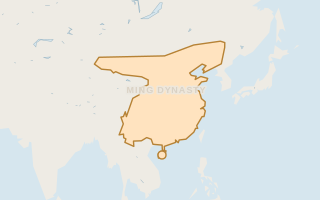
Ming dynasty in 1397, at the end of act I
I1368 – 1398

Hongwu builds a new order

The Hongwu Emperor rebuilds the state: a wall around Nanjing, new palaces, the weisuo military system and the Great Ming Code, finished by 1397. He has Chancellor Hu Weiyong executed in 1380. His armies annex the southwest, once the Kingdom of Dali, in 1381, and in 1387 march on Naghachu, bringing Manchuria under Ming rule.

Watch this act on the live map, from 1368
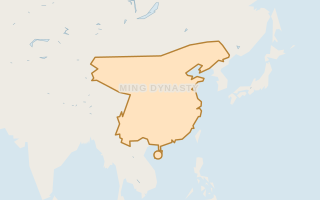
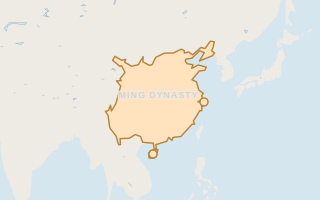
Ming dynasty in 1448, at the end of act II
II1398 – 14494.94 million → 5.5 million km²

Yongle's Beijing and the voyages

When the young Jianwen Emperor moves against his uncle Zhu Di, the Jingnan campaign puts Zhu Di on the throne in 1402 as the Yongle Emperor. He makes Beijing his capital, raising a new city around the Forbidden City from 1407 to 1420, and from 1405 sends the eunuch Zheng He with vast fleets into the Indian Ocean.

Watch this act on the live map, from 1398
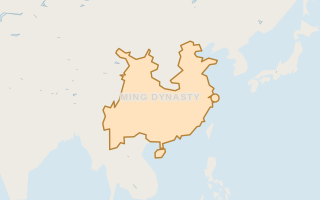
Ming dynasty in 1571, at the end of act III
III1449 – 15725.5 million → 3.67 million km²

Walls and withdrawal

In 1449 the Oirat leader Esen Tayisi routs the Zhengtong Emperor's army and captures him in the Tumu Crisis; his brother takes the throne as the Jingtai Emperor. The voyages end, the navy decays, and forced labour builds the Liaodong palisade and the Great Wall in its modern form. Portuguese traders arrive in 1516 and settle Macau in 1557.

Watch this act on the live map, from 1449
Ming dynasty in 1643, at the end of act IV
IV1572 – 16443.67 million → 3.36 million km²

Silver, Manchus and rebels

The Wanli Emperor begins well with his Grand Secretary Zhang Juzheng, but factions split the court and he shuts himself away in the Forbidden City. A shortage of silver brings economic crisis. Nurhaci declares himself Khan in 1616 and founds the Later Jin, and a peasant soldier, Li Zicheng, leads a rebellion that takes Beijing in 1644.

Watch this act on the live map, from 1572
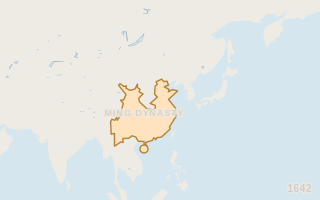
Ming dynasty in 1642, last mappedMing dynasty in 1375, first mapped
The rise and the fall in one frame: drag across it from 1375, first mapped at 4.55 million km², to 1642, last mapped at 3.36 million km². Open the live map in 1375 or 1642.

Before and after

Before it

  • Mongol Empire · replaces · 1206 – 1368
  • Yuan dynasty · replaces · 1271 – 1368
  • Song · replaces
  • Chinese Middle Ages · follows

After it

Where it sits in time

3000 BCE2000 BCE1000 BCE110002000Mongol Empire: 1206 – 1368Yuan dynasty: 1271 – 1368Southern Ming: 1644 – 1661Shun dynasty: 1644 – 1644Qing dynasty: 1644 – 1912Ming dynasty: 1368 – 1644

Five thousand years, 3000 BCE to 2026; the state in gold, what it replaced or followed and what replaced or followed it in grey.

Its people

Lives across the Ming dynasty

140015001600
Statesmen and generalsScientists and explorersAll its people on the timeline →

How it was governed

16 emperors

16 emperors on record, 1368 to 1644; a reign lasted 14 years at the median. Each bar is a reign, as long as it lasted.

Hongwu Emperor · 1368 – 1398 · died in office, manner not recordedJianwen Emperor · 1398 – 1402 · ended by a named eventYongle Emperor · 1402 – 1424 · died in office of natural causesHongxi Emperor · 1424 – 1425 · died in office of natural causesXuande Emperor · 1425 – 1435 · died in office, manner not recordedEmperor Yingzong of Ming · 1435 – 1449 · deposed or removedJingtai Emperor · 1449 – 1457 · deposed or removedEmperor Yingzong of Ming · 1457 – 1464 · died in office, manner not recordedChenghua Emperor · 1464 – 1487 · died in office, manner not recordedHongzhi Emperor · 1487 – 1505 · died in office, manner not recordedZhengde Emperor · 1505 – 1521 · died in office, manner not recordedJiajing Emperor · 1521 – 1567 · killedLongqing Emperor · 1567 – 1572 · died in office, manner not recordedWanli Emperor · 1572 – 1620 · died in office, manner not recordedTaichang Emperor · 1620 – 1620 · killedTianqi Emperor · 1620 – 1627 · died in office, manner not recordedChongzhen Emperor · 1627 – 1644 · died by suicide14001450150015501600
How their terms ended, where it is known (17 of 17):Killed 2Deposed or removed 2Died in office 12Left office alive 1
Every term, with how it ended and its source

Rulers

How 17 reigns ended - choose one to show only those

How they died, where the record says: died by suicide 2 · died of natural causes 2 · killed 2.

RulerReignLengthHow it ended · sourceTo the ruler before
14th century · 2 reigns
Hongwu Emperor · aged 401368 – 139830 yearsdied in officeWikidata's end cause on the term
Jianwen Emperor · aged 211398 – 14024 yearsended by an eventWikidata's end cause on the termdied by suicidegrandchild
15th century · 8 reigns · 2 killed or removed
Yongle Emperor · aged 421402 – 142422 yearsdied in officeWikidata's manner of deathdied of natural causes
Hongxi Emperor · aged 461424 – 14251 yeardied in officeWikidata's manner of deathdied of natural causeschild
Xuande Emperor · aged 261425 – 143510 yearsdied in officeWikidata's end cause on the termchild
Emperor Yingzong of Ming · aged 81435 – 144914 yearsdeposedWikidata's end cause on the termchild
Jingtai Emperor · aged 211449 – 14578 yearsdeposedWikidata's end cause on the termsibling
Emperor Yingzong of Ming · aged 301457 – 14647 yearsdied in officeWikidata's end cause on the termsibling
Chenghua Emperor · aged 171464 – 148723 yearsdied in officeWikidata's end cause on the termchild
Hongzhi Emperor · aged 171487 – 150518 yearsdied in officeWikidata's end cause on the termchild
16th century · 4 reigns · 1 killed or removed
Zhengde Emperor · aged 141505 – 152116 yearsdied in officeWikidata's end cause on the termchild
Jiajing Emperor · aged 141521 – 156746 yearskilled in officeWikidata's manner of death
Longqing Emperor · aged 301567 – 15725 yearsdied in officeWikidata's end cause on the termchild
Wanli Emperor · aged 91572 – 162048 yearsdied in officeWikidata's end cause on the termchild
17th century · 3 reigns · 1 killed or removed
Taichang Emperor · aged 381620 – 1620under a yearkilled in officeWikidata's manner of deathchild
Tianqi Emperor · aged 151620 – 16277 yearsdied in officeWikidata's end cause on the termchild
Chongzhen Emperor · aged 161627 – 164417 yearsdied by suicideWikidata's manner of deathdied by suicidesibling

16 rulers, 16 with terms dated as terms, covering 1368 – 1644. Median reign 14 years. 5 of 16 handovers irregular - a killing, a deposition, a rival claimant, a rising or a coup beside it. A blank in the last column means no kin on record, which is coverage, never “unrelated”.

Flag or arms

  • Seal of Ming dynasty
    seal, undatedSeal of Ming dynasty · Public domain

Its world

Who else stood

Meanwhile, elsewhere

The best-known states of other regions that stood while it did; the band is the Ming dynasty’s own years.

140015001600

How it compares

Among 3,073 states

Stood longer than 71% of 3,073 states
Ming dynasty · 276 yearsQing dynastyTang dynastyHow long it stood, among the states with a recorded end or still standing.
Held more ground at its peak than 98% of 1,464 states
Ming dynasty · 6,273,200 km²IndiaAustraliaThe most ground it held, among the states with a border in Cliopatria.
Had more wars on record per century than 94% of 3,073 states
Ming dynasty · 1.1Wars recorded per century, among the states, counting the wars the atlas hosts under each.

Why it fell

Why did the Ming dynasty fall?

Historians still argue. Here is what the atlas records about its last century:

2

wars and battles in its last century

1620

Taichang Emperor, killed in office

What led to it, and what came of it

Yuan dynasty · Linked · 1271 – 1368 · “The Ming dynasty, officially the Great Ming, was an imperial dynasty of China that ruled from 1368 to 1644, following the collapse of the Mongol-led Yuan dyna…”Yuan dynastySong · Linked · 1355 – 1366SongChinese Middle Ages · Linked · 220 – 1840Chinese Middle AgesMongol Empire · Linked · 1206 – 1368Mongol EmpireLan Yu · Coincidence · 1330 – 1393Lan YuWater Margin · Coincidence · 1350Water MarginMing dynasty · 1368 – 1644Ming dynastyQing dynasty · Linked · 1644 – 1912Qing dynastySouthern Ming · Linked · 1644 – 1661Southern MingShun dynasty · Linked · 1644Shun dynasty50010001500
linkedcoincidence

Open the investigation: every row with its evidence, the conditions at the time, the theories condition by condition, and the succession analysed.

Its centuries in the record

1300 – 1399: 9 recorded — 1 wars and battles, 0 risings, regime changes and massacres, 8 other13001400 – 1499: 10 recorded — 2 wars and battles, 2 risings, regime changes and massacres, 6 other14001500 – 1599: 7 recorded — 0 wars and battles, 0 risings, regime changes and massacres, 7 other15001600 – 1699: 9 recorded — 2 wars and battles, 0 risings, regime changes and massacres, 7 other1600

Wars and battles in red, risings, coups and massacres beside them, everything else in grey, by the century each began in. A tall bar is partly a fact about Wikipedia: better-documented centuries hold more.

Each century’s own page:1300 – 13991400 – 14991500 – 15991600 – 1699

Keep exploring

Share this page
Copy link
Embed the map
Cite this page

How this page is made

Drawn from Wikidata (Q9903, CC0), the opening and history of its English Wikipedia article retold by the atlas (CC BY-SA 4.0), borders from Cliopatria (CC BY 4.0), coast and rivers from Natural Earth, cities from Reba, Reitsma & Seto 2016 (CC BY 4.0), symbols from Wikimedia Commons, each under its own licence. Data built 2026-11-26 · Pastlas v2.47.1, by Oleh Voronko; the published atlas and its data are for non-commercial use.

How to read it

Areas are measured on an equal-area grid from borders simplified to about five kilometres. “c.” marks an approximate date, and a date known to the century is never printed to the year. Counts are what the atlas holds, and they follow Wikipedia’s coverage: a busy century is partly a fact about the record.

Something wrong?

Tell us and name the entry. We fix the data, not just this page.

Report a problem