State · Europe

County of Burgundy

982 – 1678 · 696 years

Came after Kingdom of Arles

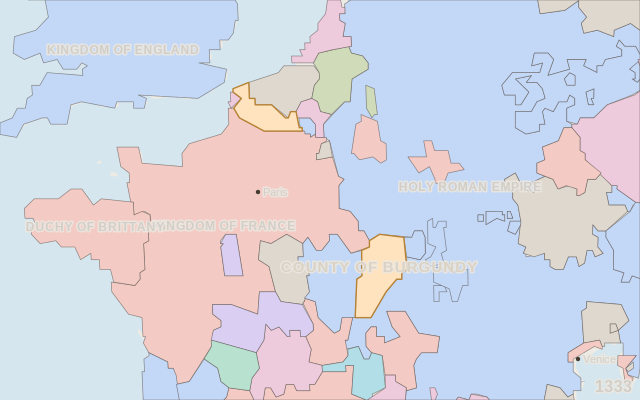
It was founded in 982, replacing the Kingdom of Arles.↓ Its borders are first mapped in 1333, around 22,600 km².↓

Continue reading

Its highest office was held by 39 rulers, covering 1057 – 1556, the median reign 21 years; 2 of 10 handovers were irregular.↓ The best known of them are Philip II of Spain, Philip the Handsome and Joan II of Burgundy.↓ Most of the 23 rows the atlas files under it are people.↓ Its record closes in 1678, after 696 years.↑

696 years

Longer than the Ottoman Empire, shorter than the House of Habsburg

22,600 km²

At its height in 1333 · about the size of Djibouti

39 rulers

the count of Burgundy

Map: County of Burgundy in 1333, its borders in gold among its neighbours
13601365137013751380
Beside it on the map in 1333: Holy Roman Empire, Kingdom of France, Kingdom of England, Margraviate of Brandenburg, Duchy of Brittany and House of Ascania.How far it reached, year by year: its ground inside the borders Cliopatria draws (CC BY 4.0), measured on an equal-area grid; the map shows it at its largest, with the cities of the year.

The story

Its key moments

Before and after

Before it

Where it sits in time

3000 BCE2000 BCE1000 BCE110002000Kingdom of Arles: 933 – 1378County of Burgundy: 982 – 1678

Five thousand years, 3000 BCE to 2026; the state in gold, what it replaced or followed and what replaced or followed it in grey.

Its people

Lives across the County of Burgundy

1000110012001300
Statesmen and generalsAll its people on the timeline →

How it was governed

39 counts

39 counts on record, 1057 to 1556; a reign lasted 21 years at the median. Each bar is a reign, as long as it lasted.

William I of Burgundy · 1057 – … · no end recordedReginald III of Burgundy · 1127 – 1148 · died in office, manner not recordedBeatrice I of Burgundy · 1148 – 1184 · died in office of natural causesHugh, Count of Burgundy · 1248 – 1266 · died in office, manner not recordedAdelaide, Countess of Burgundy · 1248 – 1279 · died in office, manner not recordedPhilip I of Savoy · 1267 – 1279 · left office aliveJoan II of Burgundy · 1303 – 1330 · died in office, manner not recordedJoan III of Burgundy · 1330 – 1347 · died in office, manner not recordedMargaret I of Burgundy · 1361 – 1382 · died in office, manner not recordedPhilip the Handsome · 1493 – 1506 · died in office of natural causesPhilip II of Spain · 1556 – … · no end recorded1000120014001600
a second row: a reign that began before the last had ended — rival claimants, or a shared throne
How their terms ended, where it is known (9 of 11):Died in office 8Left office alive 1Not on record 2
Every term, with how it ended and its source

Rulers

How 11 reigns ended - choose one to show only those

How they died, where the record says: died of natural causes 3 · died in battle 1.

RulerReignLengthHow it ended · sourceTo the ruler before
11th century · 1 reign
William I of Burgundy1057 – —no end recordedending not on recorddied in battle
12th century · 2 reigns
Reginald III of Burgundy · aged 341127 – 114821 yearsdied in officeread off the dates alonegrandchild
Beatrice I of Burgundy · aged 51148 – 118436 yearsdied in officeWikidata's manner of deathdied of natural causes
13th century · 3 reigns
Hugh, Count of Burgundy · aged 281248 – 126618 yearsdied in officeread off the dates alone
Adelaide, Countess of Burgundy1248 – 127931 yearsdied in officeread off the dates alonespouse
Philip I of Savoy · aged 601267 – 127912 yearsleft office aliveread off the dates alonespouse
14th century · 3 reigns
Joan II of Burgundy · aged 151303 – 133027 yearsdied in officeread off the dates alone
Joan III of Burgundy · aged 221330 – 134717 yearsdied in officeread off the dates alonechild
Margaret I of Burgundy · aged 521361 – 138221 yearsdied in officeread off the dates alonesibling
15th century · 1 reign
Philip the Handsome · aged 151493 – 150613 yearsdied in officeWikidata's manner of deathdied of natural causes
16th century · 1 reign
Philip II of Spain · aged 291556 – —no end recordedending not on recorddied of natural causes

39 rulers, 11 with terms dated as terms, covering 1057 – 1556. Median reign 21 years. 2 of 10 handovers irregular - a killing, a deposition, a rival claimant, a rising or a coup beside it. A blank in the last column means no kin on record, which is coverage, never “unrelated”.

The line also names 11 holders with a page of their own whose term the record gives no first year, so the table cannot place them: Frederick Barbarossa, John the Fearless, Philip the Good, Charles the Bold, Mary of Burgundy, Maximilian I, Isabella Clara Eugenia, Philip III of Spain, Philip IV of Spain, Charles II of Spain, Otto-William of Burgundy.

Flag or arms

  • Coat of arms palatine counts of Burgundy
    coat of arms, undatedCoat of arms palatine counts of Burgundy · CC BY-SA 4.0

Its world

Who else stood

Meanwhile, elsewhere

The best-known states of other regions that stood while it did; the band is the County of Burgundy’s own years.

1000120014001600

How it compares

Among 3,073 states

Stood longer than 93% of 3,073 states
County of Burgundy · 696 yearsOttoman EmpireHouse of HabsburgHow long it stood, among the states with a recorded end or still standing.
Held more ground at its peak than 23% of 1,464 states
County of Burgundy · 22,600 km²DjiboutiBurundiThe most ground it held, among the states with a border in Cliopatria.

Why it fell

Why did the County of Burgundy fall?

Historians still argue. Here is what the atlas records about its last century:

What led to it, and what came of it

Kingdom of Arles · Linked · 933 – 1378Kingdom of ArlesCounty of Burgundy · 982 – 1678County of Burgundy1000120014001600
linked

Open the investigation: every row with its evidence, the conditions at the time, the theories condition by condition, and the succession analysed.

Its centuries in the record

900 – 999: 1 recorded — 0 wars and battles, 0 risings, regime changes and massacres, 1 other9001000 – 1099: 8 recorded — 0 wars and battles, 0 risings, regime changes and massacres, 8 other10001100 – 1199: 6 recorded — 0 wars and battles, 0 risings, regime changes and massacres, 6 other11001200 – 1299: 6 recorded — 0 wars and battles, 0 risings, regime changes and massacres, 6 other12001300 – 1399: 2 recorded — 0 wars and battles, 0 risings, regime changes and massacres, 2 other13001400 – 1499: 0 recorded — 0 wars and battles, 0 risings, regime changes and massacres, 0 other14001500 – 1599: 0 recorded — 0 wars and battles, 0 risings, regime changes and massacres, 0 other15001600 – 1699: 0 recorded — 0 wars and battles, 0 risings, regime changes and massacres, 0 other1600

Wars and battles in red, risings, coups and massacres beside them, everything else in grey, by the century each began in. A tall bar is partly a fact about Wikipedia: better-documented centuries hold more.

Each century’s own page:900 – 9991000 – 10991100 – 11991200 – 12991300 – 13991400 – 14991500 – 15991600 – 1699

Keep exploring

Share this page
Copy link
Embed the map
Cite this page

How this page is made

Drawn from Wikidata (Q642314, CC0), borders from Cliopatria (CC BY 4.0), coast and rivers from Natural Earth, cities from Reba, Reitsma & Seto 2016 (CC BY 4.0), symbols from Wikimedia Commons, each under its own licence. Data built 2026-11-26 · Pastlas v2.47.1, by Oleh Voronko; the published atlas and its data are for non-commercial use.

How to read it

Areas are measured on an equal-area grid from borders simplified to about five kilometres. “c.” marks an approximate date, and a date known to the century is never printed to the year. Counts are what the atlas holds, and they follow Wikipedia’s coverage: a busy century is partly a fact about the record.

Something wrong?

Tell us and name the entry. We fix the data, not just this page.

Report a problem