State · Middle East and North Africa

Burkina Faso

1960 – present · 66 years · still standing

Came after Republic of Upper Volta and French West Africa

The land of the upright men, once Upper Volta: a poor Sahel republic of many coups, remembered for Thomas Sankara's revolution.

Burkina Faso is a landlocked country of West Africa, home to the old Mossi kingdoms, with its capital at Ouagadougou. A French protectorate from 1896, it became independent as Upper Volta in 1960 under Maurice Yaméogo. Coups followed in 1966, 1980, 1982 and 1983, when Thomas Sankara took power and renamed the country; a coup organised by Blaise Compaoré killed him in 1987. Two coups in 2022 left soldiers in power amid an Islamist insurgency.

What the record holds

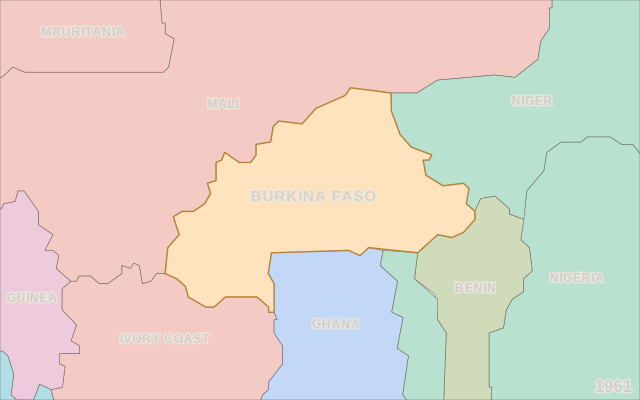
Its record opens in 1960, replacing the Republic of Upper Volta and French West Africa.↓ Its borders are first mapped in 1961, around 275,200 km².↓

The record names 14 rulers in its line, covering 1959 – 2022, the median reign 1 year; 13 of 13 handovers were irregular.↓ The best known of them are Thomas Sankara, Blaise Compaoré and Ibrahim Traoré.↓ Most of the 40 rows the atlas files under it are people.↓

From Wikipedia’s article, retold · CC BY-SA 4.0

66 years

Longer than Bremen, shorter than the Soviet Union

275,000 km²

At its height in 1961 · about the size of Gabon

14 rulers

the President of Burkina Faso

2 wars and battles

More per century than 96% of states · 40 entries in all

Map: Burkina Faso in 1961, its borders in gold among its neighbours
Agacher Strip War, 19852014 Burkina Faso uprising, 20142015 Burkina Faso coup attempt, 2015197019801990200020102020
Beside it on the map in 1961: Mali, Nigeria, Niger, Ivory Coast, Ghana and Benin.How far it reached, year by year: its ground inside the borders Cliopatria draws (CC BY 4.0), measured on an equal-area grid; the map shows it at its largest, with the cities of the year.

The story

Four acts, 1960 – present

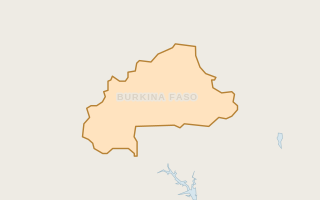
Burkina Faso in 1986, at the end of act II
II1983 – 1987275,000 → 275,000 km²

Sankara's revolution

Sankara's government runs mass vaccinations, builds infrastructure, widens women's rights and fights desertification, ruling through a National Council for the Revolution and Committees for the Defense of the Revolution. On 2 August 1984 Upper Volta becomes Burkina Faso. The Agacher Strip War comes in 1985, and on 15 October 1987 Sankara and twelve officials die in Compaoré's coup.

Watch this act on the live map, from 1983
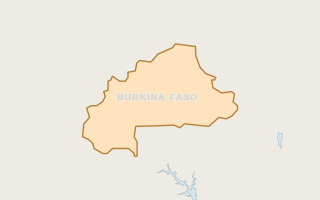
Burkina Faso in 2013, at the end of act III
III1987 – 2014275,000 → 275,000 km²

Compaoré's long rule

Blaise Compaoré rules for twenty-seven years, outlasting coup attempts in 1989 and 2003. When he seeks to change the constitution and extend his rule, protesters fill Ouagadougou in October 2014, burn the parliament building and take over national television; on 31 October he resigns, and Yacouba Isaac Zida leads the transition.

Watch this act on the live map, from 1987
IV2014 – present

Insurgency and juntas

Michel Kafando steers the transition past a failed coup in 2015, and Roch Marc Christian Kaboré wins that year's election. A jihadist insurgency begins in August 2015, bringing massacres at Solhan in 2021 and Barsalogho in 2024. Soldiers depose Kaboré in January 2022, a second coup that September brings Ibrahim Traoré to power, and the country quits ECOWAS.

Watch this act on the live map, from 2014

Before and after

Before it

Where it sits in time

3000 BCE2000 BCE1000 BCE110002000Republic of Upper Volta: 1958 – 1984Burkina Faso: 1960 – 2026

Five thousand years, 3000 BCE to 2026; the state in gold, what it replaced or followed and what replaced or followed it in grey.

Its people

Lives across Burkina Faso

192019401960198020002020
Statesmen and generalsAll its people on the timeline →

How it was governed

14 presidents

14 presidents on record, 1959 to 2022; a reign lasted 1 years at the median. Each bar is a reign, as long as it lasted.

Maurice Yaméogo · 1959 – 1966 · left office aliveSangoulé Lamizana · 1966 – 1980 · left office aliveSaye Zerbo · 1980 – 1982 · left office aliveJean-Baptiste Ouédraogo · 1982 – 1983 · no death date to read the end againstThomas Sankara · 1983 – 1987 · killed, the article saysBlaise Compaoré · 1987 – 2014 · no death date to read the end againstHonoré Traoré · 2014 – 2014 · left office aliveYacouba Isaac Zida · 2014 – 2014 · no death date to read the end againstMichel Kafando · 2015 – 2015 · no death date to read the end againstChérif Sy · 2015 – 2015 · no death date to read the end againstGilbert Diendéré · 2015 – 2015 · no death date to read the end againstRoch Marc Christian Kaboré · 2015 – 2022 · removed by a coupPaul-Henri Sandaogo Damiba · 2022 – 2022 · removed by a coupIbrahim Traoré · 2022 – … · still in office1960198020002020
How their terms ended, where it is known (8 of 14):Killed 1Deposed or removed 2Left office alive 4In office 1Not on record 6
Every term, with how it ended and its source

Rulers

How 14 reigns ended - choose one to show only those
RulerReignLengthHow it ended · sourceTo the ruler before
20th century · 6 reigns · 1 killed or removed
Maurice Yaméogo · aged 381959 – 19667 yearsleft office aliveread off the dates alone
Sangoulé Lamizana · aged 501966 – 198014 yearsleft office aliveread off the dates alone
Saye Zerbo · aged 481980 – 19822 yearsleft office aliveread off the dates alone
Jean-Baptiste Ouédraogo · aged 401982 – 19831 yearending not on record
Thomas Sankara · aged 341983 – 19874 yearskilledread from the ruler's own article
Blaise Compaoré · aged 361987 – 201427 yearsending not on record
21st century · 8 reigns · 2 killed or removed
Honoré Traoré · aged 572014 – 2014under a yearleft office aliveread off the dates alone
Yacouba Isaac Zida · aged 492014 – 2014under a yearending not on record
Michel Kafando · aged 732015 – 2015under a yearending not on record
Chérif Sy · aged 552015 – 2015under a yearending not on record
Gilbert Diendéré · aged 552015 – 2015under a yearending not on record
Roch Marc Christian Kaboré · aged 582015 – 20227 yearsremoved by a coupWikidata's end cause on the term
Paul-Henri Sandaogo Damiba · aged 412022 – 2022under a yearremoved by a coupWikidata's end cause on the term
Ibrahim Traoré · aged 342022 – in officein office since 2022still in office

14 rulers, 14 with terms dated as terms, covering 1959 – 2022. Median reign 1 years. 13 of 13 handovers irregular - a killing, a deposition, a rival claimant, a rising or a coup beside it. A blank in the last column means no kin on record, which is coverage, never “unrelated”.

Heads of government

The line of Prime Minister of Burkina Faso, drawn and never measured: a cabinet is not a reign.

Gérard Kango Ouédraogo1971 – 1974
Sangoulé Lamizana1974 – 1978
Joseph Conombo1978 – 1980
Saye Zerbo1980 – 1982
Thomas Sankara1983 – 1983
Youssouf Ouédraogo1992 – 1994
Roch Marc Christian Kaboré1994 – 1996
Kadré Désiré Ouédraogo1996 – 2000
Paramanga Ernest Yonli2000 – 2007
Tertius Zongo2007 – 2011
Luc-Adolphe Tiao2011 – 2014
Yacouba Isaac Zida2014 – 2015
Paul Kaba Thieba2016 – 2019
Christophe Joseph Marie Dabiré2019 – 2021
Lassina Zerbo2021 – 2022
Albert Ouédraogo2022 – 2022
Apollinaire J. Kyélem de Tambèla2022 – 2024
Jean Emmanuel Ouédraogo2024 – …

Flags and arms, in order

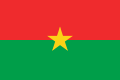
  • Flag of Burkina Faso
    flag, from 1984Flag of Burkina Faso · Public domain
  • Coat of arms of Burkina Faso (1984-2025)
    coat of arms, from 1997Coat of arms of Burkina Faso (1984-2025) · CC BY-SA 3.0 · F l a n k e r

Its world

Who else stood

Meanwhile, elsewhere

The best-known states of other regions that stood while it did; the band is Burkina Faso’s own years.

1960198020002020

How it compares

Among 3,073 states

Stood longer than 38% of 3,073 states
Burkina Faso · 66 yearsBremenSoviet UnionHow long it stood, among the states with a recorded end or still standing.
Held more ground at its peak than 64% of 1,464 states
Burkina Faso · 275,200 km²GabonItalyThe most ground it held, among the states with a border in Cliopatria.
Had more wars on record per century than 96% of 3,073 states
Burkina Faso · 2.0Wars recorded per century, among the states, counting the wars the atlas hosts under each.

How it began

How did Burkina Faso begin?

What led to it, and what came of it

French West Africa · Linked · 1895 – 1958French West AfricaEmirate of Liptako · Linked · 1809 – 1897Emirate of LiptakoRepublic of Upper Volta · Linked · 1958 – 1984Republic of Upper VoltaBurkina Faso · 1960 – 2026Burkina Faso18001850190019502000
linked

Open the investigation: every row with its evidence, the conditions at the time, the theories condition by condition, and the succession analysed.

Its centuries in the record

1900 – 1999: 29 recorded — 1 wars and battles, 2 risings, regime changes and massacres, 26 other19002000 – 2099: 11 recorded — 1 wars and battles, 9 risings, regime changes and massacres, 1 other2000

Wars and battles in red, risings, coups and massacres beside them, everything else in grey, by the century each began in. A tall bar is partly a fact about Wikipedia: better-documented centuries hold more.

Each century’s own page:1900 – 19992000 – 2099

Keep exploring

Share this page
Copy link
Embed the map
Cite this page

How this page is made

Drawn from Wikidata (Q965, CC0), the opening and history of its English Wikipedia article retold by the atlas (CC BY-SA 4.0), borders from Cliopatria (CC BY 4.0), coast and rivers from Natural Earth, cities from Reba, Reitsma & Seto 2016 (CC BY 4.0), symbols from Wikimedia Commons, each under its own licence. Data built 2026-11-26 · Pastlas v2.47.1, by Oleh Voronko; the published atlas and its data are for non-commercial use.

How to read it

Areas are measured on an equal-area grid from borders simplified to about five kilometres. “c.” marks an approximate date, and a date known to the century is never printed to the year. Counts are what the atlas holds, and they follow Wikipedia’s coverage: a busy century is partly a fact about the record.

  • Still standing: the span runs to the year of the build, 2026.

Something wrong?

Tell us and name the entry. We fix the data, not just this page.

Report a problem