State · Sub-Saharan Africa

Ivory Coast

1960 – present · 66 years · still standing

Came after French West Africa and French Ivory Coast

The world's largest cocoa exporter, stable for three decades under its founding president, then torn by a coup and two civil wars.

Ivory Coast, or Côte d'Ivoire, lies on the Gulf of Guinea; Yamoussoukro is its capital and Abidjan its largest city. A French colony from 1893, it became independent in 1960 under Félix Houphouët-Boigny, who ruled until 1993 and made coffee and cocoa the basis of its wealth. A coup in 1999 and civil wars in 2002–2007 and 2010–2011 broke that stability, but since 2011 the economy under Alassane Ouattara has grown fast.

What the record holds

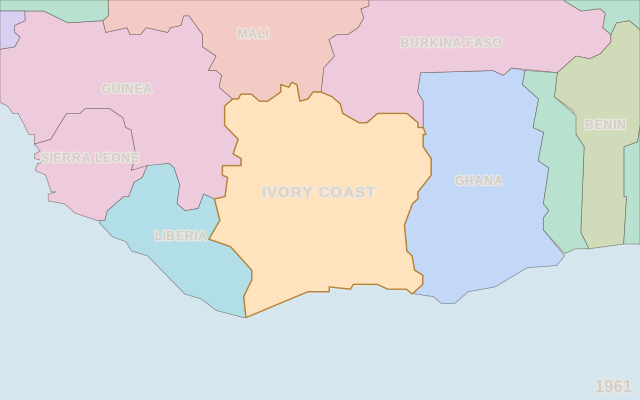
It was founded in 1960, replacing French West Africa and French Ivory Coast.↓ Its borders are first mapped in 1961, around 323,100 km².↓

Its highest office was held by 5 rulers, covering 1960 – 2011, the median reign 8.5 years; 3 of 4 handovers were irregular.↓ Among them, Alassane Ouattara, Laurent Gbagbo and Félix Houphouët-Boigny are the best known.↓ The atlas files 27 rows under it, most of them people.↓

From Wikipedia’s article, retold · CC BY-SA 4.0

66 years

Longer than Bremen, shorter than the Soviet Union

323,000 km²

At its height in 1961 · about the size of Oman

5 rulers

the President of the Ivory Coast

4 wars and battles

More per century than 99% of states · 27 entries in all

Map: Ivory Coast in 1961, its borders in gold among its neighbours
First Ivorian Civil War, 2002 – 2007Second Ivorian Civil War, 2010 – 20112010–2011 Ivorian crisis, 2010 – 2011Grand-Bassam shootings, 20162017 Ivory Coast mutinies, 2017197019801990200020102020
Beside it on the map in 1961: Ghana, Guinea, Burkina Faso, Mali, Benin and Liberia.How far it reached, year by year: its ground inside the borders Cliopatria draws (CC BY 4.0), measured on an equal-area grid; the map shows it at its largest, with the cities of the year.

The story

Four acts, 1960 – present

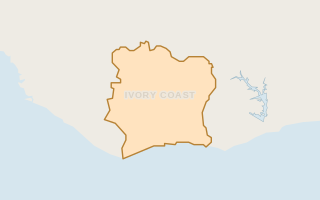
Ivory Coast in 1992, at the end of act I
I1960 – 1993

Houphouët-Boigny's one-party state

Félix Houphouët-Boigny, a cocoa farmer and the son of a Baoulé chief, rules a one-party state close to France. Coffee and cocoa make the country a West African economic power in the 1960s and 1970s, but crisis follows in the 1980s. Laurent Gbagbo flees after founding the Ivorian Popular Front, and the president makes his home village, Yamoussoukro, the capital.

Watch this act on the live map, from 1960
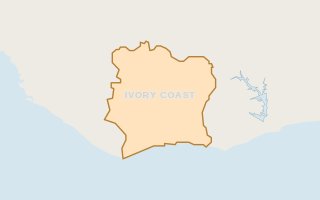
Ivory Coast in 2001, at the end of act II
II1993 – 2002323,000 → 323,000 km²

Ivoirité and the coup

Henri Konan Bédié, re-elected in 1995, jails hundreds of opponents and wields the idea of Ivoirité to bar Alassane Ouattara from the presidency. A coup in 1999 brings Robert Guéï to power; after a disputed election and an uprising in 2000 Laurent Gbagbo replaces him, while the Supreme Court disqualifies Ouattara over his alleged Burkinabé nationality.

Watch this act on the live map, from 1993
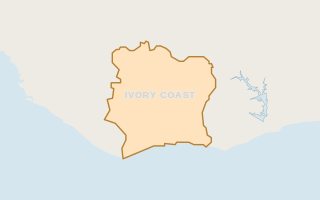
Ivory Coast in 2010, at the end of act III
III2002 – 2011323,000 → 323,000 km²

Two civil wars

An armed uprising on 19 September 2002, while Gbagbo is in Italy, opens the first civil war, leaving the north to the rebel New Forces; French and Ivorian troops clash in 2004. The election due in 2005 is held in November 2010: Ouattara leads the count, but a Constitutional Council of Gbagbo loyalists declares Gbagbo the winner, and war resumes.

Watch this act on the live map, from 2002
IV2011 – present

Ouattara's years of growth

With Ouattara in power, peace returns and the economy grows by an average of 7.1% a year from 2012 to 2023, among the fastest rates in the world. A new constitution is adopted in 2016, the year of the Grand-Bassam shootings; soldiers mutiny in 2017, and in 2020 Ouattara wins a third term in an election the opposition boycotts.

Watch this act on the live map, from 2011

Before and after

Before it

  • French West Africa · replaces
  • French Ivory Coast · replaces

Where it sits in time

3000 BCE2000 BCE1000 BCE110002000Ivory Coast: 1960 – 2026

Five thousand years, 3000 BCE to 2026; the state in gold.

Its people

Lives across Ivory Coast

19251950197520002025
Statesmen and generalsAll its people on the timeline →

How it was governed

5 presidents

5 presidents on record, 1960 to 2011; a reign lasted 8.5 years at the median. Each bar is a reign, as long as it lasted.

Félix Houphouët-Boigny · 1960 – 1993 · died in office of natural causesHenri Konan Bédié · 1993 – 1999 · deposed, the article saysRobert Guéï · 1999 – 2000 · left office aliveLaurent Gbagbo · 2000 – 2011 · no death date to read the end againstAlassane Ouattara · 2010 – … · still in office1960198020002020
a second row: a reign that began before the last had ended — rival claimants, or a shared throne
How their terms ended, where it is known (4 of 5):Deposed or removed 1Died in office 1Left office alive 1In office 1Not on record 1
Every term, with how it ended and its source

Rulers

How 5 reigns ended - choose one to show only those

How they died, where the record says: died of natural causes 1 · killed 1.

RulerReignLengthHow it ended · sourceTo the ruler before
20th century · 4 reigns · 1 killed or removed
Félix Houphouët-Boigny · aged 551960 – 199333 yearsdied in officeWikidata's manner of deathdied of natural causes
Henri Konan Bédié · aged 591993 – 19996 yearsdeposedread from the ruler's own article
Robert Guéï · aged 581999 – 20001 yearleft office aliveread off the dates alonekilled
Laurent Gbagbo · aged 552000 – 201111 yearsending not on record
21st century · 1 reign
Alassane Ouattara · aged 682010 – in officein office since 2010still in office

5 rulers, 5 with terms dated as terms, covering 1960 – 2011. Median reign 8.5 years. 3 of 4 handovers irregular - a killing, a deposition, a rival claimant, a rising or a coup beside it. A blank in the last column means no kin on record, which is coverage, never “unrelated”.

Heads of government

The line of Prime Minister of Ivory Coast, drawn and never measured: a cabinet is not a reign.

Félix Houphouët-Boigny1960 – 1960
Daniel Kablan Duncan1993 – 1999
Seydou Diarra2000 – 2000
Pascal Affi N'Guessan2000 – 2003
Seydou Diarra2003 – 2005
Charles Konan Banny2005 – 2007
Guillaume Soro2007 – 2012
Gilbert Aké2010 – 2011
Jeannot Ahoussou-Kouadio2012 – 2012
Daniel Kablan Duncan2012 – 2017
Amadou Gon Coulibaly2017 – 2020
Hamed Bakayoko2020 – 2021
Patrick Achi2021 – 2023
Robert Beugré Mambé2023 – …

Flags and arms, in order

  • Coat of arms of Ivory Coast (2)
    coat of arms, undatedCoat of arms of Ivory Coast (2) · CC BY-SA 4.0 · Republic of Côte d'Ivoire vectored by FOX 52
  • Flag of Côte d'Ivoire
    flag, from 1959Flag of Côte d'Ivoire · Public domain

Its world

Who else stood

Meanwhile, elsewhere

The best-known states of other regions that stood while it did; the band is Ivory Coast’s own years.

1960198020002020

How it compares

Among 3,073 states

Stood longer than 38% of 3,073 states
Ivory Coast · 66 yearsBremenSoviet UnionHow long it stood, among the states with a recorded end or still standing.
Held more ground at its peak than 67% of 1,464 states
Ivory Coast · 323,100 km²OmanFinlandThe most ground it held, among the states with a border in Cliopatria.
Had more wars on record per century than 99% of 3,073 states
Ivory Coast · 4.0Wars recorded per century, among the states, counting the wars the atlas hosts under each.

How it began

How did Ivory Coast begin?

What led to it, and what came of it

French West Africa · Linked · 1895 – 1958French West AfricaFrench Ivory Coast · Linked · 1893 – 1960French Ivory CoastIvory Coast · 1960 – 2026Ivory Coast190019502000
linked

Open the investigation: every row with its evidence, the conditions at the time, the theories condition by condition, and the succession analysed.

Its centuries in the record

1900 – 1999: 17 recorded — 0 wars and battles, 1 risings, regime changes and massacres, 16 other19002000 – 2099: 10 recorded — 4 wars and battles, 5 risings, regime changes and massacres, 1 other2000

Wars and battles in red, risings, coups and massacres beside them, everything else in grey, by the century each began in. A tall bar is partly a fact about Wikipedia: better-documented centuries hold more.

Each century’s own page:1900 – 19992000 – 2099

Keep exploring

Share this page
Copy link
Embed the map
Cite this page

How this page is made

Drawn from Wikidata (Q1008, CC0), the opening and history of its English Wikipedia article retold by the atlas (CC BY-SA 4.0), borders from Cliopatria (CC BY 4.0), coast and rivers from Natural Earth, cities from Reba, Reitsma & Seto 2016 (CC BY 4.0), symbols from Wikimedia Commons, each under its own licence. Data built 2026-11-26 · Pastlas v2.47.1, by Oleh Voronko; the published atlas and its data are for non-commercial use.

How to read it

Areas are measured on an equal-area grid from borders simplified to about five kilometres. “c.” marks an approximate date, and a date known to the century is never printed to the year. Counts are what the atlas holds, and they follow Wikipedia’s coverage: a busy century is partly a fact about the record.

  • Still standing: the span runs to the year of the build, 2026.

Something wrong?

Tell us and name the entry. We fix the data, not just this page.

Report a problem