State · Middle East and North Africa

Mali

1960 – present · 66 years · still standing

Came after Mali Federation and French West Africa

A landlocked West African republic, once part of three trading empires, shaken by Tuareg rebellions, Islamist war and repeated coups.

Mali, the eighth-largest country in Africa, stretches from the Sahara to the savanna of the Niger and Senegal rivers, with its capital at Bamako. Part of French Sudan, it won independence in 1960 within a short-lived federation with Senegal, then stood alone. One-party rule ended with a coup in 1991, and two decades of democracy followed; but since 2012 Tuareg rebellion, Islamist war and coups have left it under a military junta.

What the record holds

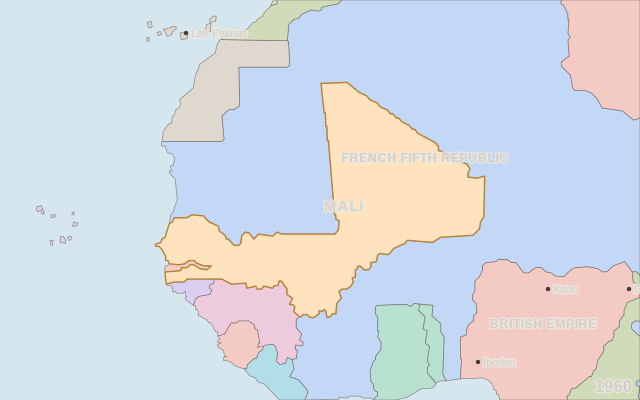
Its record opens in 1960, replacing the Mali Federation and French West Africa.↓ In 1960, the first year its borders are mapped, it covered 1.45 million km².↓

Its line counts 9 rulers, covering 1960 – 2021, the median reign 7 years; 8 of 9 handovers were irregular.↓ The best known of them are Ibrahim Boubacar Keïta, Amadou Toumani Touré and Modibo Keïta.↓ Most of the 48 rows the atlas files under it are people.↓

From Wikipedia’s article, retold · CC BY-SA 4.0

66 years

Longer than Bremen, shorter than the Soviet Union

1.45 million km²

At its height in 1960 · about the size of Mongolia

9 rulers

the President of Mali

5 wars and battles

More per century than 98% of states · 48 entries in all

Map: Mali in 1960, its borders in gold among its neighbours
Agacher Strip War, 1985Tuareg rebellion (2012), 2012Mali War, 2012 – present2012 Malian coup d'état, 20122020 Malian coup d'état, 20201960197019801990200020102020
Beside it on the map in 1960: French Fifth Republic, British Empire, Kingdom of Libya, Francoist Spain, Guinea and Dominion of Ghana.How far it reached, year by year: its ground inside the borders Cliopatria draws (CC BY 4.0), measured on an equal-area grid; the map shows it at its largest, with the cities of the year.

The story

Four acts, 1960 – present

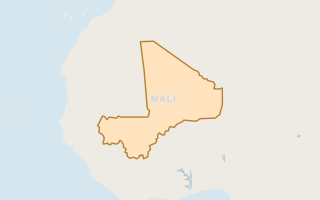
Mali in 1990, at the end of act II
II1968 – 19911.25 million → 1.25 million km²

Traoré's military regime

Moussa Traoré's military regime tries to reform the economy but is undone by turmoil and by the drought of 1968 to 1974, whose famine kills thousands. It survives student unrest and three coup attempts, fights the Agacher Strip War in 1985 and imposes austerity to satisfy the International Monetary Fund, until a coup topples it in 1991.

Watch this act on the live map, from 1968
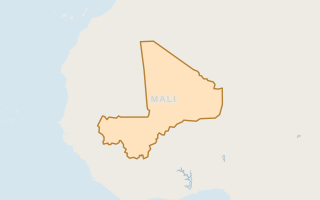
Mali in 2011, at the end of act III
III1991 – 20121.25 million → 1.25 million km²

Two decades of democracy

Amadou Toumani Touré heads a transition in which a national congress drafts a democratic constitution for approval by referendum. Alpha Oumar Konaré wins the first multi-party presidential election in 1992 and again in 1997, and Touré returns by election in 2002. Mali is counted among Africa's most stable states, though slavery persists.

Watch this act on the live map, from 1991
IV2012 – present

Rebellion, war and juntas

A Tuareg rebellion in January 2012 provokes Amadou Sanogo's coup; the rebels declare Azawad, then their Islamist allies turn on them and take the north until French forces intervene in 2013. Protests and a mutiny led by Colonel Assimi Goïta force Ibrahim Boubacar Keïta out in 2020, and a second coup in 2021 leaves Goïta in charge.

Watch this act on the live map, from 2012

Before and after

Before it

  • Mali Federation · replaces · 1959 – 1960
  • French West Africa · replaces
  • French Sudan · replaces

Where it sits in time

3000 BCE2000 BCE1000 BCE110002000Mali Federation: 1959 – 1960Mali: 1960 – 2026

Five thousand years, 3000 BCE to 2026; the state in gold, what it replaced or followed and what replaced or followed it in grey.

Its people

Lives across Mali

192019401960198020002020
Statesmen and generalsAll its people on the timeline →

How it was governed

9 presidents

9 presidents on record, 1960 to 2021; a reign lasted 7 years at the median. Each bar is a reign, as long as it lasted.

Modibo Keïta · 1960 – 1968 · deposed, the article saysMoussa Traoré · 1968 – 1991 · deposed, the article saysAmadou Toumani Touré · 1991 – 1992 · left office aliveAlpha Oumar Konaré · 1992 – 2002 · resigned or stood down, the article saysAmadou Toumani Touré · 2002 – 2012 · left office aliveAmadou Sanogo · 2012 – 2012 · no death date to read the end againstDioncounda Traoré · 2012 – 2013 · no death date to read the end againstIbrahim Boubacar Keïta · 2013 – 2020 · deposed, the article saysBah Ndaw · 2020 – 2021 · no death date to read the end againstAssimi Goïta · 2021 – … · still in office1960198020002020
How their terms ended, where it is known (7 of 10):Deposed or removed 3Left office alive 3In office 1Not on record 3
Every term, with how it ended and its source

Rulers

How 10 reigns ended - choose one to show only those

How they died, where the record says: died of natural causes 1.

RulerReignLengthHow it ended · sourceTo the ruler before
20th century · 4 reigns · 2 killed or removed
Modibo Keïta · aged 451960 – 19688 yearsdeposedread from the ruler's own article
Moussa Traoré · aged 321968 – 199123 yearsdeposedread from the ruler's own articledied of natural causes
Amadou Toumani Touré · aged 431991 – 19921 yearleft office aliveread off the dates alone
Alpha Oumar Konaré · aged 461992 – 200210 yearsresignedread from the ruler's own article
21st century · 6 reigns · 1 killed or removed
Amadou Toumani Touré · aged 542002 – 201210 yearsleft office aliveread off the dates alone
Amadou Sanogo · aged 402012 – 2012under a yearending not on record
Dioncounda Traoré · aged 702012 – 20131 yearending not on record
Ibrahim Boubacar Keïta · aged 682013 – 20207 yearsdeposedread from the ruler's own article
Bah Ndaw · aged 702020 – 20211 yearending not on record
Assimi Goïta · aged 382021 – in officein office since 2021still in office

9 rulers, 9 with terms dated as terms, covering 1960 – 2021. Median reign 7 years. 8 of 9 handovers irregular - a killing, a deposition, a rival claimant, a rising or a coup beside it. The violent-handover count is withheld: power changed hands so often that any rising falls beside one (exposure 0.61, limit 0.6). A blank in the last column means no kin on record, which is coverage, never “unrelated”.

Heads of government

The line of Prime Minister of Mali, drawn and never measured: a cabinet is not a reign.

Yoro Diakité1968 – 1969
Mamadou Dembelé1986 – 1988
Soumana Sacko1991 – 1992
Younoussi Touré1992 – 1993
Abdoulaye Sékou Sow1993 – 1994
Ibrahim Boubacar Keïta1994 – 2000
Mandé Sidibé2000 – 2002
Ahmed Mohamed ag Hamani2002 – 2004
Modibo Keïta (born 1942)2002 – 2002
Ousmane Issoufi Maïga2004 – 2007
Modibo Sidibé2007 – 2011
Cissé Mariam Kaïdama Sidibé2011 – 2012
Cheick Modibo Diarra2012 – 2012
Django Sissoko2012 – 2013
Oumar Tatam Ly2013 – 2014
Moussa Mara2014 – 2015
Modibo Keïta (born 1942)2015 – 2017
Soumeylou Boubèye Maïga2017 – 2019
Abdoulaye Idrissa Maïga2017 – 2017
Boubou Cissé2019 – 2020
Moctar Ouane2020 – 2021
Choguel Kokalla Maïga2021 – 2024
Abdoulaye Maïga2022 – 2022
Abdoulaye Maïga2024 – …

Flags and arms, in order

  • Flag of Mali
    flag, from 1961Flag of Mali · Public domain
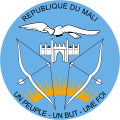
  • Coat of arms of Mali
    coat of arms, from 1973Coat of arms of Mali · Public domain

Its world

Who else stood

Meanwhile, elsewhere

The best-known states of other regions that stood while it did; the band is Mali’s own years.

1960198020002020

How it compares

Among 3,073 states

Stood longer than 38% of 3,073 states
Mali · 66 yearsBremenSoviet UnionHow long it stood, among the states with a recorded end or still standing.
Held more ground at its peak than 88% of 1,464 states
Mali · 1,451,100 km²PeruMongoliaThe most ground it held, among the states with a border in Cliopatria.
Had more wars on record per century than 98% of 3,073 states
Mali · 3.0Wars recorded per century, among the states, counting the wars the atlas hosts under each.

How it began

How did Mali begin?

What led to it, and what came of it

French Sudan · Linked · 1880 – 1959French SudanFrench West Africa · Linked · 1895 – 1958French West AfricaMali Federation · Linked · 1959 – 1960Mali FederationSoumeylou Boubèye Maïga · Coincidence · 1954 – 2022Soumeylou Boubèye MaïgaMali · 1960 – 2026Mali190019502000
linkedcoincidence

Open the investigation: every row with its evidence, the conditions at the time, the theories condition by condition, and the succession analysed.

Its centuries in the record

1900 – 1999: 35 recorded — 1 wars and battles, 3 risings, regime changes and massacres, 31 other19002000 – 2099: 13 recorded — 4 wars and battles, 8 risings, regime changes and massacres, 1 other2000

Wars and battles in red, risings, coups and massacres beside them, everything else in grey, by the century each began in. A tall bar is partly a fact about Wikipedia: better-documented centuries hold more.

Each century’s own page:1900 – 19992000 – 2099

Keep exploring

Share this page
Copy link
Embed the map
Cite this page

How this page is made

Drawn from Wikidata (Q912, CC0), the opening and history of its English Wikipedia article retold by the atlas (CC BY-SA 4.0), borders from Cliopatria (CC BY 4.0), coast and rivers from Natural Earth, cities from Reba, Reitsma & Seto 2016 (CC BY 4.0), symbols from Wikimedia Commons, each under its own licence. Data built 2026-11-26 · Pastlas v2.47.1, by Oleh Voronko; the published atlas and its data are for non-commercial use.

How to read it

Areas are measured on an equal-area grid from borders simplified to about five kilometres. “c.” marks an approximate date, and a date known to the century is never printed to the year. Counts are what the atlas holds, and they follow Wikipedia’s coverage: a busy century is partly a fact about the record.

  • Still standing: the span runs to the year of the build, 2026.

Something wrong?

Tell us and name the entry. We fix the data, not just this page.

Report a problem