State · Americas and Oceania

Empire of Brazil

1822 – 1889 · 67 years

Came after United Kingdom of Portugal, Brazil and the Algarves and Kingdom of Brazil · became Brazil and First Brazilian Republic

Brazil under two emperors, father and son: a huge, stable constitutional monarchy that abolished slavery, then gave way to a republic.

In 1822 Pedro, the regent left behind when John VI returned to Portugal, declared Brazil independent and was acclaimed its first emperor. His empire took in modern Brazil and, until 1828, Uruguay. Pedro I abdicated in 1831, and the weak regency for his five-year-old son Pedro II saw regional civil wars. Under Pedro II the country grew stable and prosperous, but after slavery was abolished in 1888 the ultraconservatives turned republican, and the monarchy fell in 1889.

What the record holds

It was founded in 1822, replacing the United Kingdom of Portugal, Brazil and the Algarves and the Kingdom of Brazil.↓ In 1822, the first year its borders are mapped, it covered 8.02 million km².↓ Over the years of the Ragamuffin War, 1835 – 1845, its ground went from 7.85 million km² to 7.56 million km².↓

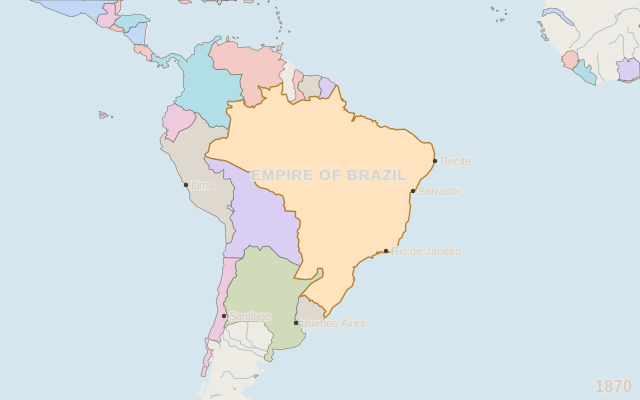
It reached its greatest extent in 1870: 8.54 million km².↓ Its line counts 3 rulers, covering 1822 – 1889, the median reign 9 years; 2 of 2 handovers were irregular.↓ Among them, Pedro I of Brazil, Pedro II of Brazil and John VI of Portugal are the best known.↓ The atlas files 24 rows under it, people the largest group of them.↓

It was replaced by Brazil and the First Brazilian Republic in 1889, 67 years after it began.↓ One theory of why states fall has every condition present at its end: “Elite conflict”.↓

From Wikipedia’s article, retold · CC BY-SA 4.0

67 years

Longer than Bremen, shorter than the Soviet Union

8.54 million km²

At its height in 1870 · about the size of Brazil

3 rulers

the Emperor of Brazil

5 wars and battles

More per century than 96% of states · 24 entries in all

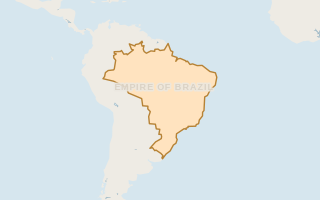
Map: Empire of Brazil in 1870, its borders in gold among its neighbours
Brazilian War of Independence, 1822 – 1824: 8.02 million km² → 8.02 million km²Confederation of the Equator, 1824Treaty of Rio de Janeiro, 1825Ragamuffin War, 1835 – 1845: 7.85 million km² → 7.56 million km²Proclamation of the Republic, 1889184018601880
Beside it on the map in 1870: Argentina, Bolivia, Peru, Colombia, United States of Venezuela and Chile.How far it reached, year by year: its ground inside the borders Cliopatria draws (CC BY 4.0), measured on an equal-area grid; the map shows it at its largest, with the cities of the year.

The story

Four acts, 1822 – 1889

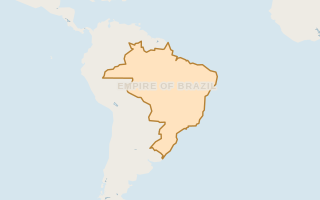
Empire of Brazil in 1830, at the end of act I
I1822 – 18318.02 million → 7.85 million km²

The first emperor

Pedro declares independence and defeats his father's kingdom. He quarrels with parliament over the crown's role, and the lost Cisplatine War costs Brazil the province of Cisplatina. King of Portugal from 1826, he hands that throne to his daughter Maria, and in 1831 abdicates in Brazil and leaves for Europe.

Watch this act on the live map, from 1822
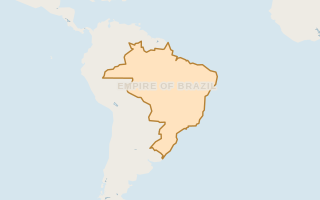
Empire of Brazil in 1852, at the end of act II
II1831 – 18537.85 million → 7.85 million km²

Regency and revolt

A five-year-old is emperor, and a regency subordinate to the General Assembly cannot fill the void at the head of government. Regional revolts break out, among them the Cabanagem, the Balaiada and the ten-year Ragamuffin War. By 1846 Pedro II has grown into his office; he removes the courtiers who swayed him and begins to rule in earnest.

Watch this act on the live map, from 1831
Empire of Brazil in 1869, at the end of act III
III1853 – 18708.05 million → 8.5 million km²

Growth and the Paraguayan War

Railways, the telegraph and steamships knit the country together, and in 1853 the Marquis of Paraná forms a cabinet to carry out the Emperor's plan of Conciliation. A British ultimatum in 1863 ends in a break with Britain. Brazil then turns south, defeats Uruguay in 1865 and fights Paraguay until victory in 1870.

Watch this act on the live map, from 1853
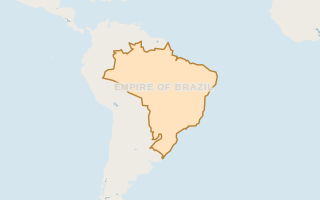
Empire of Brazil in 1888, at the end of act IV
IV1870 – 18898.54 million → 8.39 million km²

Golden age and fall

Victory opens a golden age of rapid growth, railways and immigration. A weary Pedro II stops stepping in to keep the peace. In 1888, while he is in Europe for treatment, Princess Isabel signs the Golden Law ending slavery; the ultraconservatives swing to the republicans, and the Republic is proclaimed in 1889.

Watch this act on the live map, from 1870

Before and after

Before it

After it

  • Brazil · replaced by · 1889 – present
  • First Brazilian Republic · replaced by · 1889 – 1930
  • Republic of the United States of Brazil · replaced by

Where it sits in time

3000 BCE2000 BCE1000 BCE110002000United Kingdom of Portugal, Brazil and the Algarves: 1815 – 1825Brazil: 1889 – 2026First Brazilian Republic: 1889 – 1930Empire of Brazil: 1822 – 1889

Five thousand years, 3000 BCE to 2026; the state in gold, what it replaced or followed and what replaced or followed it in grey.

Its people

Lives across the Empire of Brazil

180018251850187519001925
Statesmen and generalsWriters, artists and thinkersScientists and explorersLived on after it endedAll its people on the timeline →

How it was governed

3 emperors

3 emperors on record, 1822 to 1889; a reign lasted 9 years at the median. Each bar is a reign, as long as it lasted.

Pedro I of Brazil · 1822 – 1831 · abdicated, the article saysJohn VI of Portugal · 1825 – 1826 · killedPedro II of Brazil · 1831 – 1889 · deposed, the article says184018601880
a second row: a reign that began before the last had ended — rival claimants, or a shared throne
How their terms ended, where it is known (3 of 3):Killed 1Deposed or removed 2
Every term, with how it ended and its source

Rulers

How 3 reigns ended - choose one to show only those

How they died, where the record says: died of natural causes 2 · killed 1.

RulerReignLengthHow it ended · sourceTo the ruler before
19th century · 3 reigns · 3 killed or removed
Pedro I of Brazil · aged 241822 – 18319 yearsabdicatedread from the ruler's own articledied of natural causes
John VI of Portugal · aged 581825 – 18261 yearkilled in officeWikidata's manner of deathparent
Pedro II of Brazil · aged 61831 – 188958 yearsdeposedread from the ruler's own articledied of natural causesgrandchild

3 rulers, 3 with terms dated as terms, covering 1822 – 1889. Median reign 9 years. 2 of 2 handovers irregular - a killing, a deposition, a rival claimant, a rising or a coup beside it. A blank in the last column means no kin on record, which is coverage, never “unrelated”.

Flags and arms, in order

  • Coat of arms of the Empire of Brazil
    coat of arms, undatedCoat of arms of the Empire of Brazil · CC BY 3.0 · Gusthavum
  • Flag of the Kingdom of Brazil (18 september - 1 december 1822)
    flag, 1822 – 1822Flag of the Kingdom of Brazil (18 september - 1 december 1822) · Public domain
  • Flag of Brazil (1822–1853)
    flag, 1822 – 1889Flag of Brazil (1822–1853) · Public domain
  • Flag of Brazil (1853-1889)
    flag, 1853 – 1889Flag of Brazil (1853-1889) · Public domain

Its world

Rivals, and who else stood

Who it fought most

Wars and battles both took part in, on whichever side: the record names who took part, not who fought whom.

Meanwhile, elsewhere

The best-known states of other regions that stood while it did; the band is the Empire of Brazil’s own years.

1820184018601880

How it compares

Among 3,073 states

Stood longer than 38% of 3,073 states
Empire of Brazil · 67 yearsBremenSoviet UnionHow long it stood, among the states with a recorded end or still standing.
Held more ground at its peak than 98% of 1,464 states
Empire of Brazil · 8,538,200 km²AustraliaBrazilThe most ground it held, among the states with a border in Cliopatria.
Had more wars on record per century than 96% of 3,073 states
Empire of Brazil · 2.0Wars recorded per century, among the states, counting the wars the atlas hosts under each.

Why it fell

Why did the Empire of Brazil fall?

Historians still argue. Here is what the atlas records about its last century:

1889

Pedro II of Brazil, deposed or removed in office

What led to it, and what came of it

United Kingdom of Portugal, Brazil and the Algarves · Linked · 1815 – 1825United Kingdom of Portugal, Braz…Kingdom of Brazil · Linked · 1815 – 1825Kingdom of BrazilEmpire of Brazil · 1822 – 1889Empire of BrazilBrazil · Linked · 1889 – 2026BrazilFirst Brazilian Republic · Linked · 1889 – 1930First Brazilian RepublicRepublic of the United States of Brazil · Linked · 1889Republic of the United States of…War of Canudos · Linked · 1896 – 1897War of Canudos1850190019502000
linked

Open the investigation: every row with its evidence, the conditions at the time, the theories condition by condition, and the succession analysed.

Theories that apply to its ending

  • Elite conflict

    Lachmann 2000 · Lachmann 2010

    Applies by its own logic: 2 of its 2 conditions held here (it needs all of them), and this is the kind of outcome it predicts — adverse regime change, unrest or the state's ending.

    • 2 or more elite groups in the regime's support, or a parliament met within 100 y — agrarian elites, party elites, business elites, civil servants, the military (1880)
    • an elite group among the regime's opposition within 5 y, or an elite group left the regime's support over 10 y, or a monarch deposed or killed by others within 20 y, or overlapping reigns — rival claimants — within 20 y — the aristocracy (1889)

In the record

24 entries the atlas files under it, all in 1800 – 1899.

Keep exploring

Share this page
Copy link
Embed the map
Cite this page

How this page is made

Drawn from Wikidata (Q217230, CC0), the opening and history of its English Wikipedia article retold by the atlas (CC BY-SA 4.0), borders from Cliopatria (CC BY 4.0), coast and rivers from Natural Earth, cities from Reba, Reitsma & Seto 2016 (CC BY 4.0), symbols from Wikimedia Commons, each under its own licence. Data built 2026-11-26 · Pastlas v2.47.1, by Oleh Voronko; the published atlas and its data are for non-commercial use.

How to read it

Areas are measured on an equal-area grid from borders simplified to about five kilometres. “c.” marks an approximate date, and a date known to the century is never printed to the year. Counts are what the atlas holds, and they follow Wikipedia’s coverage: a busy century is partly a fact about the record.

Something wrong?

Tell us and name the entry. We fix the data, not just this page.

Report a problem