State · Sub-Saharan Africa

Zaire

1971 – 1997 · 26 years

Came after Democratic Republic of the Congo and First Congolese Republic

Mobutu Sese Seko's one-party state in Central Africa, remade under authenticité and toppled by Kabila's rebellion.

Zaire was the name Mobutu Sese Seko gave the Democratic Republic of the Congo on 27 October 1971. Africa's third-largest country by area, it was a one-party military dictatorship run by Mobutu through his Popular Movement of the Revolution, and the U.S. backed it against Soviet influence. When American support ended with the Cold War, it sank into unrest, and in 1997 Laurent-Désiré Kabila's rebels drove Mobutu out and the old name returned.

What the record holds

Zaire began in 1971, replacing the Democratic Republic of the Congo and the First Congolese Republic.↓ When the borders dataset first draws it, in 1973, it held 2.32 million km².↓

Its highest office was held by 9 rulers, covering 1990 – 1997; 1 of 8 handovers was irregular.↓ Among them, Étienne Tshisekedi, Likulia Bolongo and Léon Kengo wa Dondo are the best known.↓ The atlas files 11 rows under it, most of them people.↓

It ended in 1997, 26 years after it began.↑ 2 theories of why states fall have every condition present at its end: “Demographic-structural breakdown” and “Elite conflict”.↓

From Wikipedia’s article, retold · CC BY-SA 4.0

26 years

Longer than South Vietnam, shorter than the Republic of Artsakh

2.32 million km²

At its height in 1973 · about the size of the Democratic Republic of the Congo

9 rulers

the Prime Minister of Zaire

2 wars and battles

More per century than 96% of states · 11 entries in all

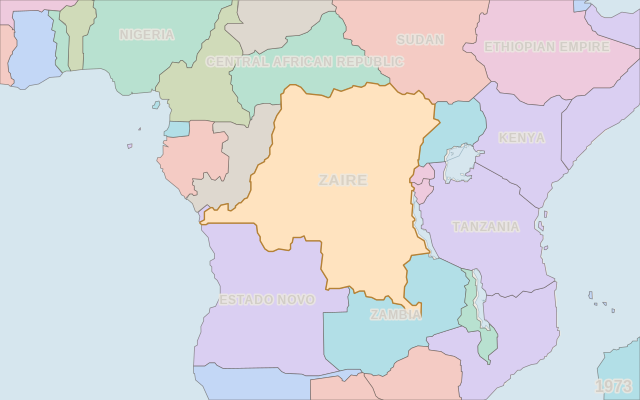
Map: Zaire in 1973, its borders in gold among its neighbours
198019851990
Beside it on the map in 1973: Estado Novo, Ethiopian Empire, Sudan, Tanzania, Zambia and Nigeria.How far it reached, year by year: its ground inside the borders Cliopatria draws (CC BY 4.0), measured on an equal-area grid; the map shows it at its largest, with the cities of the year.

The story

Its key moments

Before and after

Before it

Where it sits in time

3000 BCE2000 BCE1000 BCE110002000First Congolese Republic: 1960 – 1971Democratic Republic of the Congo: 1960 – 2026Zaire: 1971 – 1997

Five thousand years, 3000 BCE to 2026; the state in gold, what it replaced or followed and what replaced or followed it in grey.

Its people

Lives across Zaire

19401960198020002020
Statesmen and generalsLived on after it endedAll its people on the timeline →

How it was governed

9 ministers

9 ministers on record, 1990 to 1997. Each bar is a reign, as long as it lasted.

Lunda Bululu · 1990 – 1991 · no death date to read the end againstMulumba Lukoji · 1991 – 1991 · deposed, the article saysBernardin Mungul Diaka · 1991 – 1991 · left office aliveJean Nguza Karl-i-Bond · 1991 – 1992 · left office aliveÉtienne Tshisekedi · 1992 – 1993 · left office aliveFaustin Birindwa · 1993 – 1994 · resigned or stood down, the article saysLéon Kengo wa Dondo · 1994 – 1997 · resigned or stood down, the article saysLikulia Bolongo · 1997 – 1997 · left office aliveÉtienne Tshisekedi · 1997 – 1997 · left office alive19751980198519901995
How their terms ended, where it is known (8 of 9):Deposed or removed 1Left office alive 7Not on record 1
Every term, with how it ended and its source

Rulers

How 9 reigns ended - choose one to show only those

How they died, where the record says: died of natural causes 3.

RulerReignLengthHow it ended · sourceTo the ruler before
20th century · 9 reigns · 1 killed or removed
Lunda Bululu · aged 481990 – 19911 yearending not on record
Mulumba Lukoji · aged 481991 – 1991under a yeardeposedread from the ruler's own article
Bernardin Mungul Diaka · aged 581991 – 1991under a yearleft office aliveread off the dates alone
Jean Nguza Karl-i-Bond · aged 531991 – 19921 yearleft office aliveread off the dates alone
Étienne Tshisekedi · aged 601992 – 19931 yearleft office aliveread off the dates alonedied of natural causes
Faustin Birindwa · aged 501993 – 19941 yearresignedread from the ruler's own articledied of natural causes
Léon Kengo wa Dondo · aged 591994 – 19973 yearsresignedread from the ruler's own article
Likulia Bolongo · aged 581997 – 1997under a yearleft office aliveread off the dates alone
Étienne Tshisekedi · aged 651997 – 1997under a yearleft office aliveread off the dates alonedied of natural causes

9 rulers, 8 with terms dated as terms, covering 1990 – 1997. Only 7 years of the line are dated - too short for a median. 1 of 8 handovers irregular - a killing, a deposition, a rival claimant, a rising or a coup beside it. The violent-handover count is withheld: power changed hands so often that any rising falls beside one (exposure 1.00, limit 0.6). A blank in the last column means no kin on record, which is coverage, never “unrelated”.

The line also names one holder with a page of their own whose term the record gives no first year, so the table cannot place it: Mobutu Sese Seko.

Flags and arms, in order

  • Coat of arms of Zaire (1971–1997)
    coat of arms, undatedCoat of arms of Zaire (1971–1997) · Public domain
  • Flag of Zaire (1971–1997)
    flag, undatedFlag of Zaire (1971–1997) · Public domain

Its world

Rivals, and who else stood

Who it fought most

Wars and battles both took part in, on whichever side: the record names who took part, not who fought whom.

Meanwhile, elsewhere

The best-known states of other regions that stood while it did; the band is Zaire’s own years.

1970198019902000

How it compares

Among 3,073 states

Stood longer than 24% of 3,073 states
Zaire · 26 yearsSouth VietnamRepublic of ArtsakhHow long it stood, among the states with a recorded end or still standing.
Held more ground at its peak than 92% of 1,464 states
Zaire · 2,317,900 km²DenmarkAlgeriaThe most ground it held, among the states with a border in Cliopatria.
Had more wars on record per century than 96% of 3,073 states
Zaire · 2.0Wars recorded per century, among the states, counting the wars the atlas hosts under each.

Why it fell

Why did Zaire fall?

Historians still argue. Here is what the atlas records about its last century:

1991

Mulumba Lukoji, deposed or removed in office

What led to it, and what came of it

Democratic Republic of the Congo · Linked · 1960 – 2026Democratic Republic of the CongoFirst Congolese Republic · Linked · 1960 – 1971First Congolese RepublicZaire · 1971 – 1997Zaire1960198020002020
linked

Open the investigation: every row with its evidence, the conditions at the time, the theories condition by condition, and the succession analysed.

Theories that apply to its ending

  • Demographic-structural breakdown

    Goldstone 1991 · Turchin & Nefedov 2009

    Applies by its own logic: 2 of its 3 conditions held here (it needs 2), and this is the kind of outcome it predicts — unrest, adverse regime change or the state's ending.

    • overlapping reigns — rival claimants — within 20 y, or 3 or more changes of ruler within 20 y, or 2 or more reigns of two years or less within 20 y, or a monarch deposed or killed within 20 y — handovers 8; shortReigns 6
    • a war the state is fighting, still under way, or a war the state fought, ended within 10 y — warOngoing; warEnded
  • Elite conflict

    Lachmann 2000 · Lachmann 2010

    Applies by its own logic: 2 of its 2 conditions held here (it needs all of them), and this is the kind of outcome it predicts — adverse regime change, unrest or the state's ending.

    • 2 or more elite groups in the regime's support, or a parliament met within 100 y — party elites, civil servants, the military (1962)
    • an elite group among the regime's opposition within 5 y, or an elite group left the regime's support over 10 y, or a monarch deposed or killed by others within 20 y, or overlapping reigns — rival claimants — within 20 y — party elites, the military (1992)

In the record

11 entries the atlas files under it, all in 1900 – 1999.

Keep exploring

Share this page
Copy link
Embed the map
Cite this page

How this page is made

Drawn from Wikidata (Q6500954, CC0), the opening and history of its English Wikipedia article retold by the atlas (CC BY-SA 4.0), borders from Cliopatria (CC BY 4.0), coast and rivers from Natural Earth, cities from Reba, Reitsma & Seto 2016 (CC BY 4.0), symbols from Wikimedia Commons, each under its own licence. Data built 2026-11-26 · Pastlas v2.47.1, by Oleh Voronko; the published atlas and its data are for non-commercial use.

How to read it

Areas are measured on an equal-area grid from borders simplified to about five kilometres. “c.” marks an approximate date, and a date known to the century is never printed to the year. Counts are what the atlas holds, and they follow Wikipedia’s coverage: a busy century is partly a fact about the record.

Something wrong?

Tell us and name the entry. We fix the data, not just this page.

Report a problem