The story
Its key moments
Where it sits in time
Five thousand years, 3000 BCE to 2026; the state in gold.
State · Europe
987 – 1452 · 465 years
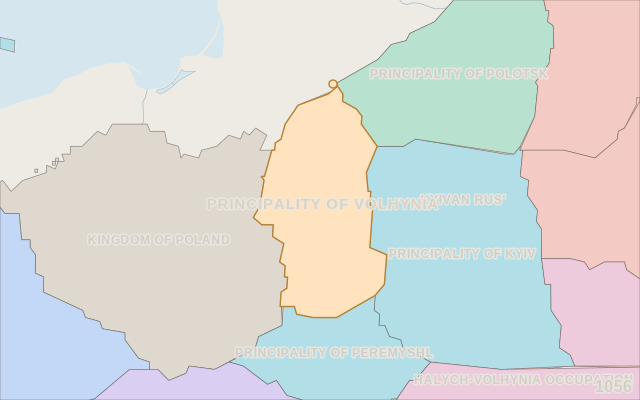
The record dates its beginning to 987.↑ In 1056, the first year its borders are mapped, it covered 82,000 km².↓
Its line counts 8 rulers, covering 987 – 1452, the median reign 17.5 years; none of its 7 handovers was irregular.↓ Among them,  Danylo of Halych,
 Roman the Great and
 Sviatoslav II of Kyiv are the best known.↓ The atlas files 5 rows under it, most of them people.↓ It ended in 1452, 465 years after it began.↑
Best known for
465 years
Longer than the Mali Empire, shorter than the Parthian Empire
82,000 km²
At its height in 1056 · about the size of Panama
8 rulers
the knyaz
 Kyivan Rus',
 Kingdom of Poland,
 Principality of Kyiv,
 Principality of Polotsk, Principality of Smolensk and
 Holy Roman Empire.How far it reached, year by year: its ground inside the borders Cliopatria draws (CC BY 4.0), measured on an equal-area grid; the map shows it at its largest, with the cities of the year.
The story
Five thousand years, 3000 BCE to 2026; the state in gold.
Its people
One axis for everyone, so you can see who knew whom: the best-known, ordered by birth.
The best-known people the record files under it, by how many Wikipedias write about them.
 Danylo of Halychruler · 1201 – 1264
 Roman the Greatruler · 1150 – 1205
 Liubartasruler · 1300 – 1384
 Yuri II Boleslavruler · 1308 – 1340
 Vsevolod Volodymyrovychruler · 1000 – 1100
How it was governed
8 knyazes on record, 987 to 1452; a reign lasted 17.5 years at the median. Each bar is a reign, as long as it lasted.
The line of knyaz.
| Ruler | Reign | Length | How it ended · source | To the ruler before |
|---|---|---|---|---|
| 10th century · 1 reign | ||||
| Vsevolod Volodymyrovych | 987 – 1013 | 26 years | left office aliveread off the dates alone | |
| 11th century · 1 reign | ||||
 Sviatoslav II of Kyiv | 1040 – 1054 | 14 years | ending not on record | nephew or niece |
| 12th century · 1 reign | ||||
| Roman the Great | 1170 – 1189 | 19 years | ending not on record | |
| 13th century · 1 reign | ||||
| Danylo of Halych | 1205 – 1206 | 1 year | ending not on record | child |
| 14th century · 3 reigns | ||||
| Andrew of Galicia | 1308 – 1323 | 15 years | ending not on record | |
| Yuri II Boleslav | 1323 – 1340 | 17 years | ending not on record | |
| Liubartas | 1340 – 1383 | 43 years | ending not on record | |
| 15th century · 1 reign | ||||
 Švitrigaila / Svidrigiello | 1434 – 1452 | 18 years | ending not on record | nephew or niece |
8 rulers, 8 with terms dated as terms, covering 987 – 1452. Median reign 17.5 years. 0 of 7 handovers irregular - a killing, a deposition, a rival claimant, a rising or a coup beside it. A blank in the last column means no kin on record, which is coverage, never “unrelated”.
Liubartas43 yrsVsevolod Volodymyrovych26 yrsRoman the Great19 yrsŠvitrigaila / Svidrigiello18 yrsYuri II Boleslav17 yrsIts world
The best-known states of other regions that stood while it did; the band is the Principality of Volhynia’s own years.
 Persian EmpireMiddle East and North Africa
 Mongol EmpireEast and Southeast Asia
 Delhi SultanateSouth Asia
 TenochtitlanAmericas and Oceania
How it compares
Each column is a share of the states; gold is the Principality of Volhynia.
Why it fell
Historians still argue. Here is what the atlas records about its last century:
The investigation's own picture: 6 causes the record names and 0 results, the strongest six of each at their own years, joined to the state by the kind of claim - a recorded statement solid, the article's sentence dashed, a theory dash-dot.
Open the investigation: every row with its evidence, the conditions at the time, the theories condition by condition, and the succession analysed.
Wars and battles in red, risings, coups and massacres beside them, everything else in grey, by the century each began in. A tall bar is partly a fact about Wikipedia: better-documented centuries hold more.
Each century’s own page:900 – 9991000 – 10991100 – 11991200 – 12991300 – 13991400 – 1499
“Principality of Volhynia”, Pastlas, a historical atlas, 2026-11-26. https://app.pastlas.com/state/principality-of-volhynia/
Drawn from Wikidata (Q680472, CC0), borders from Cliopatria (CC BY 4.0), coast and rivers from Natural Earth, cities from Reba, Reitsma & Seto 2016 (CC BY 4.0). Data built 2026-11-26 · Pastlas v2.47.1, by Oleh Voronko; the published atlas and its data are for non-commercial use.
Areas are measured on an equal-area grid from borders simplified to about five kilometres. “c.” marks an approximate date, and a date known to the century is never printed to the year. Counts are what the atlas holds, and they follow Wikipedia’s coverage: a busy century is partly a fact about the record.