State · East and Southeast Asia

Philippines

1946 – present · 80 years · still standing

Came after Commonwealth of the Philippines

An archipelago of some 7,600 islands, scarred by Marcos's dictatorship and returned to democracy by the People Power Revolution.

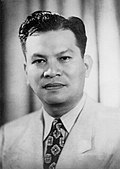
The Philippines became independent in 1946, after American forces retook the islands from Japan. Under Ramon Magsaysay post-war rebuilding succeeded and the Hukbalahap Rebellion ended, though communist insurgency kept flaring. Ferdinand Marcos, elected in 1965, ruled under martial law from 1972 to 1981, and in 1986 the People Power Revolution overthrew him and restored democracy. An archipelago of some 7,600 islands, it became home to more than 114 million people.

What the record holds

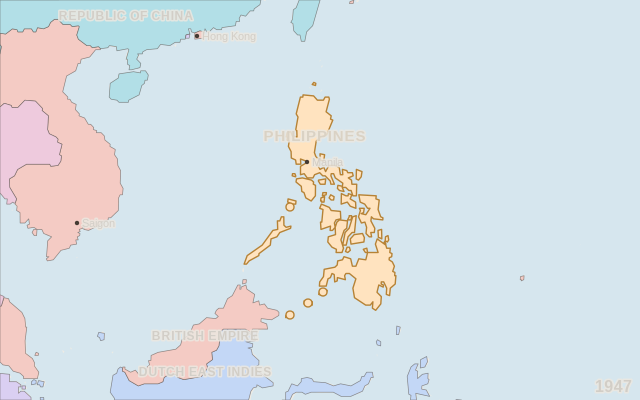
Its record opens in 1946, replacing the Commonwealth of the Philippines.↓ In 1947, the first year its borders are mapped, it covered 345,000 km².↓

Its line counts 16 rulers, covering 1935 – 2022, the median reign 5 years; 4 of 15 handovers were irregular.↓ Among them, Ferdinand Marcos, Rodrigo Duterte and Corazon Aquino are the best known.↓ The atlas files 52 rows under it, people the largest group of them.↓

From Wikipedia’s article, retold · CC BY-SA 4.0

80 years

Longer than the Empire of Japan, shorter than the Western Roman Empire

345,000 km²

At its height in 1947 · about the size of the Republic of the Congo

16 rulers

the President of the Philippines

2 wars and battles

More per century than 92% of states · 52 entries in all

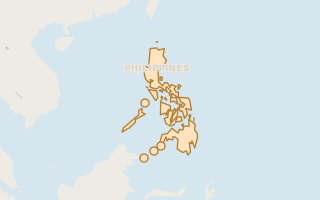
Map: Philippines in 1947, its borders in gold among its neighbours
Moro conflict, 1969People Power Revolution, 1986Maguindanao massacre, 2009196019701980199020002010
Beside it on the map in 1947: French Indochina, Republic of China, Dutch East Indies, British Empire, Thailand and Indonesia.How far it reached, year by year: its ground inside the borders Cliopatria draws (CC BY 4.0), measured on an equal-area grid; the map shows it at its largest, with the cities of the year.

The story

Four acts, 1946 – present

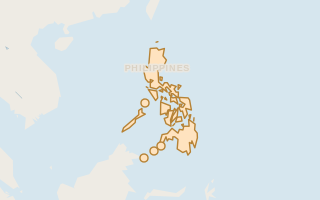
Philippines in 1964, at the end of act I
I1946 – 1965

Rebuilding after the war

Independence comes in 1946, the year of the Treaty of Manila. Under Ramon Magsaysay reconstruction succeeds and the Hukbalahap Rebellion is ended, though communist insurgency keeps flaring. Carlos P. Garcia's Filipino First policy favours Filipino-owned firms, and Diosdado Macapagal moves Independence Day to 12 June, the anniversary of Emilio Aguinaldo's declaration, and claims eastern North Borneo.

Watch this act on the live map, from 1946
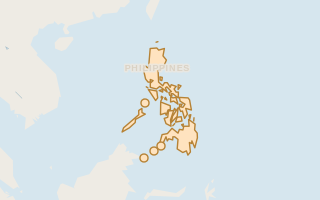
Philippines in 1985, at the end of act II
II1965 – 1986345,000 → 345,000 km²

The Marcos years

Ferdinand Marcos defeats Macapagal in 1965 and launches public works paid for largely with foreign loans. The Moro conflict, the New People's Army rebellion and a wider civil conflict all date from 1969. Marcos rules under martial law from 1972 to 1981, and in 1986 the People Power Revolution overthrows him.

Watch this act on the live map, from 1965
Philippines in 2015, at the end of act III
III1986 – 2016345,000 → 345,000 km²

Democracy restored

Corazon Aquino leads the restored democracy from 1986, followed by Fidel V. Ramos in 1992. An earthquake strikes Luzon in 1990 and Mount Pinatubo erupts in 1991. In 2001, the year of the Second EDSA Revolution, Gloria Macapagal Arroyo becomes president; the Maguindanao massacre comes in 2009, and Benigno Aquino III governs from 2010.

Watch this act on the live map, from 1986
IV2016 – present

Duterte and the second Marcos

Rodrigo Duterte takes office in 2016, the year of the Davao City bombing. The siege of Marawi in 2017 and the Jolo Cathedral bombings of 2019 follow, and 2020 brings the COVID-19 pandemic and eruptions of Taal Volcano. Bongbong Marcos becomes president in 2022, and earthquakes shake Mindanao and Cebu.

Watch this act on the live map, from 2016

Before and after

Before it

Where it sits in time

3000 BCE2000 BCE1000 BCE110002000Commonwealth of the Philippines: 1935 – 1946Philippines: 1946 – 2026

Five thousand years, 3000 BCE to 2026; the state in gold, what it replaced or followed and what replaced or followed it in grey.

Its people

Lives across Philippines

190019251950197520002025
Statesmen and generalsAll its people on the timeline →

How it was governed

16 presidents

16 presidents on record, 1935 to 2022; a reign lasted 5 years at the median. Each bar is a reign, as long as it lasted.

Manuel L. Quezon · 1935 – 1944 · died in office of natural causesJose P. Laurel · 1943 – 1945 · left office aliveSergio Osmeña · 1944 – 1946 · left office aliveManuel Roxas · 1946 – 1948 · died in office of natural causesElpidio Quirino · 1948 – 1953 · left office aliveRamon Magsaysay · 1953 – 1957 · died by accidentCarlos P. Garcia · 1957 – 1961 · left office aliveDiosdado Macapagal · 1961 – 1965 · left office aliveFerdinand Marcos · 1965 – 1986 · deposed, the article saysCorazon Aquino · 1986 – 1992 · resigned or stood down, the article saysFidel V. Ramos · 1992 – 1998 · left office aliveJoseph Estrada · 1998 – 2001 · deposed, the article saysGloria Macapagal Arroyo · 2001 – 2010 · resigned or stood down, the article saysBenigno Aquino III · 2010 – 2016 · left office aliveRodrigo Duterte · 2016 – 2022 · no death date to read the end againstBongbong Marcos · 2022 – … · still in office1960198020002020
a second row: a reign that began before the last had ended — rival claimants, or a shared throne
How their terms ended, where it is known (15 of 16):Deposed or removed 2Died in office 3Left office alive 9In office 1Not on record 1
Every term, with how it ended and its source

Rulers

How 16 reigns ended - choose one to show only those

How they died, where the record says: died of natural causes 11 · died by accident 1.

RulerReignLengthHow it ended · sourceTo the ruler before
20th century · 12 reigns · 2 killed or removed
Manuel L. Quezon · aged 571935 – 19449 yearsdied in officeWikidata's manner of deathdied of natural causes
Jose P. Laurel · aged 521943 – 19452 yearsleft office aliveread off the dates alonedied of natural causes
Sergio Osmeña · aged 661944 – 19462 yearsleft office aliveread off the dates alonedied of natural causes
Manuel Roxas · aged 541946 – 19482 yearsdied in officeWikidata's manner of deathdied of natural causes
Elpidio Quirino · aged 581948 – 19535 yearsleft office aliveread off the dates alonedied of natural causes
Ramon Magsaysay · aged 461953 – 19574 yearsdied by accidentWikidata's manner of deathdied by accident
Carlos P. Garcia · aged 611957 – 19614 yearsleft office aliveread off the dates alonedied of natural causes
Diosdado Macapagal · aged 511961 – 19654 yearsleft office aliveread off the dates alonedied of natural causes
Ferdinand Marcos · aged 481965 – 198621 yearsdeposedread from the ruler's own articledied of natural causes
Corazon Aquino · aged 531986 – 19926 yearsresignedread from the ruler's own articledied of natural causes
Fidel V. Ramos · aged 641992 – 19986 yearsleft office aliveread off the dates alonedied of natural causes
Joseph Estrada · aged 611998 – 20013 yearsdeposedread from the ruler's own article
21st century · 4 reigns
Gloria Macapagal Arroyo · aged 542001 – 20109 yearsresignedread from the ruler's own article
Benigno Aquino III · aged 502010 – 20166 yearsleft office aliveread off the dates alonedied of natural causes
Rodrigo Duterte · aged 712016 – 20226 yearsending not on record
Bongbong Marcos · aged 652022 – in officein office since 2022still in office

16 rulers, 16 with terms dated as terms, covering 1935 – 2022. Median reign 5 years. 4 of 15 handovers irregular - a killing, a deposition, a rival claimant, a rising or a coup beside it. The violent-handover count is withheld: power changed hands so often that any rising falls beside one (exposure 0.80, limit 0.6). A blank in the last column means no kin on record, which is coverage, never “unrelated”.

Flags and arms, in order

  • Flag of the Philippines (1985–1986)
    flag, undatedFlag of the Philippines (1985–1986) · Public domain
  • Flag of the Philippines (navy blue)
    flag, 1936 – 1985Flag of the Philippines (navy blue) · Public domain
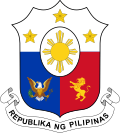
  • Coat of arms of the Philippines
    coat of arms, from 1940Coat of arms of the Philippines · Public domain
  • Flag of the Philippines (navy blue)
    flag, 1986 – 1998Flag of the Philippines (navy blue) · Public domain
  • Flag of the Philippines
    flag, from 1998Flag of the Philippines · Public domain

Its world

Rivals, and who else stood

Who it fought most

Wars and battles both took part in, on whichever side: the record names who took part, not who fought whom.

Meanwhile, elsewhere

The best-known states of other regions that stood while it did; the band is Philippines’s own years.

19401960198020002020

How it compares

Among 3,073 states

Stood longer than 42% of 3,073 states
Philippines · 80 yearsEmpire of JapanWestern Roman EmpireHow long it stood, among the states with a recorded end or still standing.
Held more ground at its peak than 68% of 1,464 states
Philippines · 345,000 km²VietnamRepublic of the CongoThe most ground it held, among the states with a border in Cliopatria.
Had more wars on record per century than 92% of 3,073 states
Philippines · 1.0Wars recorded per century, among the states, counting the wars the atlas hosts under each.

How it began

How did Philippines begin?

What led to it, and what came of it

Commonwealth of the Philippines · Linked · 1935 – 1946Commonwealth of the PhilippinesEmilio Aguinaldo · Coincidence · 1869 – 1964Emilio AguinaldoTan Malaka · Coincidence · 1897 – 1949Tan MalakaLuis Taruc · Coincidence · 1913 – 2005Luis TarucNick Joaquin · Coincidence · 1917 – 2004Nick JoaquinNinoy Aquino · Coincidence · 1932 – 1983Ninoy AquinoPhilippines · 1946 – 2026Philippines190019502000
linkedcoincidence

Open the investigation: every row with its evidence, the conditions at the time, the theories condition by condition, and the succession analysed.

Its centuries in the record

1900 – 1999: 28 recorded — 1 wars and battles, 7 risings, regime changes and massacres, 20 other19002000 – 2099: 20 recorded — 1 wars and battles, 6 risings, regime changes and massacres, 13 other2000

Wars and battles in red, risings, coups and massacres beside them, everything else in grey, by the century each began in. A tall bar is partly a fact about Wikipedia: better-documented centuries hold more.

Each century’s own page:1900 – 19992000 – 2099

Keep exploring

Share this page
Copy link
Embed the map
Cite this page

How this page is made

Drawn from Wikidata (Q928, CC0), the opening and history of its English Wikipedia article retold by the atlas (CC BY-SA 4.0), borders from Cliopatria (CC BY 4.0), coast and rivers from Natural Earth, cities from Reba, Reitsma & Seto 2016 (CC BY 4.0), symbols from Wikimedia Commons, each under its own licence. Data built 2026-11-26 · Pastlas v2.47.1, by Oleh Voronko; the published atlas and its data are for non-commercial use.

How to read it

Areas are measured on an equal-area grid from borders simplified to about five kilometres. “c.” marks an approximate date, and a date known to the century is never printed to the year. Counts are what the atlas holds, and they follow Wikipedia’s coverage: a busy century is partly a fact about the record.

  • Wikidata records foundings in 1565 and 1901 and 1935 and 1946; the atlas draws the present-day state from 1946.
  • Still standing: the span runs to the year of the build, 2026.

Something wrong?

Tell us and name the entry. We fix the data, not just this page.

Report a problem