State · East and Southeast Asia

North Korea

1948 – present · 78 years · still standing

Came after People's Committee of North Korea and Korea

The northern half of Korea, ruled by three generations of the Kim family as a closed, nuclear-armed one-party state.

North Korea holds the north of the Korean Peninsula, with its capital at Pyongyang. Born of the Soviet occupation zone, it was proclaimed in 1948, and its invasion of the South in 1950 began the Korean War, halted by the armistice of 1953. Kim Il Sung made Juche the state creed; his son and grandson have ruled since. Famine struck in the 1990s, and the regime has built nuclear weapons in near isolation.

What the record holds

Its record opens in 1948, replacing the People's Committee of North Korea and Korea.↓ When the borders dataset first draws it, in 1948, it held 129,300 km².↓ Between the start and the end of the Korean War, 1950 – 1953, it went from 129,300 km² to 126,700 km².↓

Its line counts 3 rulers, covering 1948 – 2011, the median reign 31.5 years; none of its 2 handovers was irregular.↓ Among them, Kim Jong Un, Kim Il Sung and Kim Jong Il are the best known.↓ The atlas files 34 rows under it, people the largest group of them.↓

From Wikipedia’s article, retold · CC BY-SA 4.0

78 years

Longer than Yugoslavia, shorter than the Empire of Japan

129,000 km²

At its height in 1948 · about the size of Eritrea

3 rulers

the Supreme Leader of North Korea

13 wars and battles

More per century than 99% of states · 34 entries in all

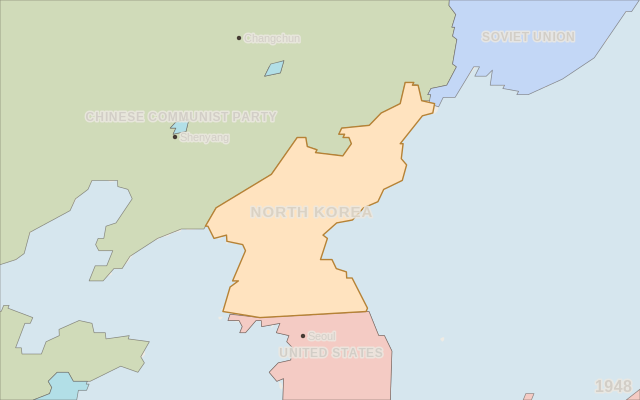
Map: North Korea in 1948, its borders in gold among its neighbours
Battle of Chosin Reservoir, 1950Korean War, 1950 – 1953: 129,300 km² → 126,700 km²Korean Armistice Agreement, 1953Panmunjom axe murder incident, 19762017–2018 North Korea crisis, 2017196019802000
Beside it on the map in 1948: Soviet Union, United States, South Korea and Republic of China.How far it reached, year by year: its ground inside the borders Cliopatria draws (CC BY 4.0), measured on an equal-area grid; the map shows it at its largest, with the cities of the year.

The story

Four acts, 1948 – present

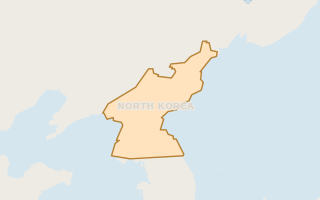
North Korea in 1952, at the end of act I
I1948 – 1953129,000 → 129,000 km²

Invasion and the Korean War

Kim Il Sung, backed by the Soviet Union, leads the new state. On 25 June 1950 its army invades the South and overruns most of it; a United Nations command led by the United States pushes deep into the North until Chinese forces intervene. The armistice of 1953 ends the fighting and creates a demilitarized zone.

Watch this act on the live map, from 1948
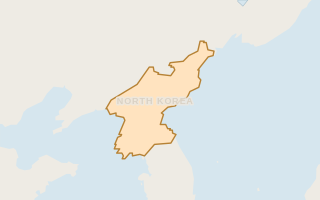
North Korea in 1993, at the end of act II
II1953 – 1994127,000 → 127,000 km²

Kim Il Sung's Juche state

Kim Il Sung purges the Soviet and Yan'an factions in the August incident of 1956 and defies Soviet and Chinese efforts to unseat him; Chinese troops leave in 1958. Juche becomes the state ideology. Clashes along the demilitarized zone follow in the 1960s and 1970s, the Soviet Union's dissolution in 1991 ends its aid, and Kim dies in 1994.

Watch this act on the live map, from 1953
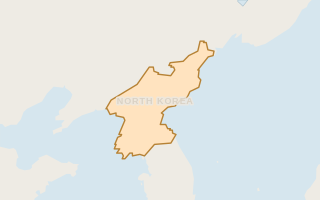
North Korea in 2010, at the end of act III
III1994 – 2011127,000 → 127,000 km²

Kim Jong Il and the famine

Kim Jong Il, who has taken on state duties since 1992, declares three years of mourning before assuming the leadership. Floods in the mid-1990s turn economic crisis into famine, killing 240,000 to 420,000 people and driving many into China. He rules until his death from a heart attack in December 2011.

Watch this act on the live map, from 1994
IV2011 – present

Kim Jong Un's arsenal

His youngest son, Kim Jong Un, succeeds him and enlarges the nuclear arsenal, perhaps with a hydrogen bomb and a missile that could reach the United States. Tension with the United States peaks in 2017 and gives way to summits that fail; in 2024 the North formally abandons reunification and names South Korea a hostile state.

Watch this act on the live map, from 2011

Before and after

Before it

Where it sits in time

3000 BCE2000 BCE1000 BCE110002000People's Committee of North Korea: 1947 – 1948North Korea: 1948 – 2026

Five thousand years, 3000 BCE to 2026; the state in gold, what it replaced or followed and what replaced or followed it in grey.

Its people

Lives across North Korea

192019401960198020002020
Statesmen and generalsAll its people on the timeline →

How it was governed

3 leaders

3 leaders on record, 1948 to 2011; a reign lasted 31.5 years at the median. Each bar is a reign, as long as it lasted.

Kim Il Sung · 1948 – 1994 · died in office of natural causesKim Jong Il · 1994 – 2011 · died in office of natural causesKim Jong Un · 2011 – … · still in office1960198020002020
How their terms ended, where it is known (3 of 3):Died in office 2In office 1
Every term, with how it ended and its source

Rulers

How 3 reigns ended - choose one to show only those

How they died, where the record says: died of natural causes 2.

RulerReignLengthHow it ended · sourceTo the ruler before
20th century · 2 reigns
Kim Il Sung · aged 361948 – 199446 yearsdied in officeWikidata's manner of deathdied of natural causes
Kim Jong Il · aged 531994 – 201117 yearsdied in officeWikidata's manner of deathdied of natural causeschild
21st century · 1 reign
Kim Jong Un · aged 272011 – in officein office since 2011still in officechild

3 rulers, 3 with terms dated as terms, covering 1948 – 2011. Median reign 31.5 years. 0 of 2 handovers irregular - a killing, a deposition, a rival claimant, a rising or a coup beside it. A blank in the last column means no kin on record, which is coverage, never “unrelated”.

Heads of government

The line of Premier of North Korea, drawn and never measured: a cabinet is not a reign.

Kim Il Sung1948 – 1972
Kim Il1972 – 1976
Pak Song-chol1976 – 1977
Yon Hyong-muk1988 – 1992
Hong Song-nam1998 – 2003
Pak Pong-ju2003 – 2007
Kim Yong-il2007 – 2010
Choe Yong-rim2010 – 2013
Pak Pong-ju2013 – 2019
Kim Jae-ryong2019 – 2020
Kim Tok-hun2020 – …
Pak Thae-song2024 – …

Flags and arms, in order

  • Emblem of North Korea (1948–1993)
    coat of arms, 1948 – 1992Emblem of North Korea (1948–1993) · Public domain
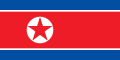
  • Flag of North Korea
    flag, from 1948Flag of North Korea · Public domain
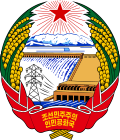
  • Emblem of North Korea
    coat of arms, from 1992Emblem of North Korea · Public domain

Its world

Rivals, and who else stood

Who it fought most

Wars and battles both took part in, on whichever side: the record names who took part, not who fought whom.

Meanwhile, elsewhere

The best-known states of other regions that stood while it did; the band is North Korea’s own years.

19401960198020002020

How it compares

Among 3,073 states

Stood longer than 41% of 3,073 states
North Korea · 78 yearsYugoslaviaEmpire of JapanHow long it stood, among the states with a recorded end or still standing.
Held more ground at its peak than 51% of 1,464 states
North Korea · 129,300 km²EritreaTajikistanThe most ground it held, among the states with a border in Cliopatria.
Had more wars on record per century than 99% of 3,073 states
North Korea · 4.0Wars recorded per century, among the states, counting the wars the atlas hosts under each.

How it began

How did North Korea begin?

What led to it, and what came of it

Indochina wars · Linked · 1946 – 1989Indochina warsPeople's Committee of North Korea · Linked · 1947 – 1948People's Committee of North KoreaThree Kingdoms of Korea · In the article · 18 BCE · “Following the unification of the Three Kingdoms of Korea into Silla and Balhae in the late 7th century, Korea was ruled by the Goryeo dynasty (918–1392) and t…”Three Kingdoms of KoreaUnited States · In the article · 1776 · “It claims that the Korean War was caused by the United States and South Korea.”United StatesPak Hon-yong · Coincidence · 1900 – 1956Pak Hon-yongChoe Yong-gon · Coincidence · 1900 – 1976Choe Yong-gonNorth Korea · 1948 – 2026North Korea1500100015002000
in the articlelinkedcoincidence

Open the investigation: every row with its evidence, the conditions at the time, the theories condition by condition, and the succession analysed.

Its centuries in the record

1900 – 1999: 30 recorded — 10 wars and battles, 3 risings, regime changes and massacres, 17 other19002000 – 2099: 4 recorded — 3 wars and battles, 0 risings, regime changes and massacres, 1 other2000

Wars and battles in red, risings, coups and massacres beside them, everything else in grey, by the century each began in. A tall bar is partly a fact about Wikipedia: better-documented centuries hold more.

Each century’s own page:1900 – 19992000 – 2099

Keep exploring

Share this page
Copy link
Embed the map
Cite this page

How this page is made

Drawn from Wikidata (Q423, CC0), the opening and history of its English Wikipedia article retold by the atlas (CC BY-SA 4.0), borders from Cliopatria (CC BY 4.0), coast and rivers from Natural Earth, cities from Reba, Reitsma & Seto 2016 (CC BY 4.0), symbols from Wikimedia Commons, each under its own licence. Data built 2026-11-26 · Pastlas v2.47.1, by Oleh Voronko; the published atlas and its data are for non-commercial use.

How to read it

Areas are measured on an equal-area grid from borders simplified to about five kilometres. “c.” marks an approximate date, and a date known to the century is never printed to the year. Counts are what the atlas holds, and they follow Wikipedia’s coverage: a busy century is partly a fact about the record.

  • Still standing: the span runs to the year of the build, 2026.

Something wrong?

Tell us and name the entry. We fix the data, not just this page.

Report a problem