State · Europe

Kingdom of Sicily

1130 – 1816 · 686 years

Came after Duchy of Amalfi and Duchy of Naples

A Norman kingdom of Sicily and southern Italy, split by the Sicilian Vespers and then ruled for centuries from Aragon and Spain.

Roger II founded the Kingdom of Sicily in 1130, joining Sicily to the south of the Italian peninsula. Hohenstaufen and then Angevin kings followed, until the Sicilian Vespers of 1282 drove the Angevins from the island, which passed to the House of Barcelona and in 1412 to the Crown of Aragon. Savoy, Austria and the Bourbons ruled it in turn, and in 1816 it was joined to Naples as the Kingdom of the Two Sicilies.

What the record holds

The Kingdom of Sicily began in 1130, replacing the Duchy of Naples.↓ When the borders dataset first draws it, in 1130, it held 79,500 km².↓

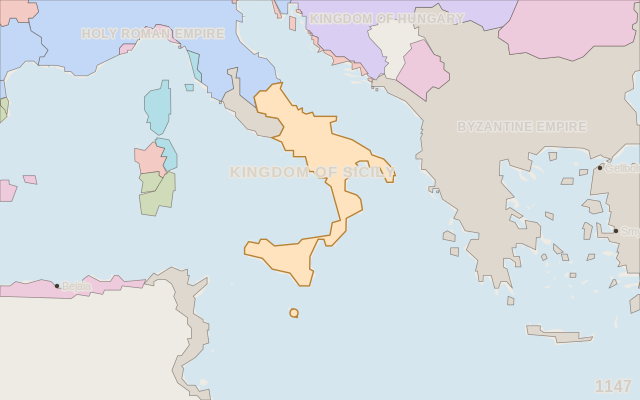
At its largest, in 1147, it held 91,900 km².↓ Its highest office was held by 15 rulers, covering 1198 – 1759, the median reign 10 years; 1 of 11 handovers was irregular.↓ The best known of them are Frederick II, Holy Roman Emperor, Charles III of Spain and Peter III of Aragon.↓ Of the 35 rows the atlas files under it, wars and battles are the largest group.↓ Its record closes in 1816, after 686 years.↑

From Wikipedia’s article, retold · CC BY-SA 4.0

686 years

Longer than the Ottoman Empire, shorter than the House of Habsburg

91,900 km²

At its height in 1147 · about the size of Hungary

15 rulers

the King of Sicily

14 wars and battles

35 entries in all

Map: Kingdom of Sicily in 1147, its borders in gold among its neighbours
Battle of Benevento, 1266Battle of Tagliacozzo, 126811501200125013001350
Beside it on the map in 1147: Byzantine Empire, Holy Roman Empire, Kingdom of Hungary, Kingdom of Galicia–Volhynia, Zirid dynasty and Grand Principality of Serbia.How far it reached, year by year: its ground inside the borders Cliopatria draws (CC BY 4.0), measured on an equal-area grid; the map shows it at its largest, with the cities of the year.

The story

Five acts, 1130 – 1816

Kingdom of Sicily in 1197, at the end of act I
I1130 – 119879,500 → 91,900 km²

Roger II's Norman kingdom

Built on the Norman conquest that took Sicily from the Sicilian Muslims, the kingdom is born in 1130, when Roger II has the Curiae Generales at Palermo proclaim him king, with Antipope Anacletus II's agreement. That assembly, arguably the earliest parliament of the modern kind, sets the rule that every later king needs its assent.

Watch this act on the live map, from 1130
Kingdom of Sicily in 1281, at the end of act II
II1198 – 128291,900 → 500 km²

Hohenstaufen and Angevin kings

The child Frederick, later Emperor Frederick II, inherits a realm used to strong kings, and his youth opens a power vacuum. In 1258 Manfred takes the throne from Conradin; the papacy offers the crown to Charles of Anjou, who conquers Sicily in 1266. In 1282 the Sicilian Vespers throw off Angevin rule on the island.

Watch this act on the live map, from 1198
III1282 – 1700

Under Aragon and Spain

The island becomes a kingdom of its own under relatives of the House of Barcelona, while the Angevins keep the mainland. The Compromise of Caspe binds it to the Crown of Aragon in 1412. Alfonso V briefly reunites the two crowns in 1443. Once Castile and Aragon unite, Spanish control tightens and the Inquisition moves against non-Catholics.

Watch this act on the live map, from 1282
V1735 – 1816

Bourbon kings

Austria gives up Sicily, and Duke Charles of Parma, a Bourbon already king at Naples, becomes Charles V of Sicily. His rule brings economic growth, reforms, public works and cultural projects. After the Napoleonic period the island's kingdom is merged with Naples into the Kingdom of the Two Sicilies.

Watch this act on the live map, from 1735
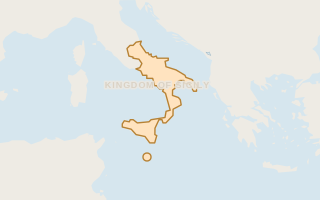
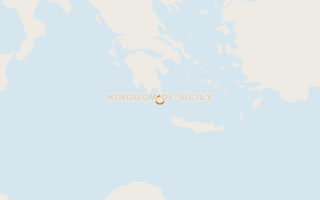
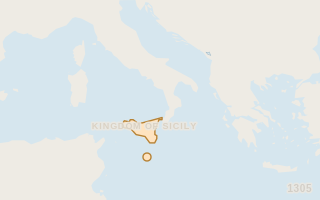
Kingdom of Sicily in 1305, last mappedKingdom of Sicily in 1147, at its largest
The rise and the fall in one frame: drag across it from 1147, at its largest at 91,900 km², to 1305, last mapped at 22,900 km². Open the live map in 1147 or 1305.

Before and after

Before it

Where it sits in time

3000 BCE2000 BCE1000 BCE110002000Duchy of Naples: 763 – 1138Duchy of Amalfi: 839 – 1137Kingdom of Sicily: 1130 – 1816

Five thousand years, 3000 BCE to 2026; the state in gold, what it replaced or followed and what replaced or followed it in grey.

Its people

Lives across the Kingdom of Sicily

115012001250130013501400
Statesmen and generalsRebels and raidersWriters, artists and thinkersAll its people on the timeline →

How it was governed

15 kings

15 kings on record, 1198 to 1759; a reign lasted 10 years at the median. Each bar is a reign, as long as it lasted.

Frederick II, Holy Roman Emperor · 1198 – … · died a natural deathManfred, King of Sicily · 1258 – 1266 · deposed or killedPeter III of Aragon · 1282 – 1285 · died a natural deathJames II of Aragon · 1285 – 1295 · ended otherwise, as coded — neither deposed nor a natural deathFrederick III of Sicily · 1295 – 1337 · died a natural deathFrederick the Simple · 1355 – 1377 · died a natural deathMaria, Queen of Sicily · 1377 – 1401 · died a natural deathMartin I of Sicily · 1401 – 1409 · died a natural deathMartin of Aragon · 1409 – 1410 · died a natural deathJohn II of Aragon · 1458 – 1468 · left office aliveVictor Amadeus II · 1713 – 1720 · left office aliveCharles III of Spain · 1734 – 1759 · left office alive1200140016001800
How their terms ended, where it is known (12 of 12):Deposed or removed 1Died in office 7Left office alive 4
Every term, with how it ended and its source

Rulers

How 12 reigns ended - choose one to show only those

How they died, where the record says: died of natural causes 4 · died in battle 1.

RulerReignLengthHow it ended · sourceTo the ruler before
12th century · 1 reign
Frederick II, Holy Roman Emperor · aged 31198 – —no end recordednatural deathcoded by Kokkonen & Sundelldied of natural causes
13th century · 4 reigns · 1 killed or removed
Manfred, King of Sicily · aged 261258 – 12668 yearsdeposed or killedcoded by Kokkonen & Sundelldied in battle
Peter III of Aragon · aged 421282 – 12853 yearsnatural deathcoded by Kokkonen & Sundell
James II of Aragon · aged 181285 – 129510 yearsended otherwisecoded by Kokkonen & Sundell
Frederick III of Sicily · aged 231295 – 133742 yearsnatural deathcoded by Kokkonen & Sundell
14th century · 2 reigns
Frederick the Simple · aged 141355 – 137722 yearsnatural deathcoded by Kokkonen & Sundell
Maria, Queen of Sicily · aged 141377 – 140124 yearsnatural deathcoded by Kokkonen & Sundelldied of natural causes
15th century · 3 reigns
Martin I of Sicily · aged 271401 – 14098 yearsnatural deathcoded by Kokkonen & Sundelldied of natural causesspouse
Martin of Aragon · aged 531409 – 14101 yearnatural deathcoded by Kokkonen & Sundellparent
John II of Aragon · aged 601458 – 146810 yearsleft office aliveread off the dates alone
18th century · 2 reigns
Victor Amadeus II · aged 471713 – 17207 yearsleft office aliveread off the dates alonedied of natural causes
Charles III of Spain · aged 181734 – 175925 yearsleft office aliveread off the dates alone

15 rulers, 12 with terms dated as terms, covering 1198 – 1759. Median reign 10 years. 1 of 11 handovers irregular - a killing, a deposition, a rival claimant, a rising or a coup beside it. A blank in the last column means no kin on record, which is coverage, never “unrelated”.

The line also names one holder with a page of their own whose term the record gives no first year, so the table cannot place it: Philip II of Spain.

Flags and arms, in order

  • Bandiera del Regno di Sicilia 4
    flag, undatedBandiera del Regno di Sicilia 4 · Public domain
  • Arms of the Aragonese Kings of Sicily(Crowned)
    coat of arms, undatedArms of the Aragonese Kings of Sicily(Crowned) · Public domain

Its world

Rivals, and who else stood

Who it fought most

Wars and battles both took part in, on whichever side: the record names who took part, not who fought whom.

Meanwhile, elsewhere

The best-known states of other regions that stood while it did; the band is the Kingdom of Sicily’s own years.

1200140016001800

How it compares

Among 3,073 states

Stood longer than 93% of 3,073 states
Kingdom of Sicily · 686 yearsOttoman EmpireHouse of HabsburgHow long it stood, among the states with a recorded end or still standing.
Held more ground at its peak than 44% of 1,464 states
Kingdom of Sicily · 91,900 km²JordanMalawiThe most ground it held, among the states with a border in Cliopatria.

Why it fell

Why did the Kingdom of Sicily fall?

Historians still argue. Here is what the atlas records about its last century:

What led to it, and what came of it

Duchy of Naples · Linked · 763 – 1138Duchy of NaplesDuchy of Amalfi · Linked · 839 – 1137Duchy of AmalfiByzantine–Norman wars · Linked · 1039 – 1189Byzantine–Norman warsGeorge of Antioch · Coincidence · 1050 – 1151George of AntiochRoger II of Sicily · Coincidence · 1095 – 1154Roger II of SicilyWilliam I of Sicily · Coincidence · 1120 – 1166William I of SicilyKingdom of Sicily · 1130 – 1816Kingdom of Sicily80010001200140016001800
linkedcoincidence

Open the investigation: every row with its evidence, the conditions at the time, the theories condition by condition, and the succession analysed.

Its centuries in the record

1100 – 1199: 8 recorded — 1 wars and battles, 0 risings, regime changes and massacres, 7 other11001200 – 1299: 9 recorded — 3 wars and battles, 0 risings, regime changes and massacres, 6 other12001300 – 1399: 4 recorded — 0 wars and battles, 0 risings, regime changes and massacres, 4 other13001400 – 1499: 0 recorded — 0 wars and battles, 0 risings, regime changes and massacres, 0 other14001500 – 1599: 1 recorded — 1 wars and battles, 0 risings, regime changes and massacres, 0 other15001600 – 1699: 8 recorded — 6 wars and battles, 1 risings, regime changes and massacres, 1 other16001700 – 1799: 5 recorded — 3 wars and battles, 2 risings, regime changes and massacres, 0 other17001800 – 1899: 0 recorded — 0 wars and battles, 0 risings, regime changes and massacres, 0 other1800

Wars and battles in red, risings, coups and massacres beside them, everything else in grey, by the century each began in. A tall bar is partly a fact about Wikipedia: better-documented centuries hold more.

Each century’s own page:1100 – 11991200 – 12991300 – 13991400 – 14991500 – 15991600 – 16991700 – 17991800 – 1899

Keep exploring

Share this page
Copy link
Embed the map
Cite this page

How this page is made

Drawn from Wikidata (Q188586, CC0), the opening and history of its English Wikipedia article retold by the atlas (CC BY-SA 4.0), borders from Cliopatria (CC BY 4.0), coast and rivers from Natural Earth, cities from Reba, Reitsma & Seto 2016 (CC BY 4.0), symbols from Wikimedia Commons, each under its own licence. Data built 2026-11-26 · Pastlas v2.47.1, by Oleh Voronko; the published atlas and its data are for non-commercial use.

How to read it

Areas are measured on an equal-area grid from borders simplified to about five kilometres. “c.” marks an approximate date, and a date known to the century is never printed to the year. Counts are what the atlas holds, and they follow Wikipedia’s coverage: a busy century is partly a fact about the record.

Something wrong?

Tell us and name the entry. We fix the data, not just this page.

Report a problem