State · Europe

Kingdom of Naples

1282 – 1816 · 534 years

Became Kingdom of the Two Sicilies and Kingdom of Naples (Napoleonic)

The mainland part of the Kingdom of Sicily, ruled from Naples by Angevin, Aragonese, Spanish, Habsburg and Bourbon kings for five centuries.

The Kingdom of Naples held the Italian mainland south of the Papal States from 1282 to 1816. It was born when the War of the Sicilian Vespers cut the island of Sicily off from Charles of Anjou's mainland lands, which kept the old name. Aragon took it in 1442, Spain held it through the 17th century, and the Bourbons won it in 1734. In 1816 it was joined with Sicily as the Kingdom of the Two Sicilies.

What the record holds

The record dates its beginning to 1282.↑ When the borders dataset first draws it, in 1285, it held 68,600 km².↓

Its highest office was held by 9 rulers, covering 1285 – 1808, the median reign 20 years; 1 of 5 handovers was irregular.↓ The best known of them are Charles III of Spain, Joseph Bonaparte and Alfonso V of Aragon.↓ Of the 26 rows the atlas files under it, people are the largest group.↓

It was followed by the Kingdom of the Two Sicilies and the Kingdom of Naples in 1816, 534 years after it began.↓

From Wikipedia’s article, retold · CC BY-SA 4.0

534 years

Longer than the Abbasid Caliphate, shorter than Vikings

68,600 km²

At its height in 1285 · about the size of Georgia

9 rulers

the King of Naples

12 wars and battles

More per century than 88% of states · 26 entries in all

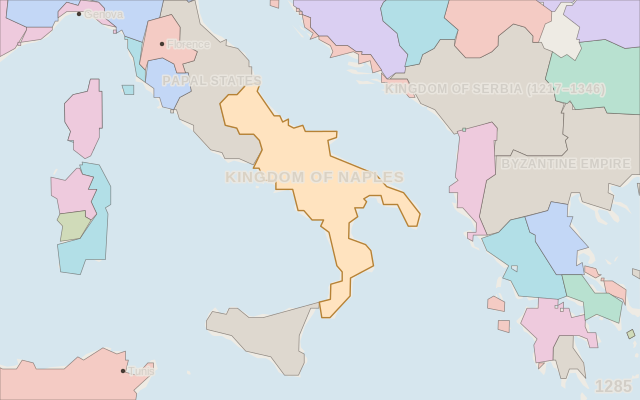
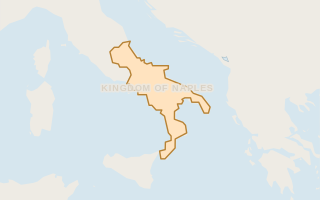
Map: Kingdom of Naples in 1285, its borders in gold among its neighbours
Ottoman conquest of Otranto, 1480 – 1481135014001450
Beside it on the map in 1285: Kingdom of Serbia (1217–1346), Byzantine Empire, Papal States, Capetian House of Anjou, Second Bulgarian Empire and Hafsid dynasty.How far it reached, year by year: its ground inside the borders Cliopatria draws (CC BY 4.0), measured on an equal-area grid; the map shows it at its largest, with the cities of the year.

The story

Five acts, 1282 – 1816

Kingdom of Naples in 1441, at the end of act I
I1282 – 1442

The Angevin kingdom

Peter III of Aragon's troops force Charles of Anjou out of Sicily, but he keeps the mainland, and his heirs fight the Aragonese for the island until Joanna I gives up the claim in 1373. Rival Angevin lines contest the throne; Charles III of Naples murders Joanna I, and Joanna II adopts Alfonso V of Aragon as heir.

Watch this act on the live map, from 1282
II1442 – 1504

Aragon and the French invasions

Alfonso V conquers Naples in 1442 and joins it to Sicily under Aragon; after his death it passes to his illegitimate son Ferdinand I. In 1494 Charles VIII of France invades, opening the Italian Wars. France and Aragon partition the kingdom, then fight over it, until Ferdinand II of Aragon holds all of it by 1504.

Watch this act on the live map, from 1442
IV1714 – 1806

Habsburg and Bourbon kings

The Treaty of Rastatt gives Naples to the emperor Charles VI in 1714, but in 1734 a Spanish army conquers Naples and Sicily, and Charles, Duke of Parma, a Bourbon, reigns from 1735. He leaves Naples when he inherits the Spanish throne in 1759, and in 1805 King Ferdinand joins the Third Coalition against Napoleon.

Watch this act on the live map, from 1714

Before and after

After it

Where it sits in time

3000 BCE2000 BCE1000 BCE110002000Kingdom of the Two Sicilies: 1738 – 1861Kingdom of Naples (Napoleonic): 1806 – 1815Kingdom of Naples: 1282 – 1816

Five thousand years, 3000 BCE to 2026; the state in gold, what it replaced or followed and what replaced or followed it in grey.

Its people

Lives across the Kingdom of Naples

140016001800
Statesmen and generalsScientists and explorersLived on after it endedAll its people on the timeline →

How it was governed

9 kings

9 kings on record, 1285 to 1808; a reign lasted 20 years at the median. Each bar is a reign, as long as it lasted.

Charles II of Naples · 1285 – 1309 · died a natural deathCharles III of Naples · 1382 – 1386 · deposed or killedLadislaus of Naples · 1386 – 1414 · ended otherwise, as coded — neither deposed nor a natural deathAlfonso V of Aragon · 1442 – 1458 · died a natural deathCharles III of Spain · 1734 – 1759 · abdicatedJoseph Bonaparte · 1806 – 1808 · left office alive130014001500160017001800
How their terms ended, where it is known (6 of 6):Deposed or removed 2Died in office 2Left office alive 2
Every term, with how it ended and its source

Rulers

How 6 reigns ended - choose one to show only those

How they died, where the record says: killed 1.

RulerReignLengthHow it ended · sourceTo the ruler before
13th century · 1 reign
Charles II of Naples · aged 311285 – 130924 yearsnatural deathcoded by Kokkonen & Sundell
14th century · 2 reigns · 1 killed or removed
Charles III of Naples · aged 371382 – 13864 yearsdeposed or killedcoded by Kokkonen & Sundellkilled
Ladislaus of Naples · aged 91386 – 141428 yearsended otherwisecoded by Kokkonen & Sundell
15th century · 1 reign
Alfonso V of Aragon · aged 461442 – 145816 yearsnatural deathcoded by Kokkonen & Sundell
18th century · 1 reign · 1 killed or removed
Charles III of Spain · aged 181734 – 175925 yearsabdicatedWikidata's end cause on the term
19th century · 1 reign
Joseph Bonaparte · aged 381806 – 18082 yearsleft office aliveread off the dates alone

9 rulers, 6 with terms dated as terms, covering 1285 – 1808. Median reign 20 years. 1 of 5 handovers irregular - a killing, a deposition, a rival claimant, a rising or a coup beside it. A blank in the last column means no kin on record, which is coverage, never “unrelated”.

The line also names 2 holders with a page of their own whose term the record gives no first year, so the table cannot place them: Philip II of Spain, Ferdinand II of the Two Sicilies.

Flags and arms, in order

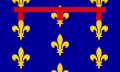
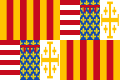
  • Flag of the Kingdom of Naples
    flag, to 1442Flag of the Kingdom of Naples · Public domain
  • Image-Blason Sicile Péninsulaire
    coat of arms, undatedImage-Blason Sicile Péninsulaire · CC BY 3.0
  • Bandera de Nápoles - Trastámara
    flag, 1442 – 1516Bandera de Nápoles - Trastámara · Public domain
  • Flag of Cross of Burgundy
    flag, 1516 – 1700Flag of Cross of Burgundy · Public domain
  • Flag of Spain (1701–1760)
    flag, 1700 – 1713Flag of Spain (1701–1760) · CC BY-SA 4.0 · Durero
  • Banner of the Holy Roman Emperor with haloes (1430-1806)
    flag, 1713 – 1738Banner of the Holy Roman Emperor with haloes (1430-1806) · CC BY-SA 3.0 · David Liuzzo , eagle by N3MO
  • Flag of the Kingdom of the Two Sicilies (1816)
    flag, 1738 – 1806Flag of the Kingdom of the Two Sicilies (1816) · Public domain
  • Flag of Kingdom of Naples (1806-1808)
    flag, 1806 – 1808Flag of Kingdom of Naples (1806-1808) · Public domain
  • Flag of the Kingdom of Naples (1808)
    flag, 1808 – 1811Flag of the Kingdom of Naples (1808) · Public domain
  • Flag of the Kingdom of Naples (1811)
    flag, from 1811Flag of the Kingdom of Naples (1811) · Public domain

Its world

Rivals, and who else stood

Who it fought most

Wars and battles both took part in, on whichever side: the record names who took part, not who fought whom.

Meanwhile, elsewhere

The best-known states of other regions that stood while it did; the band is the Kingdom of Naples’s own years.

140016001800

How it compares

Among 3,073 states

Stood longer than 88% of 3,073 states
Kingdom of Naples · 534 yearsAbbasid CaliphateVikingsHow long it stood, among the states with a recorded end or still standing.
Held more ground at its peak than 38% of 1,464 states
Kingdom of Naples · 68,600 km²LatviaGeorgiaThe most ground it held, among the states with a border in Cliopatria.
Had more wars on record per century than 88% of 3,073 states
Kingdom of Naples · 0.4Wars recorded per century, among the states, counting the wars the atlas hosts under each.

Why it fell

Why did the Kingdom of Naples fall?

Historians still argue. Here is what the atlas records about its last century:

1759

Charles III of Spain, deposed or removed in office

What led to it, and what came of it

Crown of Aragon · Linked · 1162 – 1715Crown of AragonCharles · In the article · 856 · “Following the rebellion in 1282, King Charles I of Sicily (Charles of Anjou) was forced to leave the island of Sicily by Peter III of Aragon's troops.”CharlesRainier I of Monaco, Lord of Cagnes · Coincidence · 1267 – 1314Rainier I of Monaco, Lord of Cag…House of Bourbon · Coincidence · 1272 – 1594House of BourbonKingdom of Naples · 1282 – 1816Kingdom of NaplesKingdom of Naples (Napoleonic) · Linked · 1806 – 1815Kingdom of Naples (Napoleonic)Kingdom of the Two Sicilies · Linked · 1738 – 1861Kingdom of the Two Sicilies10001200140016001800
in the articlelinkedcoincidence

Open the investigation: every row with its evidence, the conditions at the time, the theories condition by condition, and the succession analysed.

Its centuries in the record

1200 – 1299: 2 recorded — 1 wars and battles, 0 risings, regime changes and massacres, 1 other12001300 – 1399: 4 recorded — 1 wars and battles, 0 risings, regime changes and massacres, 3 other13001400 – 1499: 9 recorded — 4 wars and battles, 0 risings, regime changes and massacres, 5 other14001500 – 1599: 4 recorded — 3 wars and battles, 0 risings, regime changes and massacres, 1 other15001600 – 1699: 0 recorded — 0 wars and battles, 0 risings, regime changes and massacres, 0 other16001700 – 1799: 7 recorded — 3 wars and battles, 0 risings, regime changes and massacres, 4 other17001800 – 1899: 0 recorded — 0 wars and battles, 0 risings, regime changes and massacres, 0 other1800

Wars and battles in red, risings, coups and massacres beside them, everything else in grey, by the century each began in. A tall bar is partly a fact about Wikipedia: better-documented centuries hold more.

Each century’s own page:1200 – 12991300 – 13991400 – 14991500 – 15991600 – 16991700 – 17991800 – 1899

Keep exploring

Share this page
Copy link
Embed the map
Cite this page

How this page is made

Drawn from Wikidata (Q173065, CC0), the opening and history of its English Wikipedia article retold by the atlas (CC BY-SA 4.0), borders from Cliopatria (CC BY 4.0), coast and rivers from Natural Earth, cities from Reba, Reitsma & Seto 2016 (CC BY 4.0), symbols from Wikimedia Commons, each under its own licence. Data built 2026-11-26 · Pastlas v2.47.1, by Oleh Voronko; the published atlas and its data are for non-commercial use.

How to read it

Areas are measured on an equal-area grid from borders simplified to about five kilometres. “c.” marks an approximate date, and a date known to the century is never printed to the year. Counts are what the atlas holds, and they follow Wikipedia’s coverage: a busy century is partly a fact about the record.

Something wrong?

Tell us and name the entry. We fix the data, not just this page.

Report a problem