State · 1832 – 1973
Kingdom of Greece
A state of 1832 – 1973 — 141 years in Europe. It replaced First Hellenic Republic, United States of the Ionian Islands and Autonomous Republic of Northern Epirus and 1 more. The atlas records 82 things within it — wars and battles 27 · regime change 2 · unrest and atrocity 2 · natural disasters 1 · treaties 3 · people 46 · works and ideas 1. Its line of rulers holds 7 people.
For the full story, the article on Wikipedia (CC BY-SA 4.0); this page holds what the record says of the state.
- Stood
- 141 years
- 1832 – 1973
- Rulers
- 7
- the King of the Hellenes
- Most ground
- 206,400 km²
- in 1920
- Within it
- 82
- recorded rows
- Symbols
- 2
- on record, with years
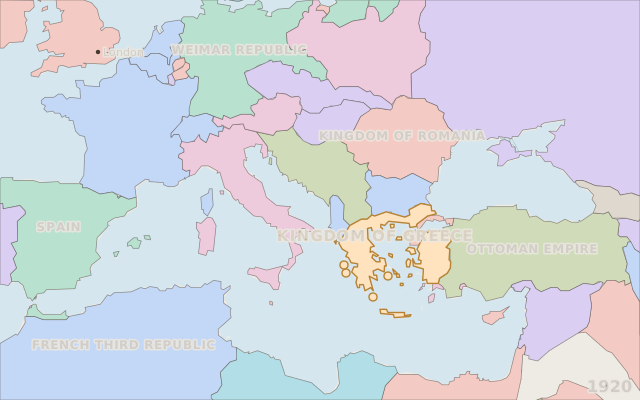
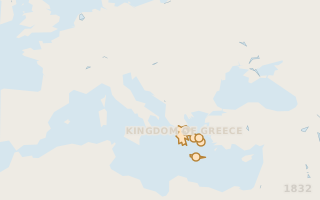
1832 · first mapped · 45,100 km²
1920 · at its largest · 206,400 km²
Where it sits in time
Five thousand years, 3000 BCE to 2026; the state in gold, what it replaced or followed and what replaced or followed it in grey.
Before and after
The states the record files it as replacing or following, and those that replaced or followed it - Wikidata's own statements, each read from this state's side.
Before it
- United States of the Ionian Islands · replaces · 1815 – 1864
- Free State of Icaria · replaces
- First Hellenic Republic · replaces · 1822 – 1832
- Autonomous Republic of Northern Epirus · replaces · 1914
Rulers
The line of King of the Hellenes - the office this state names as its head of state.
| Ruler | Reign | Length | How it ended · source | To the ruler before |
|---|---|---|---|---|
| Otto of Greece | 1832 – 1862 | 30 years | deposed, the article saysread from the ruler's own article | |
| George I of Greece | 1863 – 1913 | 50 years | killedWikidata's manner of death | |
| Constantine I of Greece | 1913 – 1917 | 4 years | left office aliveread off the dates alone | child |
| Alexander of Greece | 1917 – 1920 | 3 years | died in office of natural causesWikidata's manner of death | child |
| Constantine I of Greece | 1920 – 1922 | 2 years | abdicated, the article saysread from the ruler's own article | parent |
| George II of Greece | 1922 – 1924 | 2 years | left office aliveread off the dates alone | child |
| George II of Greece | 1935 – 1947 | 12 years | died in office, manner not recordedread off the dates alone | |
| Paul of Greece | 1947 – 1964 | 17 years | died in office of natural causesWikidata's manner of death | sibling |
| Constantine II of Greece | 1964 – 1973 | 9 years | left office aliveread off the dates alone | child |
7 rulers, 7 with terms dated as terms, covering 1832 – 1973. Median reign 9 years. 4 of 8 handovers irregular - a killing, a deposition, a rival claimant, a rising or a coup beside it. A blank in the last column means no kin on record, which is coverage, never “unrelated”.
Ground held, by year
km² inside its borders as the borders dataset draws them, measured on an equal-area grid; a step series, held between the years the dataset maps.
45,100 km² in 1832, 121,900 km² in 1962; at its largest 141,100 km² in 1922. Cliopatria, CC BY 4.0.
Flags and arms, in order
Each symbol with the years its own statement gives; the timeline flies the one of the year on screen.
.svg/120px-State_Flag_of_Greece_(1863-1924_and_1935-1973).svg.png)
flag, undatedState Flag of Greece (1863-1924 and 1935-1973) · Public domain .svg/120px-Coat_of_Arms_of_Greece_(1936-1967).svg.png)
coat of arms, undatedCoat of Arms of Greece (1936-1967) · CC BY-SA 3.0 · Royal_Coat_of_Arms_of_Greece.svg : Sodacan derivative work: Sodacan ( talk )
What happened within it, by century
Every row the atlas hosts under this state, by the century it began in: wars and battles in red, risings, regime changes and massacres beside them, everything else in grey. A tall bar is a century the record is full for, which is partly a fact about Wikipedia.
1800 – 189936 rows · 2 wars and battles · 1 risings, regime changes and massacres
- George I of Greece · ruler · 1845 – 1913
- Otto of Greece · ruler · 1815 – 1867
- Constantine I of Greece · ruler · 1868 – 1923
- George II of Greece · ruler · 1890 – 1947
- Alexander of Greece · ruler · 1893 – 1920
- Ioannis Metaxas · politician · 1871 – 1941
- Georgios Papandreou · politician · 1888 – 1968
- Greco-Turkish War · war · 1897
and 28 more in the atlas.
1900 – 199946 rows · 25 wars and battles · 3 risings, regime changes and massacres
- Prince Philip, Duke of Edinburgh · commander · 1921 – 2021
- Odysseas Elytis · writer · 1911 – 1996
- Constantine II of Greece · ruler · 1940 – 2023
- Paul of Greece · ruler · 1901 – 1964
- Antonis Samaras · politician · 1951 – present
- Greek Civil War · war · 1946 – 1949
- Georgios Papadopoulos · ruler · 1919 – 1999
- Greco-Italian War · war · 1940 – 1941
and 38 more in the atlas.
Among all states
Each measure against the states that carry it, never against all of them: a bar is the share of those states below this one.
- How long it stood141 years
stood longer than 54% of 3,187 states with a recorded end or still standing.
- The most ground it held206,400 km²
held more ground at its peak than 58% of 1,465 states with a border in Cliopatria.
- Wars recorded per century2.1
had more wars on record per century than 98% of 3,187 states, counting the wars the atlas hosts under each.
- How long a reign lasted, at the median9 years
had longer reigns, at the median, than 31% of 967 states whose dated line can carry a median.
- Rulers on record7
has more rulers on record than 73% of 1,968 states with a line of rulers.
What led to it, and what came of it
The investigation's own picture: 9 causes the record names and 0 results, the strongest six of each at their own years, joined to the state by the kind of claim - a recorded statement solid, the article's sentence dashed, a theory dash-dot.
Open the investigation: every row with its evidence, the conditions at the time, the theories condition by condition, and the succession analysed.
Theories that apply to its ending
Of 3 theories of why states fall, 1 has every condition present at this ending and 2 some of them; each is applied by its own logic, condition by condition, and whether its authors named this case is a footnote.
Dynastic cycle and the decay of group feeling
Ibn Khaldun 1377 · Turchin & Nefedov 2009
Applies by its own logic: the condition it names held here, and this is the kind of outcome it predicts — adverse regime change or the state's ending.
- the state 90 to 160 years old — ageBand 141
Open in the atlas
- On the timeline, 1818 – 1987, with everything that stood beside it.
- On the map in 1920, live: scrub the year and watch its borders move.
- Investigate it: what led to it, what came of it, and its succession analysed.
Wikidata Q209065 (CC0) · borders Cliopatria, CC BY 4.0 · coast and rivers Natural Earth · symbols from Wikimedia Commons, each credited above · data built 2026-10-06 · Pastlas v2.9.1, by Oleh Voronko. The published atlas and its data are for non-commercial use.