State · Europe

Kingdom of the Two Sicilies

1738 – 1861 · 123 years

Came after Kingdom of Naples and Kingdom of Naples (Napoleonic) · became Kingdom of Italy

The Bourbon kingdom of Sicily and southern Italy, the largest Italian state before unification, until Giuseppe Garibaldi overthrew its king.

The Kingdom of the Two Sicilies joined the kingdoms of Naples and Sicily, both named after the island, under the House of Bourbon-Two Sicilies. Covering Sicily and nearly all the peninsula south of the Papal States, it was the largest state in Italy before unification. Giuseppe Garibaldi overthrew its king in 1860; a plebiscite then took it into the Kingdom of Sardinia, and in 1861 the Kingdom of Italy was proclaimed.

What the record holds

Its record opens in 1738, after the Kingdom of Naples and the Kingdom of Naples.↓ In 1815, the first year its borders are mapped, it covered 91,300 km².↓

The record names 5 rulers in its line, covering 1737 – 1861, the median reign 5 years; none of its 4 handovers was irregular.↓ The best known of them are Ferdinand I of the Two Sicilies, Francis I of the Two Sicilies and Ferdinand II of the Two Sicilies.↓ Most of the 13 rows the atlas files under it are people.↓

In 1861, after 123 years, it was replaced by the Kingdom of Italy.↓ Its end fits “Dynastic cycle and the decay of group feeling”, every condition present.↓

From Wikipedia’s article, retold · CC BY-SA 4.0

123 years

Longer than Nizhny Novgorod, shorter than the Maurya Empire

91,300 km²

At its height in 1815 · about the size of Hungary

5 rulers

the Capitán General

3 wars and battles

13 entries in all

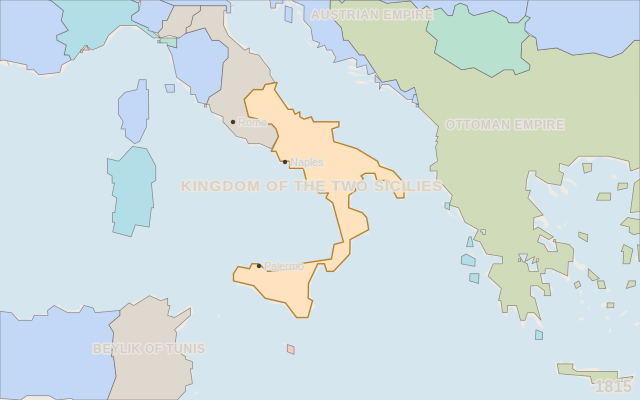
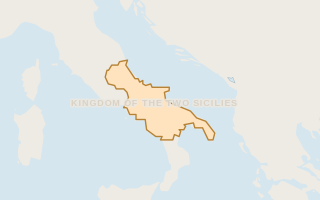
Map: Kingdom of the Two Sicilies in 1815, its borders in gold among its neighbours
Sicilian revolution of 1848, 1848 – 18491820183018401850
Beside it on the map in 1815: Ottoman Empire, Regency of Algiers, Austrian Empire, Beylik of Tunis, Kingdom of Sardinia (1720–1861) and Principality of Wallachia.How far it reached, year by year: its ground inside the borders Cliopatria draws (CC BY 4.0), measured on an equal-area grid; the map shows it at its largest, with the cities of the year.

The story

Three acts, 1738 – 1861

Kingdom of the Two Sicilies in 1847, at the end of act II
II1816 – 184891,300 → 91,300 km²

One kingdom under the Bourbons

In 1816 Ferdinand annuls the Sicilian constitution, folds the island into one Kingdom of the Two Sicilies and reigns as Ferdinand I. Some reforms from Murat's time to the civil, penal and commercial codes survive and are extended to Sicily. Francis I follows him in 1825, and Ferdinand II in 1830.

Watch this act on the live map, from 1816
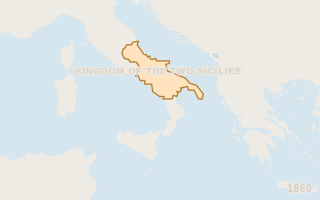
Kingdom of the Two Sicilies in 1860, at the end of act III
III1848 – 186169,200 → 56,500 km²

Revolution, reaction and Garibaldi

The kingdom puts down the revolution of 1848–1849 and Sicily's bid to secede with its own troops, hired Swiss Guards among them. Ferdinand II, once a reformer, turns cautious and authoritarian. In 1860 Giuseppe Garibaldi overthrows the king, Francis II; a plebiscite votes to join the Kingdom of Sardinia, and in 1861 the Kingdom of Italy is proclaimed.

Watch this act on the live map, from 1848
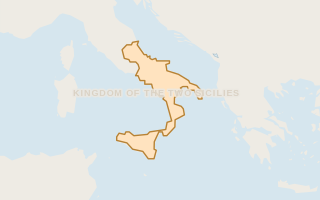
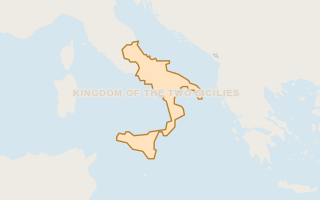
Kingdom of the Two Sicilies in 1860, last mappedKingdom of the Two Sicilies in 1815, at its largest
The rise and the fall in one frame: drag across it from 1815, at its largest at 91,300 km², to 1860, last mapped at 56,500 km². Open the live map in 1815 or 1860.

Before and after

Before it

After it

Where it sits in time

3000 BCE2000 BCE1000 BCE110002000Kingdom of Naples: 1282 – 1816Kingdom of Naples (Napoleonic): 1806 – 1815Kingdom of Italy: 1861 – 1946Kingdom of the Two Sicilies: 1738 – 1861

Five thousand years, 3000 BCE to 2026; the state in gold, what it replaced or followed and what replaced or followed it in grey.

Its people

Lives across the Kingdom of the Two Sicilies

17001750180018501900
Statesmen and generalsLived on after it endedAll its people on the timeline →

How it was governed

5 generals

5 generals on record, 1737 to 1861; a reign lasted 5 years at the median. Each bar is a reign, as long as it lasted.

Manuel of Orléans · 1737 – 1740 · died in office, manner not recordedFerdinand I of the Two Sicilies · 1816 – 1825 · no death date to read the end againstFrancis I of the Two Sicilies · 1825 – 1830 · no death date to read the end againstFerdinand II of the Two Sicilies · 1830 – 1859 · died in office, manner not recordedFrancis II of the Two Sicilies · 1859 – 1861 · deposed, the article says175018001850
How their terms ended, where it is known (3 of 5):Deposed or removed 1Died in office 2Not on record 2
Every term, with how it ended and its source

Rulers

How 5 reigns ended - choose one to show only those

How they died, where the record says: died of natural causes 1.

RulerReignLengthHow it ended · sourceTo the ruler before
18th century · 1 reign
Manuel of Orléans · aged 601737 – 17403 yearsdied in officeread off the dates alone
19th century · 4 reigns · 1 killed or removed
Ferdinand I of the Two Sicilies1816 – 18259 yearsending not on record
Francis I of the Two Sicilies1825 – 18305 yearsending not on recordchild
Ferdinand II of the Two Sicilies · aged 201830 – 185929 yearsdied in officeread off the dates alonechild
Francis II of the Two Sicilies1859 – 18612 yearsdeposedread from the ruler's own articledied of natural causeschild

5 rulers, 5 with terms dated as terms, covering 1737 – 1861. Median reign 5 years. 0 of 4 handovers irregular - a killing, a deposition, a rival claimant, a rising or a coup beside it. A blank in the last column means no kin on record, which is coverage, never “unrelated”.

Flags and arms, in order

  • CoA Kingdom of the Two Sicilies
    coat of arms, undatedCoA Kingdom of the Two Sicilies · CC BY-SA 4.0 · Flopao
  • Flag of the Kingdom of the Two Sicilies (1816) (Sodacan style)
    flag, undatedFlag of the Kingdom of the Two Sicilies (1816) (Sodacan style) · CC BY-SA 4.0 · Original: Flopao Derivative work: ZuppaDiCarlo
  • Flag of the Kingdom of the Two Sicilies (1848) (Sodacan style)
    flag, undatedFlag of the Kingdom of the Two Sicilies (1848) (Sodacan style) · CC BY-SA 4.0 · Original: Flopao Derivative work: ZuppaDiCarlo

Its world

Who else stood

Meanwhile, elsewhere

The best-known states of other regions that stood while it did; the band is the Kingdom of the Two Sicilies’s own years.

175018001850

How it compares

Among 3,073 states

Stood longer than 51% of 3,073 states
Kingdom of the Two Sicilies · 123 yearsNizhny NovgorodMaurya EmpireHow long it stood, among the states with a recorded end or still standing.
Held more ground at its peak than 43% of 1,464 states
Kingdom of the Two Sicilies · 91,300 km²JordanHungaryThe most ground it held, among the states with a border in Cliopatria.

Why it fell

Why did the Kingdom of the Two Sicilies fall?

Historians still argue. Here is what the atlas records about its last century:

3

wars and battles in its last century, more than in any before it

1861

Francis II of the Two Sicilies, deposed or removed in office

What led to it, and what came of it

Kingdom of Naples · Linked · 1282 – 1816Kingdom of NaplesKingdom of the Two Sicilies · 1738 – 1861Kingdom of the Two SiciliesKingdom of Italy · Linked · 1861 – 1946Kingdom of Italy140016001800
linked

Open the investigation: every row with its evidence, the conditions at the time, the theories condition by condition, and the succession analysed.

Theories that apply to its ending

  • Dynastic cycle and the decay of group feeling

    Ibn Khaldun 1377 · Turchin & Nefedov 2009

    Applies by its own logic: the condition it names held here, and this is the kind of outcome it predicts — adverse regime change or the state's ending.

    • the state 90 to 160 years old — ageBand 123

Its centuries in the record

1700 – 1799: 2 recorded — 0 wars and battles, 0 risings, regime changes and massacres, 2 other17001800 – 1899: 10 recorded — 3 wars and battles, 1 risings, regime changes and massacres, 6 other1800

Wars and battles in red, risings, coups and massacres beside them, everything else in grey, by the century each began in. A tall bar is partly a fact about Wikipedia: better-documented centuries hold more.

Each century’s own page:1700 – 17991800 – 1899

Keep exploring

Share this page
Copy link
Embed the map
Cite this page

How this page is made

Drawn from Wikidata (Q180393, CC0), the opening and history of its English Wikipedia article retold by the atlas (CC BY-SA 4.0), borders from Cliopatria (CC BY 4.0), coast and rivers from Natural Earth, cities from Reba, Reitsma & Seto 2016 (CC BY 4.0), symbols from Wikimedia Commons, each under its own licence. Data built 2026-11-26 · Pastlas v2.47.1, by Oleh Voronko; the published atlas and its data are for non-commercial use.

How to read it

Areas are measured on an equal-area grid from borders simplified to about five kilometres. “c.” marks an approximate date, and a date known to the century is never printed to the year. Counts are what the atlas holds, and they follow Wikipedia’s coverage: a busy century is partly a fact about the record.

Something wrong?

Tell us and name the entry. We fix the data, not just this page.

Report a problem