War of the First Coalition
war · 1792 – 1797 · put down
State · Europe
1792 – 1804 · 12 years
Came after  Duchy of Brabant and
 County of Flanders · became First French Empire
Revolutionary France without a king: it fought the rest of Europe, passed through the Reign of Terror and ended in Napoleon's empire.
The French First Republic was founded in September 1792, when the deputies of the Convention, meeting for the first time, abolished the monarchy. Until 1802 it fought the rest of Europe while facing revolt at home, notably in the Vendée. Its government changed again and again, through the Reign of Terror under the National Convention, then the Directory and the Consulate, until Napoleon declared the First Empire in 1804.
Its record opens in 1792, replacing the Duchy of Brabant and the County of Flanders.↓ Its borders are first mapped in 1792, around 569,700 km².↓
It reached its greatest extent in 1794: 643,200 km².↓ One ruler is on record in its line, covering 1799 – 1804.↓ Of the 96 rows the atlas files under it, wars and battles are the largest group.↓
The First French Empire replaced it in 1804, after 12 years.↓
From Wikipedia’s article, retold · CC BY-SA 4.0
Best known for
12 years
Longer than Freetown, shorter than the Weimar Republic
643,000 km²
At its height in 1794 · about the size of Afghanistan
1 ruler
the Governments
47 wars and battles
More per century than 99% of states · 96 entries in all
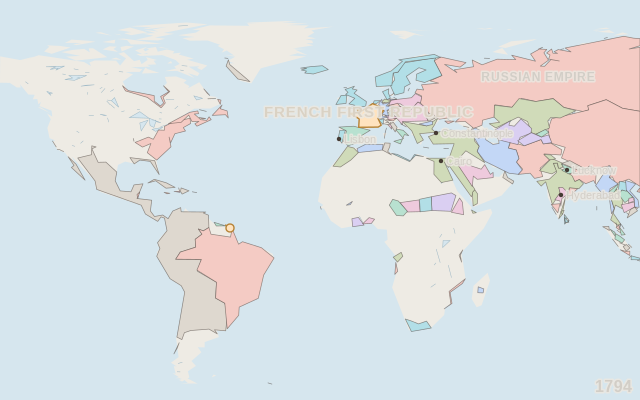
 Russian Empire,
 Spanish Empire,
 Qing dynasty,
 Portuguese Empire,
 Ottoman Empire and
 Kazakh Khanate.How far it reached, year by year: its ground inside the borders Cliopatria draws (CC BY 4.0), measured on an equal-area grid; the map shows it at its largest, with the cities of the year.
The story
The best-known wars, battles, risings and changes of regime the record files under it; a war within a war is folded into it.
war · 1792 – 1797 · put down
atrocity · 1793 – 1796
adverse regime change · November 1799
treaty · 9 February 1801
treaty · 25 March 1802
The states the record files it as replacing or following, and those that replaced or followed it - Wikidata's own statements, each read from this state's side.
County of Flanders · replaces · 866 – 1797 Prince-Bishopric of Liège · replaces · 985 – 1795Duchy of Brabant · replaces · 1183 – 1795
 Duchy of Luxembourg · replaces · 1353 – 1795
 County of Hainaut · replaces · 1071 – 1794
 County of Dagsburg · follows · 1001 – 1793
 Republic of Mulhouse · replaces · 1308 – 1798
 Comtat Venaissin · replaces · 1274 – 1791
 County of Namur · replaces · 981 – 1795
 Kingdom of France (1791–92) · replaces · 1791 – 1792
 Duchy of Limburg · replaces · 1065 – 1795
Five thousand years, 3000 BCE to 2026; the state in gold, what it replaced or followed and what replaced or followed it in grey.
Its people
One axis for everyone, so you can see who knew whom: the best-known, ordered by birth.
 Léon Cognietpainter
 Aimable Pélissierpolitician · diplomat
 François Mignetwriter
 Charles Cousin-Montaubanpolitician · military officer
 Jacques Leroy de Saint-Arnaudpolitician · military officer
 Heinrich Heinecomposer · poet
 Paul Delarochesculptor · painter
 Auguste Comtemathematician · philosopher
 Eugène Delacroixpainter
 Honoré de Balzacwriter
 Victor Hugopolitician · poet
 Alexandre Dumaswriter
 Émile de Girardinpolitician · writer
 Charles Lenormantwriter
 Hector Berliozcomposer · writer
 Prosper Mériméepainter · politician
 Edgar Quinetphilosopher · politician
How it was governed
1 governments on record, 1799 to 1804. Each bar is a reign, as long as it lasted.
Read from the state’s own English article and its rulers’ articles, where Wikidata names no ruler.
| Ruler | Reign | Length | How it ended · source | To the ruler before |
|---|---|---|---|---|
| 18th century · 1 reign | ||||
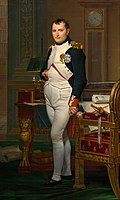 Napoleon | 1799 – 1804 | 5 years | ending not on recorddied of natural causes | |
1 ruler, 1 with terms dated as terms, covering 1799 – 1804. Only 5 years of the line are dated - too short for a median. A blank in the last column means no kin on record, which is coverage, never “unrelated”.
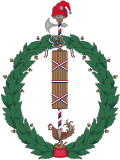
Each symbol with the years its own statement gives; the timeline flies the one of the year on screen.



Its world
Wars and battles both took part in, on whichever side: the record names who took part, not who fought whom.
 Kingdom of Great BritainFrench Revolutionary Wars16
 Kingdom of PortugalFrench Revolutionary Wars6
 United Kingdom of Great Britain and IrelandWar of the Second Coalition6
 FranceSecond Hundred Years' War6
 Kingdom of NaplesFrench Revolutionary Wars5Ottoman EmpireFrench Revolutionary Wars4
 Helvetic RepublicFrench Revolutionary Wars4
The best-known states of other regions that stood while it did; the band is the French First Republic’s own years.
Ottoman EmpireMiddle East and North Africa BruneiEast and Southeast Asia
 Mughal EmpireSouth Asia
 MoroccoMiddle East and North Africa
 DahomeySub-Saharan AfricaQing dynastyEast and Southeast Asia
 GreenlandAmericas and Oceania
 United StatesAmericas and Oceania
How it compares
Each column is a share of the states; gold is the French First Republic.
Why it fell
Napoleon, who rose to power under the Consulate, ended it in 1804 by declaring the First Empire.
Historians still argue. Here is what the atlas records about its last century:
2
wars and battles in its last century
The investigation's own picture: 13 causes the record names and 3 results, the strongest six of each at their own years, joined to the state by the kind of claim - a recorded statement solid, the article's sentence dashed, a theory dash-dot.
Open the investigation: every row with its evidence, the conditions at the time, the theories condition by condition, and the succession analysed.
Wars and battles in red, risings, coups and massacres beside them, everything else in grey, by the century each began in. A tall bar is partly a fact about Wikipedia: better-documented centuries hold more.
Each century’s own page:1700 – 17991800 – 1899
“French First Republic”, Pastlas, a historical atlas, 2026-11-26. https://app.pastlas.com/state/french-first-republic/
Drawn from Wikidata (Q58296, CC0), the opening and history of its English Wikipedia article retold by the atlas (CC BY-SA 4.0), borders from Cliopatria (CC BY 4.0), coast and rivers from Natural Earth, cities from Reba, Reitsma & Seto 2016 (CC BY 4.0), symbols from Wikimedia Commons, each under its own licence. Data built 2026-11-26 · Pastlas v2.47.1, by Oleh Voronko; the published atlas and its data are for non-commercial use.
Areas are measured on an equal-area grid from borders simplified to about five kilometres. “c.” marks an approximate date, and a date known to the century is never printed to the year. Counts are what the atlas holds, and they follow Wikipedia’s coverage: a busy century is partly a fact about the record.