State · Europe

Kingdom of Majorca

1229 – 1715 · 486 years

Came after Taifa of Majorca · became Captaincy General of Mallorca

Its record opens in 1229, replacing the Taifa of Majorca.↓ In 1279, the first year its borders are mapped, it covered 12,500 km².↓

Continue reading

Its ground peaked in 1305 at 13,500 km².↓ Its line counts 12 rulers, covering 1230 – 1396, the median reign 13 years; none of its 8 handovers was irregular.↓ The best known of them are James I of Aragon, James II of Aragon and Alfonso III of Aragon.↓ Most of the 4 rows the atlas files under it are people.↓

Its own article says it was dissolved by Spain, in 1715.↓ In 1715, after 486 years, it was replaced by the Captaincy General of Mallorca.↓

486 years

Longer than the Etruscan civilization, shorter than Scythians

13,500 km²

At its height in 1305 · about the size of Montenegro

12 rulers

the king of Majorca

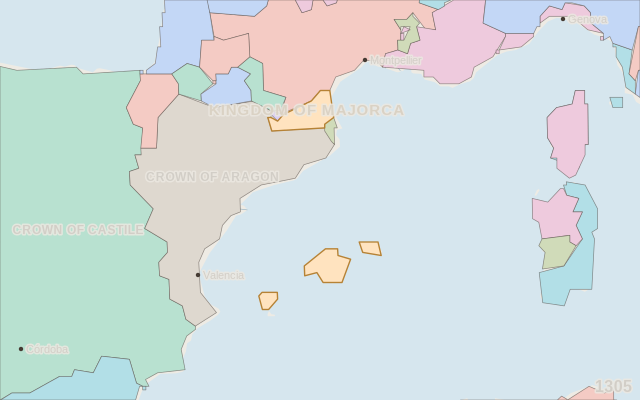
Map: Kingdom of Majorca in 1305, its borders in gold among its neighbours
12801290130013101320
Beside it on the map in 1305: Crown of Castile, Crown of Aragon, Kingdom of France, Republic of Pisa, Capetian House of Anjou and Republic of Genoa.How far it reached, year by year: its ground inside the borders Cliopatria draws (CC BY 4.0), measured on an equal-area grid; the map shows it at its largest, with the cities of the year.

The story

Its key moments

Before and after

Before it

After it

  • Captaincy General of Mallorca · replaced by

Where it sits in time

3000 BCE2000 BCE1000 BCE110002000Taifa of Majorca: 1076 – 1203Kingdom of Majorca: 1229 – 1715

Five thousand years, 3000 BCE to 2026; the state in gold, what it replaced or followed and what replaced or followed it in grey.

Its people

Lives across the Kingdom of Majorca

Notable figures

How it was governed

12 kings

12 kings on record, 1230 to 1396; a reign lasted 13 years at the median. Each bar is a reign, as long as it lasted.

James I of Aragon · 1230 – 1276 · died in office, manner not recordedJames II of Majorca · 1276 – 1285 · ended by a named eventAlfonso III of Aragon · 1286 – 1291 · died in office, manner not recordedJames II of Aragon · 1291 – 1295 · left office aliveJames II of Majorca · 1295 – 1311 · died in office, manner not recordedSancho of Majorca · 1311 – 1324 · died in office of natural causesJames III of Majorca · 1324 – 1343 · left office alivePeter IV of Aragon · 1343 – 1387 · died in office, manner not recordedJohn I of Aragon · 1387 – 1396 · died by accident13001400150016001700
How their terms ended, where it is known (9 of 9):Died in office 6Left office alive 3
Every term, with how it ended and its source

Rulers

How 9 reigns ended - choose one to show only those

How they died, where the record says: died of natural causes 1 · died in battle 1 · died by accident 1.

RulerReignLengthHow it ended · sourceTo the ruler before
13th century · 5 reigns
James I of Aragon · aged 221230 – 127646 yearsdied in officeread off the dates alone
James II of Majorca · aged 331276 – 12859 yearsended by an eventWikidata's end cause on the termchild
Alfonso III of Aragon · aged 211286 – 12915 yearsdied in officeread off the dates alonenephew or niece
James II of Aragon · aged 241291 – 12954 yearsleft office aliveread off the dates alonesibling
James II of Majorca · aged 521295 – 131116 yearsdied in officeWikidata's end cause on the term
14th century · 4 reigns
Sancho of Majorca · aged 351311 – 132413 yearsdied in officeWikidata's manner of deathdied of natural causeschild
James III of Majorca · aged 91324 – 134319 yearsleft office aliveread off the dates alonedied in battlenephew or niece
Peter IV of Aragon · aged 241343 – 138744 yearsdied in officeread off the dates alone
John I of Aragon · aged 361387 – 13969 yearsdied by accidentWikidata's manner of deathdied by accidentchild

12 rulers, 8 with terms dated as terms, covering 1230 – 1396. Median reign 13 years. 0 of 8 handovers irregular - a killing, a deposition, a rival claimant, a rising or a coup beside it. A blank in the last column means no kin on record, which is coverage, never “unrelated”.

The line also names 2 holders with a page of their own whose term the record gives no first year, so the table cannot place them: Alfonso V of Aragon, René of Anjou.

Flags and arms, in order

  • Royal Coat of Arms of the Monarchs of Majorca since the 14th Century
    coat of arms, undatedRoyal Coat of Arms of the Monarchs of Majorca since the 14th Century · CC BY-SA 3.0 · Heralder Elements by Katepanomegas
  • Royal Coat and Shield of Majorca c.1276-14th Century
    coat of arms, undatedRoyal Coat and Shield of Majorca c.1276-14th Century · CC BY-SA 3.0 · Heralder
  • Bandera del Reino de Mallorca
    flag, undatedBandera del Reino de Mallorca · CC BY-SA 3.0 · HansenBCN
  • Coat of Arms of the Kingdom of Majorca and the Balearic Islands (14th-20th Centuries)
    coat of arms, undatedCoat of Arms of the Kingdom of Majorca and the Balearic Islands (14th-20th Centuries) · CC BY-SA 3.0 · Heralder

Its world

Rivals, and who else stood

Who it fought most

Wars and battles both took part in, on whichever side: the record names who took part, not who fought whom.

Meanwhile, elsewhere

The best-known states of other regions that stood while it did; the band is the Kingdom of Majorca’s own years.

120014001600

How it compares

Among 3,073 states

Stood longer than 85% of 3,073 states
Kingdom of Majorca · 486 yearsEtruscan civilizationScythiansHow long it stood, among the states with a recorded end or still standing.
Held more ground at its peak than 17% of 1,464 states
Kingdom of Majorca · 13,500 km²QatarMontenegroThe most ground it held, among the states with a border in Cliopatria.

Why it fell

Why did the Kingdom of Majorca fall?

Historians still argue. Here is what the atlas records about its last century:

How it ended, as its article says

Dissolved by Spain, 1715. Read from the article's section “History - Fall of Mallorca” by its grammar; the claim is only that the article says so.

However, during the War of the Spanish Succession the Crown of Aragon mostly backed the claims of the Archduke Charles and with his defeat the victorious Philip V of Spain abolished the kingdom via the Nueva Planta decrees in 1715.

One sentence of the English Wikipedia article, CC BY-SA 4.0.

What led to it, and what came of it

Taifa of Majorca · Linked · 1076 – 1203Taifa of MajorcaCounty of Cerdanya · Linked · 798 – 1403County of CerdanyaOld Catalan · Coincidence · 750 – 1500Old CatalanKingdom of Majorca · 1229 – 1715Kingdom of MajorcaCaptaincy General of Mallorca · Linked · 1715Captaincy General of Mallorca8001000120014001600
linkedcoincidence

Open the investigation: every row with its evidence, the conditions at the time, the theories condition by condition, and the succession analysed.

Its centuries in the record

1200 – 1299: 3 recorded — 0 wars and battles, 0 risings, regime changes and massacres, 3 other12001300 – 1399: 1 recorded — 0 wars and battles, 0 risings, regime changes and massacres, 1 other13001400 – 1499: 0 recorded — 0 wars and battles, 0 risings, regime changes and massacres, 0 other14001500 – 1599: 0 recorded — 0 wars and battles, 0 risings, regime changes and massacres, 0 other15001600 – 1699: 0 recorded — 0 wars and battles, 0 risings, regime changes and massacres, 0 other16001700 – 1799: 0 recorded — 0 wars and battles, 0 risings, regime changes and massacres, 0 other1700

Wars and battles in red, risings, coups and massacres beside them, everything else in grey, by the century each began in. A tall bar is partly a fact about Wikipedia: better-documented centuries hold more.

Each century’s own page:1200 – 12991300 – 13991400 – 14991500 – 15991600 – 16991700 – 1799

Keep exploring

Share this page
Copy link
Embed the map
Cite this page

How this page is made

Drawn from Wikidata (Q836676, CC0), borders from Cliopatria (CC BY 4.0), coast and rivers from Natural Earth, cities from Reba, Reitsma & Seto 2016 (CC BY 4.0), symbols from Wikimedia Commons, each under its own licence, and one sentence of the article, quoted. Data built 2026-11-26 · Pastlas v2.47.1, by Oleh Voronko; the published atlas and its data are for non-commercial use.

How to read it

Areas are measured on an equal-area grid from borders simplified to about five kilometres. “c.” marks an approximate date, and a date known to the century is never printed to the year. Counts are what the atlas holds, and they follow Wikipedia’s coverage: a busy century is partly a fact about the record.

Something wrong?

Tell us and name the entry. We fix the data, not just this page.

Report a problem