Cuban Revolution of 1933
adverse regime change · 4 September 1933 · succeeded
State · Americas and Oceania
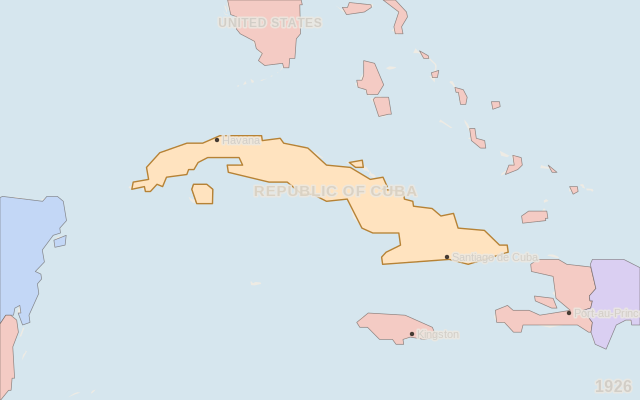
Its record opens in 1902, replacing the United States Protectorate over  Cuba.↓ When the borders dataset first draws it, in 1905, it held 121,200 km².↓
At its largest, in 1926, it held 124,200 km².↓ The record names 24 rulers in its line, covering 1902 – 1976, the median reign 4 years; 2 of 11 handovers were irregular.↓ Among them,  Fulgencio Batista,
 Osvaldo Dorticós Torrado and
 Tomás Estrada Palma are the best known.↓ The atlas files 39 rows under it, most of them people.↓
In 1959, after 57 years, it was replaced by Cuba.↓ 2 theories of why states fall have every condition present at its end: “Elite conflict” and “The five conditions of revolution”.↓
Best known for
57 years
Longer than Hamburg, shorter than the Austrian Empire
124,000 km²
At its height in 1926 · about the size of Cuba
24 rulers
the President of Cuba
2 wars and battles
39 entries in all
 United States,
 Mexico,
 British Empire and
 Dominican Republic.How far it reached, year by year: its ground inside the borders Cliopatria draws (CC BY 4.0), measured on an equal-area grid; the map shows it at its largest, with the cities of the year.
The story
The best-known wars, battles, risings and changes of regime the record files under it; a war within a war is folded into it.
adverse regime change · 4 September 1933 · succeeded
battle · 26 July 1953 · put down
unrest · 1953 – 1959
Ground held: 124,200 km² → 121,100 km²
battle · 1958 – 1959
The states the record files it as replacing or following, and those that replaced or followed it - Wikidata's own statements, each read from this state's side.
Cuba · replaced by · 1959 – presentFive thousand years, 3000 BCE to 2026; the state in gold, what it replaced or followed and what replaced or followed it in grey.
Its people
One axis for everyone, so you can see who knew whom: the best-known, ordered by birth.
 Tomás Estrada Palmapresident · military personnel1835 – 1908
 José Miguel Gómezpresident · military personnel1858 – 1921
 Alfredo Zayas y Alfonsopresident · writer1861 – 1934
 Mario García Menocalpresident · engineer1866 – 1941
 Gerardo Machadopresident1871 – 1939
 Federico Laredo Brúpolitician · military personnel1875 – 1946
 Miguel Mariano Gómezpresident1890 – 1950
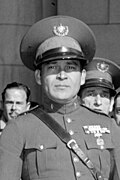 Fulgencio Batistapresident · military personnel
 Carlos Prío Socarráspresident
 Ramón Castro Ruzpolitician
 Alberto Kordaartist
 Luis Posada Carrilescommander
 Vilma Espínrevolutionary · engineer
 Aleida Marchpolitician
How it was governed
24 presidents on record, 1902 to 1976; a reign lasted 4 years at the median. Each bar is a reign, as long as it lasted.
The line of President of Cuba.
| Ruler | Reign | Length | How it ended · source | To the ruler before |
|---|---|---|---|---|
| 20th century · 12 reigns · 1 killed or removed | ||||
| Tomás Estrada Palma · aged 67 | 1902 – 1906 | 4 years | left office aliveread off the dates alone | |
| José Miguel Gómez · aged 51 | 1909 – 1913 | 4 years | left office aliveread off the dates alonedied of natural causes | |
| Mario García Menocal · aged 47 | 1913 – 1921 | 8 years | left office aliveread off the dates alone | |
| Alfredo Zayas y Alfonso · aged 60 | 1921 – 1925 | 4 years | left office aliveread off the dates alone | |
| Gerardo Machado · aged 54 | 1925 – 1933 | 8 years | deposedread from the ruler's own article | |
 Carlos Manuel de Céspedes y Quesada · aged 62 | 1933 – 1933 | under a year | left office aliveread off the dates alone | |
| Miguel Mariano Gómez · aged 47 | 1936 – 1936 | under a year | left office aliveread off the dates alonedied of natural causes | |
| Carlos Prío Socarrás · aged 45 | 1948 – 1952 | 4 years | left office aliveread off the dates alonedied by suicide | |
| Fulgencio Batista · aged 51 | 1952 – 1959 | 7 years | left office aliveread off the dates alonedied of natural causes | |
| Carlos Manuel Piedra · aged 64 | 1959 – 1959 | under a year | left office aliveread off the dates alone | |
 Manuel Urrutia Lleó · aged 58 | 1959 – 1959 | under a year | resignedread from the ruler's own article | |
 Osvaldo Dorticós Torrado · aged 40 | 1959 – 1976 | 17 years | left office aliveread off the dates alonedied by suicide | |
24 rulers, 12 with terms dated as terms, covering 1902 – 1976. Median reign 4 years. 2 of 11 handovers irregular - a killing, a deposition, a rival claimant, a rising or a coup beside it. The violent-handover count is withheld: power changed hands so often that any rising falls beside one (exposure 0.67, limit 0.6). A blank in the last column means no kin on record, which is coverage, never “unrelated”.
The line of Prime Minister of Cuba, drawn and never measured: a cabinet is not a reign.
 Carlos Saladrigas Zayas | 1940 – 1942 |
 Ramón Zaydín | 1942 – 1944 |
 Félix Lancís Sánchez | 1944 – 1945 |
 Carlos Prío Socarrás | 1945 – 1947 |
| Raúl López del Castillo | 1947 – 1948 |
 Manuel Antonio de Varona | 1948 – 1950 |
| Félix Lancís Sánchez | 1950 – 1951 |
 Jorge García Montes | 1955 – 1957 |
 Emilio Núñez Portuondo | 1958 – 1958 |
| Gonzalo Güell | 1958 – 1959 |
Each symbol with the years its own statement gives; the timeline flies the one of the year on screen.

 Osvaldo Dorticós Torrado17 yrsGerardo Machado8 yrsMario García Menocal8 yrsFulgencio Batista7 yrsAlfredo Zayas y Alfonso4 yrs
Its world
The best-known states of other regions that stood while it did; the band is the Republic of Cuba’s own years.
How it compares
Each column is a share of the states; gold is the Republic of Cuba.
Why it fell
Historians still argue. Here is what the atlas records about its last century:
1933
Gerardo Machado, deposed or removed in office
The investigation's own picture: 9 causes the record names and 1 result, the strongest six of each at their own years, joined to the state by the kind of claim - a recorded statement solid, the article's sentence dashed, a theory dash-dot.
Open the investigation: every row with its evidence, the conditions at the time, the theories condition by condition, and the succession analysed.
Of 5 theories of why states fall, 2 have every condition present at this ending and 1 some of them; each is applied by its own logic, condition by condition, and whether its authors named this case is a footnote.
Lachmann 2000 · Lachmann 2010
Applies by its own logic: 2 of its 2 conditions held here (it needs all of them), and this is the kind of outcome it predicts — adverse regime change, unrest or the state's ending.
Goldstone 2014 · Goldstone 2001
Applies by its own logic: 4 of its 5 conditions held here (it needs 4), and this is the kind of outcome it predicts — unrest, adverse regime change or the state's ending.
39 entries the atlas files under it, all in 1900 – 1999.
“Republic of Cuba”, Pastlas, a historical atlas, 2026-11-26. https://app.pastlas.com/state/republic-of-cuba/
Drawn from Wikidata (Q14905932, CC0), borders from Cliopatria (CC BY 4.0), coast and rivers from Natural Earth, cities from Reba, Reitsma & Seto 2016 (CC BY 4.0), symbols from Wikimedia Commons, each under its own licence. Data built 2026-11-26 · Pastlas v2.47.1, by Oleh Voronko; the published atlas and its data are for non-commercial use.
Areas are measured on an equal-area grid from borders simplified to about five kilometres. “c.” marks an approximate date, and a date known to the century is never printed to the year. Counts are what the atlas holds, and they follow Wikipedia’s coverage: a busy century is partly a fact about the record.


