State · Americas and Oceania

Dominican Republic

1844 – present · 182 years · still standing

Hispaniola's eastern republic, which threw off Haiti and then Spain, endured Trujillo's dictatorship and came slowly to democracy.

The Dominican Republic occupies the eastern five-eighths of Hispaniola and shares the island with Haiti; its capital is Santo Domingo. It won independence from Haiti in 1844 and, after a brief return to Spanish rule, expelled Spain for good in 1865. Civil wars, dictators and a United States occupation followed, then Rafael Trujillo's dictatorship, 1930–1961, ended by his assassination. Since 1996 it has moved toward representative democracy.

What the record holds

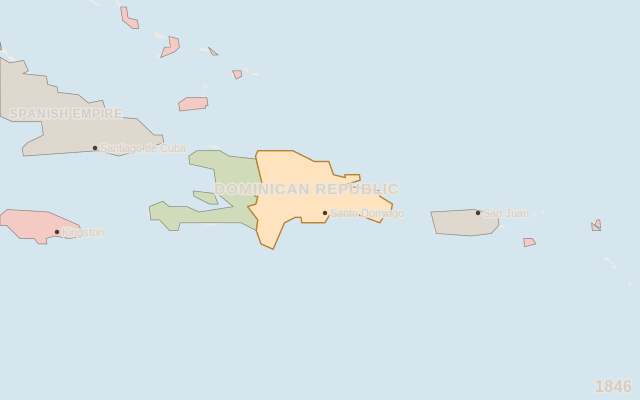
Its record opens in 1844.↑ When the borders dataset first draws it, in 1846, it held 52,800 km².↓

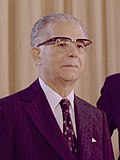
Its line counts 66 rulers, covering 1844 – 2020, the median reign 2 years; 9 of 32 handovers were irregular.↓ Among them, Rafael Trujillo, Danilo Medina and Leonel Fernández are the best known.↓ The atlas files 75 rows under it, most of them people.↓

From Wikipedia’s article, retold · CC BY-SA 4.0

182 years

Longer than the Mongol Empire, shorter than the Russian Empire

52,800 km²

At its height in 1846 · about the size of Croatia

66 rulers

the President of the Dominican Republic

8 wars and battles

More per century than 97% of states · 75 entries in all

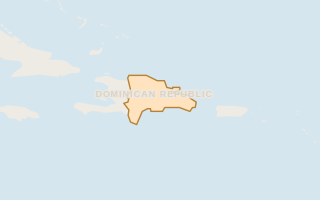
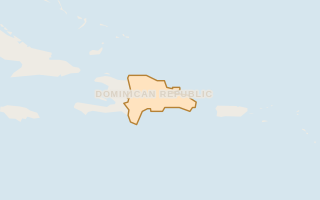
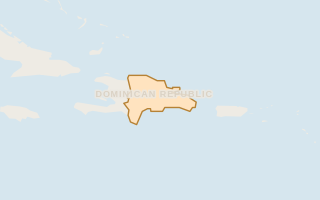
Map: Dominican Republic in 1846, its borders in gold among its neighbours
Dominican War of Independence, 1844 – 1856Dominican Restoration War, 1863 – 1865Military Government of Santo Domingo, 1924United States occupation of the Dominican Republic (1965–66), 1965 – 1966Dominican Civil War, 1965190019502000
Beside it on the map in 1846: Spanish Empire, Haiti, British Empire, Netherlands Antilles and July Monarchy.How far it reached, year by year: its ground inside the borders Cliopatria draws (CC BY 4.0), measured on an equal-area grid; the map shows it at its largest, with the cities of the year.

The story

Five acts, 1844 – present

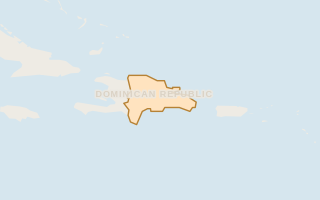
Dominican Republic in 1860, at the end of act I
I1844 – 1861

Independence won from Haiti

On 27 February 1844 La Trinitaria, the secret society Juan Pablo Duarte had founded, declared independence from Haiti, and the cattle rancher Pedro Santana took command of the new republic's army. Duarte, Sánchez and Mella came to be honoured as its founding fathers. The war with Haiti lasted until 1856, and the republic was torn by tyranny and faction.

Watch this act on the live map, from 1844
Dominican Republic in 1915, at the end of act II
II1861 – 1916

Annexation, restoration and debt

In 1861 Santana, having jailed, exiled and executed many opponents, asked Queen Isabella II to take the country back, and Spain annexed it. In the Restoration War of 1863–1865 Dominicans drove the Spanish out for good. Short-lived governments and caudillos followed; in the early 1900s the bankrupt state owed $32 million, and civil wars came in 1911 and 1914.

Watch this act on the live map, from 1861
Dominican Republic in 1960, at the end of act III
III1916 – 1961

Occupation and the Trujillo era

The United States occupied the country from 1916 to 1924. In 1930 Rafael Trujillo set up a dictatorship of absolute repression. His regime built hospitals, schools, roads and harbours, fixed the border with Haiti in 1935 and paid off the national debt by 1947, while the dictator took much of the wealth. He was assassinated in 1961.

Watch this act on the live map, from 1916
Dominican Republic in 1995, at the end of act IV
IV1961 – 199652,800 → 52,800 km²

Coup, civil war and Balaguer

Trujillo's son Ramfis held on for six months, until a United States naval task force arrived off Santo Domingo and he fled with his uncles. Juan Bosch, elected in 1962, was ousted by the army in 1963. The civil war of 1965 brought American troops back, and Joaquín Balaguer then ruled as an authoritarian, 1966–1978 and 1986–1996.

Watch this act on the live map, from 1961
V1996 – present

Toward representative democracy

In 1996 Leonel Fernández, with Balaguer's support, carried the Dominican Liberation Party, founded by Bosch in 1973, to its first win, and the economy grew fast. Hipólito Mejía, elected in 2000, governed in hard times; Fernández returned in 2004, followed by Danilo Medina in 2012 and Luis Abinader in 2020. The country moved toward representative democracy.

Watch this act on the live map, from 1996

Where it sits in time

3000 BCE2000 BCE1000 BCE110002000Dominican Republic: 1844 – 2026

Five thousand years, 3000 BCE to 2026; the state in gold.

Its people

Lives across the Dominican Republic

1850190019502000
Statesmen and generalsAll its people on the timeline →

How it was governed

66 presidents

66 presidents on record, 1844 to 2020; a reign lasted 2 years at the median. Each bar is a reign, as long as it lasted.

José María Caminero · 1844 – 1844 · left office aliveJosé Antonio Salcedo · 1863 – 1864 · killed, the article saysBenigno Filomeno de Rojas · 1865 – 1865 · died in office, manner not recordedPedro Guillermo · 1865 – 1865 · left office aliveMarcos Antonio Cabral · 1876 – 1876 · left office aliveJacinto de Castro · 1878 – 1878 · left office aliveFernando Arturo de Meriño · 1880 – 1882 · left office aliveUlises Heureaux · 1882 – 1884 · left office aliveFrancisco Gregorio Billini · 1884 – 1885 · resigned or stood down, the article saysUlises Heureaux · 1887 – 1889 · left office aliveManuel María Gautier · 1889 – 1889 · left office aliveUlises Heureaux · 1889 – 1899 · killedRamón Cáceres · 1906 – 1911 · killed, the article saysJosé Bordas Valdez · 1913 – 1914 · left office aliveJuan Isidro Jimenes · 1914 – 1916 · deposed, the article saysHoracio Vásquez · 1924 – 1930 · left office aliveRafael Trujillo · 1930 – 1938 · left office aliveRafael Trujillo · 1942 – 1952 · left office aliveJoaquín Balaguer · 1960 – 1962 · deposed, the article saysJuan Bosch · 1963 – 1963 · deposed, the article saysPedro Bartolomé Benoit · 1965 – 1965 · left office aliveAntonio Imbert Barrera · 1965 – 1965 · left office aliveHéctor García-Godoy · 1965 – 1966 · left office aliveJoaquín Balaguer · 1966 – 1978 · left office aliveAntonio Guzmán Fernández · 1978 – 1982 · died by suicideJacobo Majluta · 1982 – 1982 · served out the term, the article saysSalvador Jorge Blanco · 1982 – 1986 · left office aliveJoaquín Balaguer · 1986 – 1996 · left office aliveLeonel Fernández · 1996 – 2000 · no death date to read the end againstHipólito Mejía · 2000 – 2004 · no death date to read the end againstLeonel Fernández · 2004 – 2012 · no death date to read the end againstDanilo Medina · 2012 – 2020 · no death date to read the end againstLuis Abinader · 2020 – … · still in office1850190019502000
How their terms ended, where it is known (29 of 33):Killed 3Deposed or removed 3Died in office 2Left office alive 20In office 1Not on record 4
Every term, with how it ended and its source

Rulers

How 33 reigns ended - choose one to show only those

How they died, where the record says: died of natural causes 7 · killed 5 · died by suicide 1.

RulerReignLengthHow it ended · sourceTo the ruler before
19th century · 12 reigns · 2 killed or removed
José María Caminero · aged 621844 – 1844under a yearleft office aliveread off the dates alone
José Antonio Salcedo · aged 471863 – 18641 yearkilledread from the ruler's own article
Benigno Filomeno de Rojas · aged 541865 – 1865under a yeardied in officeread off the dates alone
Pedro Guillermo · aged 511865 – 1865under a yearleft office aliveread off the dates alone
Marcos Antonio Cabral · aged 341876 – 1876under a yearleft office aliveread off the dates alone
Jacinto de Castro · aged 671878 – 1878under a yearleft office aliveread off the dates alone
Fernando Arturo de Meriño · aged 471880 – 18822 yearsleft office aliveread off the dates alone
Ulises Heureaux · aged 371882 – 18842 yearsleft office aliveread off the dates alonekilled
Francisco Gregorio Billini · aged 401884 – 18851 yearresignedread from the ruler's own article
Ulises Heureaux · aged 421887 – 18892 yearsleft office aliveread off the dates alonekilled
Manuel María Gautier · aged 591889 – 1889under a yearleft office aliveread off the dates alone
Ulises Heureaux · aged 441889 – 189910 yearskilled in officeWikidata's manner of death
20th century · 18 reigns · 4 killed or removed
Ramón Cáceres · aged 401906 – 19115 yearskilledread from the ruler's own article
José Bordas Valdez · aged 391913 – 19141 yearleft office aliveread off the dates alone
Juan Isidro Jimenes · aged 681914 – 19162 yearsdeposedread from the ruler's own article
Horacio Vásquez · aged 641924 – 19306 yearsleft office aliveread off the dates alone
Rafael Trujillo · aged 391930 – 19388 yearsleft office aliveread off the dates alonekilled
Rafael Trujillo · aged 511942 – 195210 yearsleft office aliveread off the dates alonekilled
Joaquín Balaguer · aged 541960 – 19622 yearsdeposedread from the ruler's own articledied of natural causes
Juan Bosch · aged 541963 – 1963under a yeardeposedread from the ruler's own articledied of natural causes
Pedro Bartolomé Benoit · aged 441965 – 1965under a yearleft office aliveread off the dates alone
Antonio Imbert Barrera · aged 451965 – 1965under a yearleft office aliveread off the dates alonedied of natural causes
Héctor García-Godoy · aged 441965 – 19661 yearleft office aliveread off the dates alone
Joaquín Balaguer · aged 601966 – 197812 yearsleft office aliveread off the dates alonedied of natural causes
Antonio Guzmán Fernández · aged 671978 – 19824 yearsdied by suicideWikidata's manner of deathdied by suicide
Jacobo Majluta · aged 481982 – 1982under a yearserved out the termread from the ruler's own articledied of natural causes
Salvador Jorge Blanco · aged 561982 – 19864 yearsleft office aliveread off the dates alonedied of natural causes
Joaquín Balaguer · aged 801986 – 199610 yearsleft office aliveread off the dates alonedied of natural causes
Leonel Fernández · aged 431996 – 20004 yearsending not on record
Hipólito Mejía · aged 592000 – 20044 yearsending not on record
21st century · 3 reigns
Leonel Fernández · aged 512004 – 20128 yearsending not on record
Danilo Medina · aged 612012 – 20208 yearsending not on record
Luis Abinader · aged 532020 – in officein office since 2020still in office

66 rulers, 27 with terms dated as terms, covering 1844 – 2020. Median reign 2 years. 9 of 32 handovers irregular - a killing, a deposition, a rival claimant, a rising or a coup beside it. The violent-handover count is withheld: power changed hands so often that any rising falls beside one (exposure 0.68, limit 0.6). A blank in the last column means no kin on record, which is coverage, never “unrelated”.

The line also names 6 holders with a page of their own whose term the record gives no first year, so the table cannot place them: Manuel de Regla Mota, Pedro Santana, Manuel Jimenes, Buenaventura Báez, José Desiderio Valverde, Ramfis Trujillo.

Flags and arms, in order

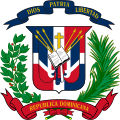
  • Coat of arms of the Dominican Republic
    coat of arms, from 1845Coat of arms of the Dominican Republic · Public domain
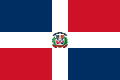
  • Flag of the Dominican Republic
    flag, from 1862Flag of the Dominican Republic · Public domain

Its world

Rivals, and who else stood

Who it fought most

Wars and battles both took part in, on whichever side: the record names who took part, not who fought whom.

Meanwhile, elsewhere

The best-known states of other regions that stood while it did; the band is the Dominican Republic’s own years.

1850190019502000

How it compares

Among 3,073 states

Stood longer than 59% of 3,073 states
Dominican Republic · 182 yearsMongol EmpireRussian EmpireHow long it stood, among the states with a recorded end or still standing.
Held more ground at its peak than 35% of 1,464 states
Dominican Republic · 52,800 km²CroatiaCosta RicaThe most ground it held, among the states with a border in Cliopatria.
Had more wars on record per century than 97% of 3,073 states
Dominican Republic · 2.7Wars recorded per century, among the states, counting the wars the atlas hosts under each.

How it began

How did the Dominican Republic begin?

What led to it, and what came of it

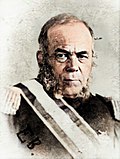
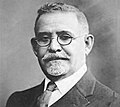
Máximo Gómez · Coincidence · 1836 – 1905Máximo GómezDominican Republic · 1844 – 2026Dominican Republic1850190019502000
coincidence

Open the investigation: every row with its evidence, the conditions at the time, the theories condition by condition, and the succession analysed.

Its centuries in the record

1800 – 1899: 44 recorded — 3 wars and battles, 0 risings, regime changes and massacres, 41 other18001900 – 1999: 27 recorded — 5 wars and battles, 1 risings, regime changes and massacres, 21 other19002000 – 2099: 1 recorded — 0 wars and battles, 0 risings, regime changes and massacres, 1 other2000

Wars and battles in red, risings, coups and massacres beside them, everything else in grey, by the century each began in. A tall bar is partly a fact about Wikipedia: better-documented centuries hold more.

Each century’s own page:1800 – 18991900 – 19992000 – 2099

Keep exploring

Share this page
Copy link
Embed the map
Cite this page

How this page is made

Drawn from Wikidata (Q786, CC0), the opening and history of its English Wikipedia article retold by the atlas (CC BY-SA 4.0), borders from Cliopatria (CC BY 4.0), coast and rivers from Natural Earth, cities from Reba, Reitsma & Seto 2016 (CC BY 4.0), symbols from Wikimedia Commons, each under its own licence. Data built 2026-11-26 · Pastlas v2.47.1, by Oleh Voronko; the published atlas and its data are for non-commercial use.

How to read it

Areas are measured on an equal-area grid from borders simplified to about five kilometres. “c.” marks an approximate date, and a date known to the century is never printed to the year. Counts are what the atlas holds, and they follow Wikipedia’s coverage: a busy century is partly a fact about the record.

  • Still standing: the span runs to the year of the build, 2026.

Something wrong?

Tell us and name the entry. We fix the data, not just this page.

Report a problem