State · Sub-Saharan Africa

Central African Republic

1960 – present · 66 years · still standing

Came after Central African Empire

A landlocked country rich in resources yet among the world's poorest, ruled by autocrats and torn by civil war.

The Central African Republic is a landlocked country of savanna and forest, with Bangui, its capital, on its southern border. Once the French colony of Ubangi-Shari, it became independent in 1960 and was then ruled by a series of autocrats, among them Jean-Bédel Bokassa, who made it an empire from 1976 to 1979. Fighting began with the Central African Bush War in 2004, and despite peace treaties in 2007 and 2011 civil war resumed in 2012.

What the record holds

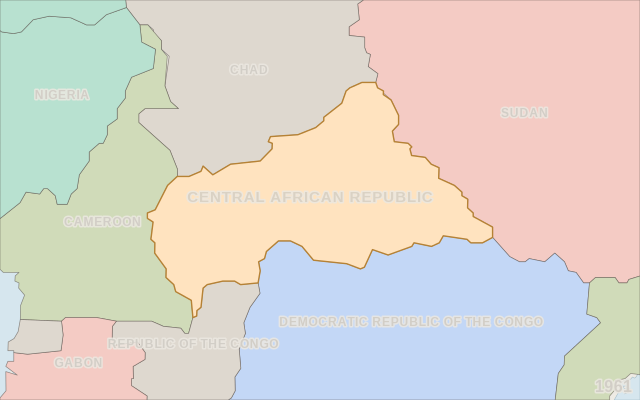
Its record opens in 1960, replacing the Central African Empire.↓ Its borders are first mapped in 1961, around 622,600 km².↓

The record names 9 rulers in its line, covering 1960 – 2016, the median reign 6 years; 5 of 9 handovers were irregular.↓ The best known of them are Jean-Bédel Bokassa, Faustin-Archange Touadéra and François Bozizé.↓ Most of the 40 rows the atlas files under it are people.↓

From Wikipedia’s article, retold · CC BY-SA 4.0

66 years

Longer than Bremen, shorter than the Soviet Union

623,000 km²

At its height in 1961 · about the size of Madagascar

9 rulers

the President of the Central African Republic

2 wars and battles

More per century than 96% of states · 40 entries in all

Map: Central African Republic in 1961, its borders in gold among its neighbours
2001 Central African Republic coup attempt, 20012003 Central African Republic coup d'état, 2003Central African Bush War, 2004 – 2007Central African Republic Civil War, 2012 – 2013197019801990200020102020
Beside it on the map in 1961: Sudan, Democratic Republic of the Congo, Chad, Cameroon, Nigeria and Republic of the Congo.How far it reached, year by year: its ground inside the borders Cliopatria draws (CC BY 4.0), measured on an equal-area grid; the map shows it at its largest, with the cities of the year.

The story

Four acts, 1960 – present

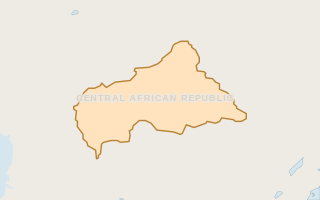
Central African Republic in 1978, at the end of act I
I1960 – 1979

Dacko and Bokassa's empire

David Dacko, cousin of Boganda, who had proclaimed the republic and died in a 1959 plane crash, leads the new state. On 31 December 1965 Colonel Jean-Bédel Bokassa overthrows him and suspends the constitution. In 1972 Bokassa becomes President for Life, and in 1976 Emperor Bokassa I; in April 1979 his government kills 100 young protesters.

Watch this act on the live map, from 1960
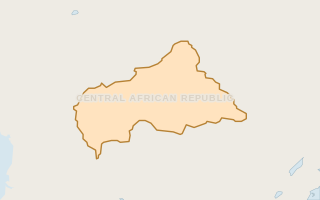
Central African Republic in 1992, at the end of act II
II1979 – 1993623,000 → 623,000 km²

Dacko again, then Kolingba

With the empire gone, Dacko returns to the presidency from 1979 to 1981, when André Kolingba takes over. Kolingba suspends the constitution and rules with a military junta until 1985, then brings in a new constitution by referendum in 1986. Semi-free elections in 1987 and 1988 exclude Abel Goumba and Ange-Félix Patassé, but a pro-democracy movement rises from 1990.

Watch this act on the live map, from 1979
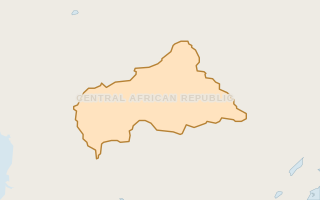
Central African Republic in 2012, at the end of act III
III1993 – 2013623,000 → 623,000 km²

Patassé, Bozizé and the bush war

Patassé, president from 1993, purges Kolingba's men; three mutinies in 1996–1997 wreck property and inflame ethnic tension, and coup attempts follow in 2001 and 2002. François Bozizé takes power in 2003 and wins the 2005 election, but the Central African Bush War against his rule lasts from 2004 to 2007, and civil war breaks out again in 2012.

Watch this act on the live map, from 1993
IV2013 – present

Transition and Touadéra

Michel Djotodia holds the presidency in 2013–2014 and Catherine Samba-Panza follows until 2016. Faustin-Archange Touadéra, a former prime minister, wins the 2016 run-off with 63% against Anicet-Georges Dologuélé and is sworn in on 30 March 2016; the vote passes without the feared violence.

Watch this act on the live map, from 2013

Before and after

Before it

Where it sits in time

3000 BCE2000 BCE1000 BCE110002000Central African Empire: 1976 – 1979Central African Republic: 1960 – 2026

Five thousand years, 3000 BCE to 2026; the state in gold, what it replaced or followed and what replaced or followed it in grey.

Its people

Lives across the Central African Republic

19401960198020002020
Statesmen and generalsAll its people on the timeline →

How it was governed

9 presidents

9 presidents on record, 1960 to 2016; a reign lasted 6 years at the median. Each bar is a reign, as long as it lasted.

David Dacko · 1960 – 1966 · left office aliveJean-Bédel Bokassa · 1966 – 1976 · left office aliveDavid Dacko · 1979 – 1981 · left office aliveAndré Kolingba · 1981 – 1993 · left office aliveAnge-Félix Patassé · 1993 – 2003 · deposed, the article saysFrançois Bozizé · 2003 – 2013 · exiled, imprisoned or confined, the article saysMichel Djotodia · 2013 – 2014 · resigned or stood down, the article saysAlexandre-Ferdinand Nguendet · 2014 – 2014 · no death date to read the end againstCatherine Samba-Panza · 2014 – 2016 · served out the term, the article saysFaustin-Archange Touadéra · 2016 – … · still in office1960198020002020
How their terms ended, where it is known (9 of 10):Deposed or removed 2Left office alive 6In office 1Not on record 1
Every term, with how it ended and its source

Rulers

How 10 reigns ended - choose one to show only those

How they died, where the record says: died of natural causes 5.

RulerReignLengthHow it ended · sourceTo the ruler before
20th century · 5 reigns · 1 killed or removed
David Dacko · aged 301960 – 19666 yearsleft office aliveread off the dates alonedied of natural causes
Jean-Bédel Bokassa · aged 451966 – 197610 yearsleft office aliveread off the dates alonedied of natural causes
David Dacko · aged 491979 – 19812 yearsleft office aliveread off the dates alonedied of natural causes
André Kolingba · aged 461981 – 199312 yearsleft office aliveread off the dates alonedied of natural causes
Ange-Félix Patassé · aged 561993 – 200310 yearsdeposedread from the ruler's own articledied of natural causes
21st century · 5 reigns · 1 killed or removed
François Bozizé · aged 572003 – 201310 yearsexiledread from the ruler's own article
Michel Djotodia · aged 642013 – 20141 yearresignedread from the ruler's own article
Alexandre-Ferdinand Nguendet · aged 422014 – 2014under a yearending not on record
Catherine Samba-Panza · aged 602014 – 20162 yearsserved out the termread from the ruler's own article
Faustin-Archange Touadéra · aged 592016 – in officein office since 2016still in office

9 rulers, 9 with terms dated as terms, covering 1960 – 2016. Median reign 6 years. 5 of 9 handovers irregular - a killing, a deposition, a rival claimant, a rising or a coup beside it. The violent-handover count is withheld: power changed hands so often that any rising falls beside one (exposure 0.70, limit 0.6). A blank in the last column means no kin on record, which is coverage, never “unrelated”.

Heads of government

The line of Prime Minister of the Central African Republic, drawn and never measured: a cabinet is not a reign.

Barthélemy Boganda1958 – 1959
David Dacko1959 – 1960
Abel Goumba1959 – 1959
Elisabeth Domitien1975 – 1976
Ange-Félix Patassé1976 – 1978
Henri Maïdou1978 – 1979
Bernard Ayandho1979 – 1980
Jean-Pierre Lebouder1980 – 1981
Simon Narcisse Bozanga1981 – 1981
Édouard Frank1991 – 1992
Timothée Malendoma1992 – 1993
Jean-Luc Mandaba1993 – 1995
Enoch Derant Lakoué1993 – 1993
Gabriel Koyambounou1995 – 1996
Jean-Paul Ngoupandé1996 – 1997
Michel Gbezera-Bria1997 – 1999
Anicet-Georges Dologuélé1999 – 2001
Martin Ziguélé2001 – 2003
Célestin Gaombalet2003 – 2005
Abel Goumba2003 – 2003
Élie Doté2005 – 2008
Faustin-Archange Touadéra2008 – 2013
Nicolas Tiangaye2013 – 2014
André Nzapayeké2014 – 2014
Mahamat Kamoun2014 – 2016
Simplice Sarandji2016 – 2019
Firmin Ngrébada2019 – 2021
Henri-Marie Dondra2021 – 2022
Félix Moloua2022 – 2026

Flags and arms, in order

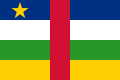
  • Flag of the Central African Republic
    flag, from 1958Flag of the Central African Republic · Public domain
  • Coat of arms of Central African Republic
    coat of arms, from 1963Coat of arms of Central African Republic · Public domain

Its world

Who else stood

Meanwhile, elsewhere

The best-known states of other regions that stood while it did; the band is the Central African Republic’s own years.

1960198020002020

How it compares

Among 3,073 states

Stood longer than 38% of 3,073 states
Central African Republic · 66 yearsBremenSoviet UnionHow long it stood, among the states with a recorded end or still standing.
Held more ground at its peak than 78% of 1,464 states
Central African Republic · 622,600 km²MadagascarAfghanistanThe most ground it held, among the states with a border in Cliopatria.
Had more wars on record per century than 96% of 3,073 states
Central African Republic · 2.0Wars recorded per century, among the states, counting the wars the atlas hosts under each.

How it began

How did the Central African Republic begin?

What led to it, and what came of it

Berlin · In the article · 1868 · “In 1987 and 1988, semi-free elections to parliament were held, but Kolingba's two major political opponents, Abel Goumba and Ange-Félix Patassé, were not allo…”BerlinCentral African Republic · 1960 – 2026Central African Republic190019502000
in the article

Open the investigation: every row with its evidence, the conditions at the time, the theories condition by condition, and the succession analysed.

Its centuries in the record

1900 – 1999: 34 recorded — 0 wars and battles, 1 risings, regime changes and massacres, 33 other19002000 – 2099: 6 recorded — 2 wars and battles, 3 risings, regime changes and massacres, 1 other2000

Wars and battles in red, risings, coups and massacres beside them, everything else in grey, by the century each began in. A tall bar is partly a fact about Wikipedia: better-documented centuries hold more.

Each century’s own page:1900 – 19992000 – 2099

Keep exploring

Share this page
Copy link
Embed the map
Cite this page

How this page is made

Drawn from Wikidata (Q929, CC0), the opening and history of its English Wikipedia article retold by the atlas (CC BY-SA 4.0), borders from Cliopatria (CC BY 4.0), coast and rivers from Natural Earth, cities from Reba, Reitsma & Seto 2016 (CC BY 4.0), symbols from Wikimedia Commons, each under its own licence. Data built 2026-11-26 · Pastlas v2.47.1, by Oleh Voronko; the published atlas and its data are for non-commercial use.

How to read it

Areas are measured on an equal-area grid from borders simplified to about five kilometres. “c.” marks an approximate date, and a date known to the century is never printed to the year. Counts are what the atlas holds, and they follow Wikipedia’s coverage: a busy century is partly a fact about the record.

  • Still standing: the span runs to the year of the build, 2026.

Something wrong?

Tell us and name the entry. We fix the data, not just this page.

Report a problem