State · Middle East and North Africa

Ayyubid dynasty

1171 – 1341 · 170 years

Came after Fatimid Caliphate

Saladin's Sunni dynasty of Kurdish origin, which made Egypt the region's leading power and took most of the Crusader states.

Saladin founded the Ayyubid dynasty's sultanate in Egypt in 1171, when he abolished the Fatimid Caliphate. After 1174 he spread it over most of Syria, Yemen, the Hejaz, Upper Mesopotamia, northern Nubia and Tripolitania, and after Hattin in 1187 most Crusader states fell to him. His heirs quarrelled, Mamluk generals seized Egypt after 1249 and the Mongols sacked Aleppo in 1260; the principality of Hama lasted until the Mamluks deposed its last ruler in 1341.

What the record holds

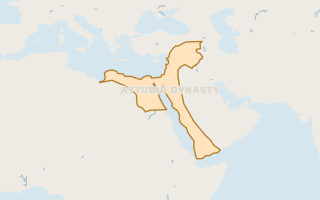
The Ayyubid dynasty began in 1171, replacing the Fatimid Caliphate.↓ Its borders are first mapped in 1177, around 1.72 million km².↓ The Third Crusade, 1189 – 1192, began with it holding 1.83 million km² and ended with 2.04 million km².↓

At its largest, in 1192, it held 2.04 million km².↓ The record names 29 rulers in its line, covering 1169 – 1347, the median reign 2 years; 5 of 30 handovers were irregular.↓ Among them, Saladin, Baybars and Shajar al-Durr are the best known.↓ The atlas files 33 rows under it, most of them people.↓ It ended in 1341, 170 years after it began.↑

From Wikipedia’s article, retold · CC BY-SA 4.0

170 years

Longer than the Mongol Empire, shorter than the Russian Empire

2.04 million km²

At its height in 1192 · about the size of Indonesia

29 rulers

the Sultan of Egypt

10 wars and battles

More per century than 97% of states · 33 entries in all

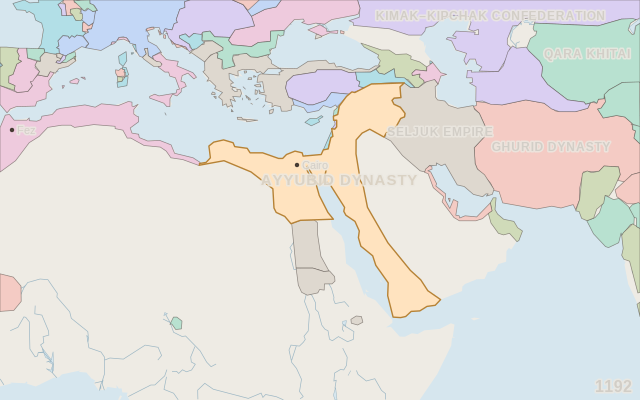
Map: Ayyubid dynasty in 1192, its borders in gold among its neighbours
Third Crusade, 1189 – 1192: 1.83 million km² → 2.04 million km²Siege of Acre (1189–1191), 1189 – 1191Battle of Arsuf, 1191Fifth Crusade, 1213 – 1221119012001210122012301240
Beside it on the map in 1192: Ghurid dynasty, Kimak–Kipchak confederation, Qara Khitai, Seljuk Empire, Almohad Caliphate and Holy Roman Empire.How far it reached, year by year: its ground inside the borders Cliopatria draws (CC BY 4.0), measured on an equal-area grid; the map shows it at its largest, with the cities of the year.

The story

Four acts, 1171 – 1341

Ayyubid dynasty in 1192, at the end of act I
I1171 – 1193

Saladin builds an empire

Saladin abolishes the Fatimid Caliphate and, after Nur al-Din dies in 1174, is proclaimed Sultan of Egypt. Turan-Shah takes Yemen for him, while he wins Damascus, Hama and Homs. Victory at Hattin in 1187 brings down most Crusader states, but the Third Crusade retakes Acre and the Syrian coast.

Watch this act on the live map, from 1171
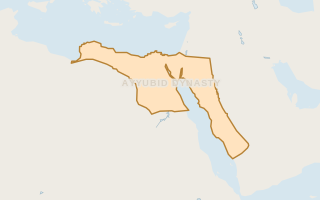
Ayyubid dynasty in 1246, at the end of act II
II1193 – 12472.04 million → 1.23 million km²

Al-Adil's heirs and a split realm

Saladin's lands are parcelled out among his kinsmen, and his sons fight over them until his brother al-Adil becomes sultan in 1200; every later sultan of Egypt descends from him. The Hejaz, Yemen and parts of Mesopotamia slip away, and in the 1230s Syria's emirs defy Cairo, until as-Salih Ayyub brings most of Syria back by 1247.

Watch this act on the live map, from 1193
III1247 – 1260

Mamluks and Mongols

Louis IX's Seventh Crusade lands at Damietta while as-Salih Ayyub lies ill, and he dies in 1249. His son al-Mu'azzam Turanshah is soon overthrown by the Mamluk generals who beat back the Crusaders, ending Ayyubid power in Egypt. An-Nasir Yusuf of Aleppo rallies the Syrian emirs but cannot retake Egypt, and in 1260 the Mongols sack Aleppo.

Watch this act on the live map, from 1247
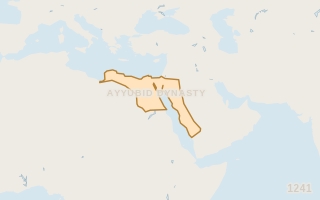
Ayyubid dynasty in 1241, last mappedAyyubid dynasty in 1192, at its largest
The rise and the fall in one frame: drag across it from 1192, at its largest at 2.04 million km², to 1241, last mapped at 1.23 million km². Open the live map in 1192 or 1241.

Before and after

Before it

Where it sits in time

3000 BCE2000 BCE1000 BCE110002000Fatimid Caliphate: 909 – 1171Ayyubid dynasty: 1171 – 1341

Five thousand years, 3000 BCE to 2026; the state in gold, what it replaced or followed and what replaced or followed it in grey.

Its people

Lives across the Ayyubid dynasty

115012001250
Statesmen and generalsWriters, artists and thinkersAll its people on the timeline →

How it was governed

29 sultans

29 sultans on record, 1169 to 1347; a reign lasted 2 years at the median. Each bar is a reign, as long as it lasted.

Saladin · 1169 – 1193 · died in office of natural causesAl-Aziz Uthman · 1193 – 1198 · died by accidentAl-Mansur Nasir al-Din Muhammad · 1198 – 1200 · no death date to read the end againstAl-Adil I · 1200 – 1217 · left office aliveAl-Kamil · 1218 – 1238 · died in office, manner not recordedAl-Adil II · 1238 – 1240 · left office aliveAs-Salih Ayyub · 1240 – 1249 · died in office of natural causesAl-Muazzam Turanshah · 1249 – 1250 · died in office, manner not recordedAybak · 1250 – 1250 · left office aliveShajar al-Durr · 1250 – 1250 · left office aliveAl-Ashraf Musa, Sultan of Egypt · 1250 – 1254 · died in office, manner not recordedAybak · 1254 – 1257 · died in office, manner not recordedAl-Mansur Ali · 1257 – 1259 · left office aliveQutuz · 1259 – 1260 · killedBaybars · 1260 – 1277 · killedAl-Sa'id Baraka · 1277 – 1279 · left office aliveSolamish · 1279 – 1279 · left office aliveQalawun · 1279 – 1290 · died in office, manner not recordedAl-Ashraf Khalil · 1290 – 1293 · killedAl-Nasir Muhammad · 1293 – 1294 · left office aliveAl-Adil Kitbugha · 1294 – 1296 · left office aliveLajin · 1296 – 1299 · died in office, manner not recordedAl-Nasir Muhammad · 1299 – 1309 · left office aliveBaybars II · 1309 – 1310 · died in office, manner not recordedAl-Nasir Muhammad · 1310 – 1341 · died in office, manner not recordedAl-Mansur Abu Bakr · 1341 – 1341 · executed, the article saysAl-Ashraf Kujuk · 1341 – 1342 · deposed, the article saysAl-Nasir Ahmad, Sultan of Egypt · 1342 – 1342 · left office aliveAl-Salih Ismail · 1342 – 1345 · died in office, manner not recordedAl-Kamil Sha'ban · 1345 – 1346 · died in office, manner not recordedAl-Muzaffar Hajji · 1346 – 1347 · died in office, manner not recorded120012501300
How their terms ended, where it is known (30 of 31):Killed 4Deposed or removed 1Died in office 14Left office alive 11Not on record 1
Every term, with how it ended and its source

Rulers

How 31 reigns ended - choose one to show only those

How they died, where the record says: killed 5 · died of natural causes 2 · died by accident 1.

RulerReignLengthHow it ended · sourceTo the ruler before
12th century · 4 reigns
Saladin · aged 311169 – 119324 yearsdied in officeWikidata's manner of deathdied of natural causes
Al-Aziz Uthman · aged 221193 – 11985 yearsdied by accidentWikidata's manner of deathdied by accidentchild
Al-Mansur Nasir al-Din Muhammad · aged 91198 – 12002 yearsending not on recordchild
Al-Adil I · aged 551200 – 121717 yearsleft office aliveread off the dates alone
13th century · 19 reigns · 3 killed or removed
Al-Kamil · aged 381218 – 123820 yearsdied in officeread off the dates alonechild
Al-Adil II · aged 171238 – 12402 yearsleft office aliveread off the dates alonechild
As-Salih Ayyub · aged 351240 – 12499 yearsdied in officeWikidata's manner of deathdied of natural causessibling
Al-Muazzam Turanshah · aged 191249 – 12501 yeardied in officeread off the dates alonechild
Aybak · aged 451250 – 1250under a yearleft office aliveread off the dates alone
Shajar al-Durr1250 – 1250under a yearleft office aliveread off the dates alonekilledspouse
Al-Ashraf Musa, Sultan of Egypt · aged 51250 – 12544 yearsdied in officeread off the dates alone
Aybak · aged 491254 – 12573 yearsdied in officeread off the dates alone
Al-Mansur Ali · aged 151257 – 12592 yearsleft office aliveread off the dates alonechild
Qutuz1259 – 12601 yearkilled in officeWikidata's manner of death
Baybars · aged 371260 – 127717 yearskilled in officeWikidata's manner of death
Al-Sa'id Baraka · aged 171277 – 12792 yearsleft office aliveread off the dates alonechild
Solamish · aged 71279 – 1279under a yearleft office aliveread off the dates alonesibling
Qalawun · aged 571279 – 129011 yearsdied in officeread off the dates alone
Al-Ashraf Khalil · aged 271290 – 12933 yearskilled in officeWikidata's manner of deathchild
Al-Nasir Muhammad · aged 91293 – 12941 yearleft office aliveread off the dates alonesibling
Al-Adil Kitbugha · aged 491294 – 12962 yearsleft office aliveread off the dates alone
Lajin1296 – 12993 yearsdied in officeread off the dates alone
Al-Nasir Muhammad · aged 151299 – 130910 yearsleft office aliveread off the dates alone
14th century · 8 reigns · 2 killed or removed
Baybars II1309 – 13101 yeardied in officeread off the dates alone
Al-Nasir Muhammad · aged 261310 – 134131 yearsdied in officeread off the dates alone
Al-Mansur Abu Bakr · aged 201341 – 1341under a yearexecutedread from the ruler's own articlechild
Al-Ashraf Kujuk · aged 71341 – 13421 yeardeposedread from the ruler's own articlekilledsibling
Al-Nasir Ahmad, Sultan of Egypt · aged 261342 – 1342under a yearleft office aliveread off the dates alonesibling
Al-Salih Ismail · aged 171342 – 13453 yearsdied in officeread off the dates alonesibling
Al-Kamil Sha'ban · aged 171345 – 13461 yeardied in officeread off the dates alonesibling
Al-Muzaffar Hajji · aged 151346 – 13471 yeardied in officeread off the dates alonesibling

29 rulers, 28 with terms dated as terms, covering 1169 – 1347. Median reign 2 years. 5 of 30 handovers irregular - a killing, a deposition, a rival claimant, a rising or a coup beside it. A blank in the last column means no kin on record, which is coverage, never “unrelated”.

Its world

Rivals, and who else stood

Who it fought most

Wars and battles both took part in, on whichever side: the record names who took part, not who fought whom.

Meanwhile, elsewhere

The best-known states of other regions that stood while it did; the band is the Ayyubid dynasty’s own years.

11501200125013001350

How it compares

Among 3,073 states

Stood longer than 58% of 3,073 states
Ayyubid dynasty · 170 yearsMongol EmpireRussian EmpireHow long it stood, among the states with a recorded end or still standing.
Held more ground at its peak than 91% of 1,464 states
Ayyubid dynasty · 2,038,000 km²IndonesiaDenmarkThe most ground it held, among the states with a border in Cliopatria.
Had more wars on record per century than 97% of 3,073 states
Ayyubid dynasty · 2.4Wars recorded per century, among the states, counting the wars the atlas hosts under each.

Why it fell

Why did the Ayyubid dynasty fall?

Historians still argue. Here is what the atlas records about its last century:

1342

Al-Ashraf Kujuk, deposed or removed in office

What led to it, and what came of it

Fatimid Caliphate · Linked · 909 – 1171Fatimid CaliphateAl-Muzaffar Umar · Coincidence · 1145 – 1191Al-Muzaffar UmarAl-Afdal ibn Salah ad-Din · Coincidence · 1169 – 1225Al-Afdal ibn Salah ad-DinAyyubid dynasty · 1171 – 1341Ayyubid dynasty9001000110012001300
linkedcoincidence

Open the investigation: every row with its evidence, the conditions at the time, the theories condition by condition, and the succession analysed.

Its centuries in the record

1100 – 1199: 14 recorded — 5 wars and battles, 0 risings, regime changes and massacres, 9 other11001200 – 1299: 19 recorded — 5 wars and battles, 0 risings, regime changes and massacres, 14 other12001300 – 1399: 0 recorded — 0 wars and battles, 0 risings, regime changes and massacres, 0 other1300

Wars and battles in red, risings, coups and massacres beside them, everything else in grey, by the century each began in. A tall bar is partly a fact about Wikipedia: better-documented centuries hold more.

Each century’s own page:1100 – 11991200 – 12991300 – 1399

Keep exploring

Share this page
Copy link
Embed the map
Cite this page

How this page is made

Drawn from Wikidata (Q180114, CC0), the opening and history of its English Wikipedia article retold by the atlas (CC BY-SA 4.0), borders from Cliopatria (CC BY 4.0), coast and rivers from Natural Earth, cities from Reba, Reitsma & Seto 2016 (CC BY 4.0). Data built 2026-11-26 · Pastlas v2.47.1, by Oleh Voronko; the published atlas and its data are for non-commercial use.

How to read it

Areas are measured on an equal-area grid from borders simplified to about five kilometres. “c.” marks an approximate date, and a date known to the century is never printed to the year. Counts are what the atlas holds, and they follow Wikipedia’s coverage: a busy century is partly a fact about the record.

Something wrong?

Tell us and name the entry. We fix the data, not just this page.

Report a problem