State · Middle East and North Africa
Armenian Kingdom of Cilicia
1080 – 1375 · 295 years
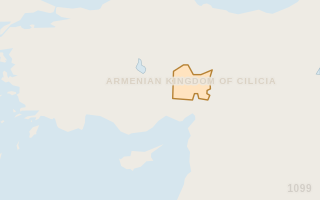
The Armenian Kingdom of Cilicia began in 1080.↑ Its borders are first mapped in 1099, around 20,600 km².↓
Continue readingShow less
At its largest, in 1192, it held 59,600 km².↓ The record names 22 rulers in its line, covering 1080 – 1375, the median reign 9.5 years; 7 of 21 handovers were irregular.↓ Among them,  Isabella, Queen of Armenia,
 Leo I, King of Armenia and
 Hethum I are the best known.↓ The atlas files 18 rows under it, most of them people.↓ It ended in 1375, 295 years after it began.↑
Best known for
295 years
Longer than the Tang dynasty, shorter than the Song dynasty
59,600 km²
At its height in 1192 · about the size of Togo
22 rulers
the list of monarchs of the Armenian Kingdom of Cilicia
1 war or battle
18 entries in all
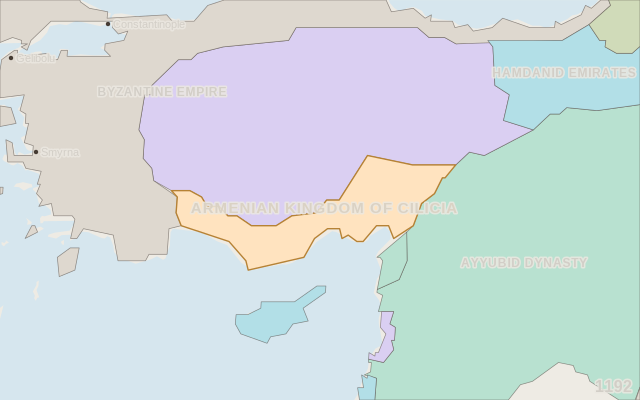
 Sultanate of Rum, Byzantine Empire, Hamdanid dynasty,
 Kingdom of Cyprus and
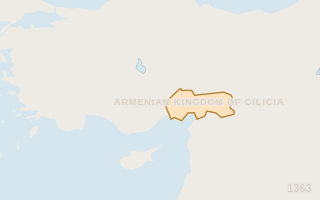
 Kingdom of Georgia.How far it reached, year by year: its ground inside the borders Cliopatria draws (CC BY 4.0), measured on an equal-area grid; the map shows it at its largest, with the cities of the year.
Its people
Lives across the Armenian Kingdom of Cilicia
One axis for everyone, so you can see who knew whom: the best-known, ordered by birth.
- TIThoros Ilist1070 – 1129
 Ruben Ilist · military personnel1080 – 1095
 Constantine I, Prince of Armenialist1095 – 1102
- TIThoros IIlist1144 – 1169
- RIRuben IIIlist1145 – 1187
 Leo I, King of Armenialist1150 – 1219
- MMlehlist1170 – 1175
- RRaymond-Roupenlist1199 – 1222
 Isabella, Queen of Armenialist1212 – 1252
 Hethum Ilist1213 – 1271
 Leo II, King of Armenialist1236 – 1289
 Hethum IIlist1266 – 1307
- LILeo III of Armenialist1289 – 1307
How it was governed
22 lists
22 lists on record, 1080 to 1375; a reign lasted 9.5 years at the median. Each bar is a reign, as long as it lasted.
Every term, with how it ended and its source
Rulers
The line of list of monarchs of the Armenian Kingdom of Cilicia - the office this state names as its head of state.
| Ruler | Reign | Length | How it ended · source | To the ruler before |
|---|---|---|---|---|
| 11th century · 3 reigns | ||||
| Ruben I | 1080 – 1095 | 15 years | ending not on record | |
| Constantine I, Prince of Armenia | 1095 – 1100 | 5 years | ending not on recorddied by accident | child |
| Thoros I | 1100 – 1130 | 30 years | ending not on record | child |
| 12th century · 7 reigns · 1 killed or removed | ||||
| Constantine II, Prince of Armenia | 1129 – 1130 | 1 year | ending not on recordkilled | child |
 Leo I, Prince of Armenia | 1129 – 1137 | 8 years | ending not on record | |
| Thoros II | 1144 – 1169 | 25 years | ending not on record | child |
| Ruben II | 1169 – 1170 | 1 year | ending not on record | child |
| Mleh | 1170 – 1175 | 5 years | deposedread from the ruler's own article | |
| Ruben III | 1175 – 1187 | 12 years | ending not on record | |
| Leo I, King of Armenia | 1187 – 1199 | 12 years | ending not on record | sibling |
| 13th century · 5 reigns · 2 killed or removed | ||||
| Raymond-Roupen | 1211 – 1219 | 8 years | ending not on recorddied in battle | |
| Isabella, Queen of Armenia | 1219 – 1252 | 33 years | ending not on record | |
| Hethum I | 1226 – 1270 | 44 years | abdicatedread from the ruler's own article | spouse |
| Leo II, King of Armenia | 1269 – 1289 | 20 years | ending not on record | child |
| Hethum II | 1289 – 1293 | 4 years | killedread from the ruler's own article | child |
| 14th century · 7 reigns | ||||
| Leo III of Armenia | 1303 – 1307 | 4 years | ending not on record | nephew or niece |
| Oshin | 1307 – 1320 | 13 years | ending not on record | |
| Leo IV | 1320 – 1341 | 21 years | ending not on record | |
| Constantine II | 1342 – 1344 | 2 years | ending not on record | |
| Leo the Usurper | 1362 – 1365 | 3 years | ending not on record | |
| Constantine IV | 1362 – 1373 | 11 years | ending not on record | |
| Leo V | 1374 – 1375 | 1 year | ending not on record | |
22 rulers, 22 with terms dated as terms, covering 1080 – 1375. Median reign 9.5 years. 7 of 21 handovers irregular - a killing, a deposition, a rival claimant, a rising or a coup beside it. A blank in the last column means no kin on record, which is coverage, never “unrelated”.
Flags and arms, in order
Each symbol with the years its own statement gives; the timeline flies the one of the year on screen.

flag, undatedFlag of the Rubenid Dynasty · CC BY-SA 3.0 · Samhanin 
coat of arms, undatedCoat of arms of the Armenian Kingdom of Cilicia · CC BY-SA 3.0 · Samhanin
Longest reigns
- Hethum I44 yrs
- Isabella, Queen of Armenia33 yrs
- Thoros I30 yrs
- Thoros II25 yrs
- Leo IV21 yrs
Its world
Rivals, and who else stood
Who it fought most
Wars and battles both took part in, on whichever side: the record names who took part, not who fought whom.
 IlkhanateSiege of Baghdad6
- Mamluk SultanateBattle of Ain Jalut5
- Kingdom of GeorgiaSiege of Baghdad4
 Abbasid CaliphateFirst Crusade2
 Seljuk EmpireFirst Crusade2
- Ayyubid dynastyBattle of Ain Jalut2
- Sultanate of RumSecond Battle of Homs2
Meanwhile, elsewhere
The best-known states of other regions that stood while it did; the band is the Armenian Kingdom of Cilicia’s own years.
- Maya civilizationAmericas and Oceania
 DenmarkEurope
 TibetansSouth Asia
- Ancestral PuebloansAmericas and Oceania
 SwedenEurope
- Kingdom of BeninSub-Saharan Africa
 Mongol EmpireEast and Southeast Asia
- Yuan dynastyEast and Southeast Asia
How it compares
Among 3,073 states
Each column is a share of the states; gold is the Armenian Kingdom of Cilicia.
Why it fell
Why did the Armenian Kingdom of Cilicia fall?
Historians still argue. Here is what the atlas records about its last century:
1293
Hethum II, killed in office
Its centuries in the record
Wars and battles in red, risings, coups and massacres beside them, everything else in grey, by the century each began in. A tall bar is partly a fact about Wikipedia: better-documented centuries hold more.
Each century’s own page:1000 – 10991100 – 11991200 – 12991300 – 1399
Keep exploring
Copy link
Embed the map
Cite this page
“Armenian Kingdom of Cilicia”, Pastlas, a historical atlas, 2026-11-26. https://app.pastlas.com/state/armenian-kingdom-of-cilicia/
How this page is made
Drawn from Wikidata (Q335088, CC0), borders from Cliopatria (CC BY 4.0), coast and rivers from Natural Earth, cities from Reba, Reitsma & Seto 2016 (CC BY 4.0), symbols from Wikimedia Commons, each under its own licence. Data built 2026-11-26 · Pastlas v2.47.1, by Oleh Voronko; the published atlas and its data are for non-commercial use.
How to read it
Areas are measured on an equal-area grid from borders simplified to about five kilometres. “c.” marks an approximate date, and a date known to the century is never printed to the year. Counts are what the atlas holds, and they follow Wikipedia’s coverage: a busy century is partly a fact about the record.