State · Americas and Oceania

Netherlands Antilles

1954 – 2010 · 56 years

Came after Curaçao and Dependencies · became Aruba and Curaçao

A Caribbean country of six islands within the Kingdom of the Netherlands, which came apart as the islands chose separate futures.

The Netherlands Antilles, also called the Dutch Antilles, was a Caribbean country within the Kingdom of the Netherlands. Three of its islands, Aruba, Bonaire and Curaçao, lay in the Leeward Antilles; Sint Maarten, Saba and Sint Eustatius lay in the Lesser Antilles. It took the place of the colony of Curaçao and Dependencies in 1954. Aruba left in 1986, and in 2010 the country was dissolved.

What the record holds

It was founded in 1954, after Curaçao and Dependencies.↓ When the borders dataset first draws it, in 1877, it held 149,800 km².↓

Its highest office was held by 20 rulers, covering 1951 – 2010, the median reign 1 year; none of its 22 handovers was irregular.↓ The best known of them are Emily de Jongh-Elhage, Suzanne Camelia-Römer and Moises Frumencio da Costa Gomez.↓ Most of the 20 rows the atlas files under it are people.↓

Its own article says it was dissolved, in 2010.↓ Aruba and Curaçao replaced it in 2010, after 56 years.↓

From Wikipedia’s article, retold · CC BY-SA 4.0

56 years

Longer than Hungarians, shorter than the Austrian Empire

150,000 km²

At its height in 1877 · about the size of Nepal

20 rulers

the Prime Minister of the Netherlands Antilles

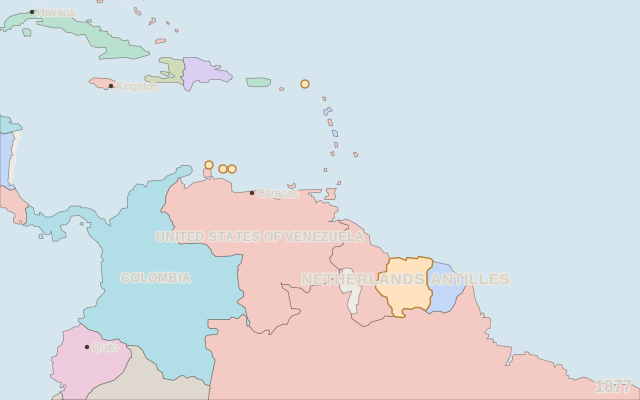
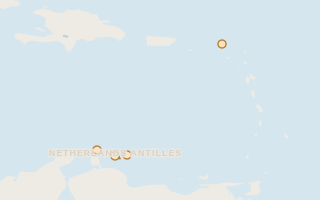
Map: Netherlands Antilles in 1877, its borders in gold among its neighbours
196019701980199020002010
Beside it on the map in 1877: United States of Venezuela, Colombia, Dominican Republic, Haiti, Spain and British Empire.How far it reached, year by year: its ground inside the borders Cliopatria draws (CC BY 4.0), measured on an equal-area grid; the map shows it at its largest, with the cities of the year.

The story

Two acts, 1954 – 2010

Before and after

Before it

  • Curaçao and Dependencies · follows

After it

  • Aruba · replaced by
  • Curaçao · replaced by
  • Sint Maarten · replaced by
  • Caribbean Netherlands · replaced by

Where it sits in time

3000 BCE2000 BCE1000 BCE110002000Netherlands Antilles: 1954 – 2010

Five thousand years, 3000 BCE to 2026; the state in gold.

Its people

Lives across Netherlands Antilles

192019401960198020002020
Statesmen and generalsLived on after it endedAll its people on the timeline →

How it was governed

20 ministers

20 ministers on record, 1951 to 2010; a reign lasted 1 years at the median. Each bar is a reign, as long as it lasted.

Moises Frumencio da Costa Gomez · 1951 – 1954 · left office aliveEfraïn Jonckheer · 1954 – 1968 · left office aliveCiro Kroon · 1968 – 1969 · left office aliveGerald Sprockel · 1969 – 1969 · left office aliveErnesto Petronia · 1969 – 1971 · left office aliveRonchi Isa · 1971 – 1971 · left office aliveOtto Beaujon · 1971 – 1972 · left office aliveJuancho Evertsz · 1973 – 1977 · left office aliveLeo Chance · 1977 – 1977 · no death date to read the end againstLucina da Costa Gomez-Matheeuws · 1977 – 1977 · left office aliveBoy Rozendal · 1977 – 1979 · left office aliveDon Martina · 1979 – 1984 · left office aliveDon Martina · 1986 – 1988 · left office aliveSuzanne Camelia-Römer · 1993 – 1993 · no death date to read the end againstAlejandro Felipe Paula · 1993 – 1994 · left office aliveMiguel Pourier · 1994 – 1998 · left office aliveSuzanne Camelia-Römer · 1998 – 1999 · no death date to read the end againstMiguel Pourier · 1999 – 2002 · left office aliveEtienne Ys · 2002 – 2003 · no death date to read the end againstBen Komproe · 2003 – 2003 · left office aliveMirna Louisa-Godett · 2003 – 2004 · no death date to read the end againstEtienne Ys · 2004 – 2006 · no death date to read the end againstEmily de Jongh-Elhage · 2006 – 2010 · no death date to read the end against196019701980199020002010
How their terms ended, where it is known (16 of 23):Left office alive 16Not on record 7
Every term, with how it ended and its source

Rulers

How 23 reigns ended - choose one to show only those
RulerReignLengthHow it ended · sourceTo the ruler before
20th century · 18 reigns
Moises Frumencio da Costa Gomez · aged 441951 – 19543 yearsleft office aliveread off the dates alone
Efraïn Jonckheer · aged 371954 – 196814 yearsleft office aliveread off the dates alone
Ciro Kroon · aged 521968 – 19691 yearleft office aliveread off the dates alone
Gerald Sprockel · aged 501969 – 1969under a yearleft office aliveread off the dates alone
Ernesto Petronia · aged 531969 – 19712 yearsleft office aliveread off the dates alone
Ronchi Isa · aged 541971 – 1971under a yearleft office aliveread off the dates alone
Otto Beaujon · aged 561971 – 19721 yearleft office aliveread off the dates alone
Juancho Evertsz · aged 501973 – 19774 yearsleft office aliveread off the dates alone
Leo Chance · aged 451977 – 1977under a yearending not on record
Lucina da Costa Gomez-Matheeuws · aged 481977 – 1977under a yearleft office aliveread off the dates alone
Boy Rozendal · aged 491977 – 19792 yearsleft office aliveread off the dates alone
Don Martina · aged 441979 – 19845 yearsleft office aliveread off the dates alone
Don Martina · aged 511986 – 19882 yearsleft office aliveread off the dates alone
Suzanne Camelia-Römer · aged 341993 – 1993under a yearending not on record
Alejandro Felipe Paula · aged 561993 – 19941 yearleft office aliveread off the dates alone
Miguel Pourier · aged 551994 – 19984 yearsleft office aliveread off the dates alone
Suzanne Camelia-Römer · aged 391998 – 19991 yearending not on record
Miguel Pourier · aged 601999 – 20023 yearsleft office aliveread off the dates alone
21st century · 5 reigns
Etienne Ys · aged 402002 – 20031 yearending not on record
Ben Komproe · aged 612003 – 2003under a yearleft office aliveread off the dates alone
Mirna Louisa-Godett · aged 492003 – 20041 yearending not on record
Etienne Ys · aged 422004 – 20062 yearsending not on record
Emily de Jongh-Elhage · aged 602006 – 20104 yearsending not on record

20 rulers, 19 with terms dated as terms, covering 1951 – 2010. Median reign 1 years. 0 of 22 handovers irregular - a killing, a deposition, a rival claimant, a rising or a coup beside it. The violent-handover count is withheld: power changed hands so often that any rising falls beside one (exposure 0.87, limit 0.6). A blank in the last column means no kin on record, which is coverage, never “unrelated”.

Flags and arms, in order

  • Flag of the Netherlands
    flag, to 1959Flag of the Netherlands · Public domain
  • Flag of the Netherlands Antilles (1959–1986)
    flag, 1959 – 1986Flag of the Netherlands Antilles (1959–1986) · CC BY-SA 2.5
  • Coat of arms of the Netherlands Antilles (1964-1986)
    coat of arms, 1964 – 1986Coat of arms of the Netherlands Antilles (1964-1986) · Public domain
  • Flag of the Netherlands Antilles (1986–2010)
    flag, from 1986Flag of the Netherlands Antilles (1986–2010) · Public domain
  • Coat of arms of the Netherlands Antilles (1986-2010)
    coat of arms, 1986 – 2010Coat of arms of the Netherlands Antilles (1986-2010) · Public domain

Its world

Who else stood

Meanwhile, elsewhere

The best-known states of other regions that stood while it did; the band is Netherlands Antilles’s own years.

1960198020002020

How it compares

Among 3,073 states

Stood longer than 35% of 3,073 states
Netherlands Antilles · 56 yearsHungariansAustrian EmpireHow long it stood, among the states with a recorded end or still standing.
Held more ground at its peak than 53% of 1,464 states
Netherlands Antilles · 149,800 km²NepalTunisiaThe most ground it held, among the states with a border in Cliopatria.

Why it fell

Why did Netherlands Antilles fall?

Historians still argue. Here is what the atlas records about its last century:

How it ended, as its article says

Dissolved, 2010. Read from the article's section “lead” by its grammar; the claim is only that the article says so.

The country came into being in 1954 as the autonomous successor of the Dutch colony of Curaçao and Dependencies, and it was dissolved in 2010, when Aruba (in 1986), Sint Maarten and Curaçao gained the status of constituent countries within the Kingdom of the Netherlands, and Saba, Sint Eustatius, an…

One sentence of the English Wikipedia article, CC BY-SA 4.0.

What led to it, and what came of it

Dutch colonial empire · Linked · 1624 – 1975Dutch colonial empireCuraçao and Dependencies · Linked · 1815 – 1954Curaçao and DependenciesNetherlands Antilles · 1954 – 2010Netherlands AntillesSint Maarten · Linked · 2010Sint MaartenCaribbean Netherlands · Linked · 2010Caribbean NetherlandsAruba · Linked · 1986ArubaCuraçao · Linked · 1954Curaçao1700180019002000
linked

Open the investigation: every row with its evidence, the conditions at the time, the theories condition by condition, and the succession analysed.

Its centuries in the record

1900 – 1999: 20 recorded — 0 wars and battles, 0 risings, regime changes and massacres, 20 other19002000 – 2099: 0 recorded — 0 wars and battles, 0 risings, regime changes and massacres, 0 other2000

Wars and battles in red, risings, coups and massacres beside them, everything else in grey, by the century each began in. A tall bar is partly a fact about Wikipedia: better-documented centuries hold more.

Each century’s own page:1900 – 19992000 – 2099

Keep exploring

Share this page
Copy link
Embed the map
Cite this page

How this page is made

Drawn from Wikidata (Q25227, CC0), the opening and history of its English Wikipedia article retold by the atlas (CC BY-SA 4.0), borders from Cliopatria (CC BY 4.0), coast and rivers from Natural Earth, cities from Reba, Reitsma & Seto 2016 (CC BY 4.0), symbols from Wikimedia Commons, each under its own licence, and one sentence of the article, quoted. Data built 2026-11-26 · Pastlas v2.47.1, by Oleh Voronko; the published atlas and its data are for non-commercial use.

How to read it

Areas are measured on an equal-area grid from borders simplified to about five kilometres. “c.” marks an approximate date, and a date known to the century is never printed to the year. Counts are what the atlas holds, and they follow Wikipedia’s coverage: a busy century is partly a fact about the record.

Something wrong?

Tell us and name the entry. We fix the data, not just this page.

Report a problem