State · East and Southeast Asia

Mongolia

1911 – present · 115 years · still standing

Came after Chinese Empire

The steppe heartland of the Mongols, independent since the fall of the Qing, a Soviet satellite, then a democracy by peaceful revolution.

Mongolia is a vast, thinly peopled land of steppe, mountains and Gobi Desert between Russia and China; about half its people live in the capital, Ulaanbaatar. It declared independence when the Qing dynasty fell in 1911, made it good in 1921 and soon became a satellite of the Soviet Union. The Mongolian People's Republic, founded in 1924, gave way after a peaceful democratic revolution in 1990 to a multi-party state and a market economy.

What the record holds

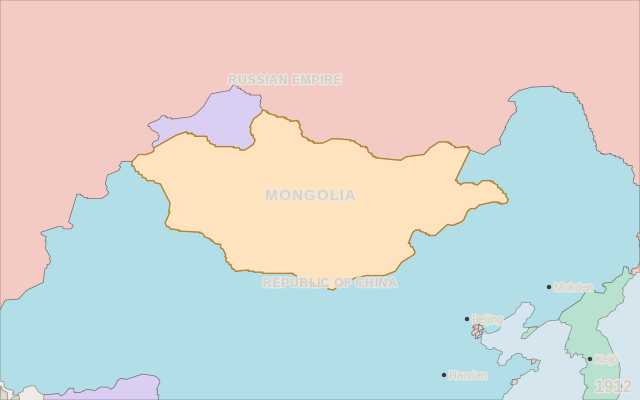
Mongolia began in 1911, replacing the Chinese Empire.↓ Its borders are first mapped in 1912, around 1.57 million km².↓

Its highest office was held by 10 rulers, covering 1924 – 2021, the median reign 4 years; 1 of 9 handovers was irregular.↓ Among them, Tsakhiagiin Elbegdorj, Ukhnaagiin Khürelsükh and Khaltmaagiin Battulga are the best known.↓ The atlas files 47 rows under it, most of them people.↓

From Wikipedia’s article, retold · CC BY-SA 4.0

115 years

Longer than Nizhny Novgorod, shorter than the Maurya Empire

1.57 million km²

At its height in 1912 · about the size of Libya

10 rulers

the President of Mongolia

Map: Mongolia in 1912, its borders in gold among its neighbours
2005201020152020
Beside it on the map in 1912: Republic of China, Russian Empire, Empire of Japan, Uryankhay Republic, Tibet and British Raj.How far it reached, year by year: its ground inside the borders Cliopatria draws (CC BY 4.0), measured on an equal-area grid; the map shows it at its largest, with the cities of the year.

The story

Three acts, 1911 – present

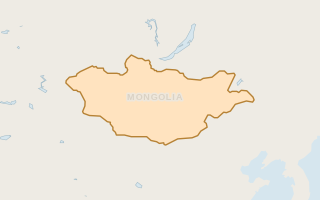
Mongolia in 1923, at the end of act I
I1911 – 1924

The Bogd Khanate

The Bogd Khaan rules an independent Mongolia roughly the size of the old Outer Mongolia, though the new Republic of China under Yuan Shikai claims it. A treaty of friendship with Tibet follows in 1913; the revolution of 1921 brings real independence from China, and Soviet influence soon dominates.

Watch this act on the live map, from 1911
II1924 – 1990

The Mongolian People's Republic

After the Bogd Khaan dies in 1924 the Mongolian People's Republic is proclaimed. Khorloogiin Choibalsan, in power from 1928, collectivises the herds, wrecks the Buddhist monasteries and purges on Stalin's model, killing many monks. A Soviet condition at Yalta secures Mongolian independence, backed by a referendum in 1945, and in 1949 the People's Republic of China recognises it.

Watch this act on the live map, from 1924
III1990 – present

Democracy and the market

A peaceful Democratic Revolution in January 1990 brings rival parties and a market economy, and the old Marxist-Leninist ruling party remakes itself as the social democratic Mongolian People's Party. The 1992 constitution drops “People's Republic” from the name. The change is rough at first, with high inflation and food shortages.

Watch this act on the live map, from 1990

Before and after

Before it

Where it sits in time

3000 BCE2000 BCE1000 BCE110002000Chinese Empire: 220 BCE – 1912Mongolia: 1911 – 2026

Five thousand years, 3000 BCE to 2026; the state in gold, what it replaced or followed and what replaced or followed it in grey.

Its people

Lives across Mongolia

190019251950197520002025
Statesmen and generalsAll its people on the timeline →

How it was governed

10 presidents

10 presidents on record, 1924 to 2021; a reign lasted 4 years at the median. Each bar is a reign, as long as it lasted.

Navaandorjiin Jadambaa · 1924 – 1924 · left office aliveSükhbaataryn Yanjmaa · 1953 – 1954 · left office aliveTsagaanlamyn Dügersüren · 1972 – 1972 · left office aliveNyamyn Jagvaral · 1984 – 1984 · left office alivePunsalmaagiin Ochirbat · 1990 – 1997 · lost an election, the article saysNatsagiin Bagabandi · 1997 – 2005 · no death date to read the end againstNambaryn Enkhbayar · 2005 – 2009 · no death date to read the end againstTsakhiagiin Elbegdorj · 2009 – 2017 · no death date to read the end againstKhaltmaagiin Battulga · 2017 – 2021 · no death date to read the end againstUkhnaagiin Khürelsükh · 2021 – … · still in office192019401960198020002020
How their terms ended, where it is known (6 of 10):Left office alive 5In office 1Not on record 4
Every term, with how it ended and its source

Rulers

How 10 reigns ended - choose one to show only those
RulerReignLengthHow it ended · sourceTo the ruler before
20th century · 6 reigns
Navaandorjiin Jadambaa · aged 241924 – 1924under a yearleft office aliveread off the dates alone
Sükhbaataryn Yanjmaa · aged 591953 – 19541 yearleft office aliveread off the dates alone
Tsagaanlamyn Dügersüren · aged 581972 – 1972under a yearleft office aliveread off the dates alone
Nyamyn Jagvaral · aged 651984 – 1984under a yearleft office aliveread off the dates alone
Punsalmaagiin Ochirbat · aged 481990 – 19977 yearslost an electionread from the ruler's own article
Natsagiin Bagabandi · aged 471997 – 20058 yearsending not on record
21st century · 4 reigns
Nambaryn Enkhbayar · aged 472005 – 20094 yearsending not on record
Tsakhiagiin Elbegdorj · aged 462009 – 20178 yearsending not on record
Khaltmaagiin Battulga · aged 542017 – 20214 yearsending not on record
Ukhnaagiin Khürelsükh · aged 532021 – in officein office since 2021still in office

10 rulers, 10 with terms dated as terms, covering 1924 – 2021. Median reign 4 years. 1 of 9 handovers irregular - a killing, a deposition, a rival claimant, a rising or a coup beside it. A blank in the last column means no kin on record, which is coverage, never “unrelated”.

Heads of government

The line of Prime Minister of Mongolia, drawn and never measured: a cabinet is not a reign.

Gonchigjalzangiin Badamdorjlived 1850 – 1919
Balingiin Tserendorjlived 1868 – 1928
Manzushir Khutagt Sambadondogiin Tserendorjlived 1872 – 1937
Jalkhanz Khutagt Sodnomyn Damdinbazarlived 1874 – 1923
Tögs-Ochiryn Namnansürenlived 1878 – 1919
Anandyn Amarlived 1886 – 1941
Tsengeltiin Jigjidjavlived 1894 – 1933
Da Lam Tserenchimed1911 – 1912
Khatanbaatar Magsarjav1921 – 1921
Dogsomyn Bodoo1921 – 1922
Dambyn Chagdarjav1921 – 1921
Jambyn Batmönkhlived 1926 – 1997
Peljidiin Genden1932 – 1936
Khorloogiin Choibalsan1939 – 1952
Yumjaagiin Tsedenbal1952 – 1974
Dumaagiin Sodnom1984 – 1990
Dashiin Byambasüren1990 – 1992
Puntsagiin Jasrai1992 – 1996
Mendsaikhany Enkhsaikhan1996 – 1998
Janlavyn Narantsatsralt1998 – 1999
Tsakhiagiin Elbegdorj1998 – 1998
Rinchinnyamyn Amarjargal1999 – 2000
Nyam-Osoryn Tuyaa1999 – 1999
Nambaryn Enkhbayar2000 – 2004
Tsakhiagiin Elbegdorj2004 – 2006
Miyeegombyn Enkhbold2006 – 2007
Sanjiin Bayar2009 – 2012
Sükhbaataryn Batbold2009 – 2012
Norovyn Altankhuyag2012 – 2014
Chimediin Saikhanbileg2014 – 2016
Dendeviin Terbishdagva2014 – 2014
Jargaltulgyn Erdenebat2016 – 2017
Ukhnaagiin Khürelsükh2017 – 2021
Luvsannamsrain Oyun-Erdene2021 – 2025
Gombojavyn Zandanshatar2025 – 2026
Nyam-Osoryn Uchral2026 – …

Flags and arms, in order

  • Flag of the Mongolian People's Republic (1945–1992)
    flag, 1945 – 1992Flag of the Mongolian People's Republic (1945–1992) · Public domain
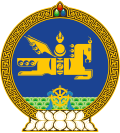
  • State emblem of Mongolia
    coat of arms, from 1992State emblem of Mongolia · Public domain
  • Flag of Mongolia (1992–2011)
    flag, 1992 – 2011Flag of Mongolia (1992–2011) · Public domain
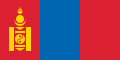
  • Flag of Mongolia
    flag, from 2011Flag of Mongolia · Public domain

Its world

Rivals, and who else stood

Who it fought most

Wars and battles both took part in, on whichever side: the record names who took part, not who fought whom.

Meanwhile, elsewhere

The best-known states of other regions that stood while it did; the band is Mongolia’s own years.

190019251950197520002025

How it compares

Among 3,073 states

Stood longer than 49% of 3,073 states
Mongolia · 115 yearsNizhny NovgorodMaurya EmpireHow long it stood, among the states with a recorded end or still standing.
Held more ground at its peak than 89% of 1,464 states
Mongolia · 1,565,800 km²PeruLibyaThe most ground it held, among the states with a border in Cliopatria.

How it began

How did Mongolia begin?

What led to it, and what came of it

Chinese Empire · Linked · 220 BCE – 1912Chinese EmpireDamdin Sükhbaatar · Coincidence · 1893 – 1923Damdin SükhbaatarKhorloogiin Choibalsan · Coincidence · 1895 – 1952Khorloogiin ChoibalsanMongolia · 1911 – 2026Mongolia1500100015002000
linkedcoincidence

Open the investigation: every row with its evidence, the conditions at the time, the theories condition by condition, and the succession analysed.

Its centuries in the record

1900 – 1999: 31 recorded — 0 wars and battles, 2 risings, regime changes and massacres, 29 other19002000 – 2099: 2 recorded — 0 wars and battles, 1 risings, regime changes and massacres, 1 other2000

Wars and battles in red, risings, coups and massacres beside them, everything else in grey, by the century each began in. A tall bar is partly a fact about Wikipedia: better-documented centuries hold more.

Each century’s own page:1900 – 19992000 – 2099

Keep exploring

Share this page
Copy link
Embed the map
Cite this page

How this page is made

Drawn from Wikidata (Q711, CC0), the opening and history of its English Wikipedia article retold by the atlas (CC BY-SA 4.0), borders from Cliopatria (CC BY 4.0), coast and rivers from Natural Earth, cities from Reba, Reitsma & Seto 2016 (CC BY 4.0), symbols from Wikimedia Commons, each under its own licence. Data built 2026-11-26 · Pastlas v2.47.1, by Oleh Voronko; the published atlas and its data are for non-commercial use.

How to read it

Areas are measured on an equal-area grid from borders simplified to about five kilometres. “c.” marks an approximate date, and a date known to the century is never printed to the year. Counts are what the atlas holds, and they follow Wikipedia’s coverage: a busy century is partly a fact about the record.

  • Wikidata records foundings in 1911 and 1992; the atlas draws the line of its rulers.
  • Still standing: the span runs to the year of the build, 2026.

Something wrong?

Tell us and name the entry. We fix the data, not just this page.

Report a problem