State · Sub-Saharan Africa

Guinea

1958 – present · 68 years · still standing

Came after French West Africa and French Guinea

A West African republic that chose immediate independence from France, then lived under long autocracies and repeated military coups.

Guinea, also called Guinea-Conakry after its capital, lies on the Atlantic coast of West Africa. Formerly French Guinea, it voted overwhelmingly for independence in the 1958 referendum. Ahmed Sékou Touré ruled a one-party state until 1984, when Lansana Conté seized power; after Conté's death in 2008 another junta took over. Alpha Condé won the first democratic election in 2010, but soldiers overthrew him in 2021. It is the world's second-largest bauxite producer.

What the record holds

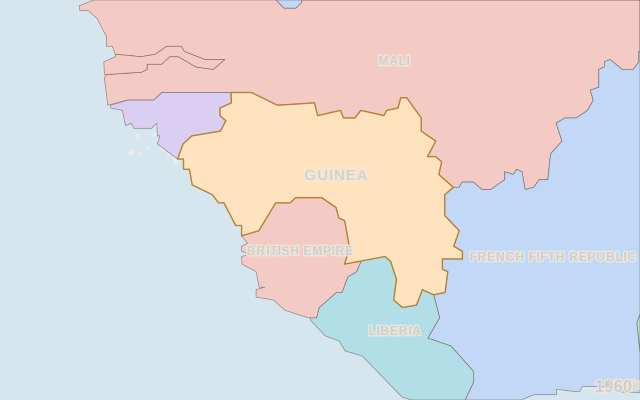
It was founded in 1958, replacing French West Africa and French Guinea.↓ In 1960, the first year its borders are mapped, it covered 246,700 km².↓

Its line counts 7 rulers, covering 1958 – 2021, the median reign 6 years; 6 of 6 handovers were irregular.↓ Among them, Ahmed Sékou Touré, Alpha Condé and Lansana Conté are the best known.↓ The atlas files 30 rows under it, most of them people.↓

From Wikipedia’s article, retold · CC BY-SA 4.0

68 years

Longer than Bremen, shorter than the Soviet Union

247,000 km²

At its height in 1960 · about the size of Ghana

7 rulers

the President of Guinea

1 war or battle

30 entries in all

Map: Guinea in 1960, its borders in gold among its neighbours
Operation Green Sea, 19701984 Guinean coup d'état, 19842008 Guinean coup d'état, 20082009 Guinean protests, 200919701980199020002010
Beside it on the map in 1960: Mali, French Fifth Republic, Liberia, British Empire, Estado Novo and Dominion of Ghana.How far it reached, year by year: its ground inside the borders Cliopatria draws (CC BY 4.0), measured on an equal-area grid; the map shows it at its largest, with the cities of the year.

The story

Four acts, 1958 – present

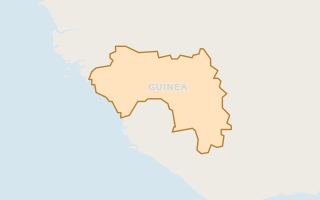
Guinea in 2007, at the end of act II
II1984 – 2008247,000 → 247,000 km²

Lansana Conté's rule

Sékou Touré dies on 26 March 1984 and Prime Minister Louis Lansana Beavogui stands in. Hours before the party can choose a successor, Colonels Lansana Conté and Diarra Traoré take power in a bloodless coup. Conté frees 250 political prisoners and invites exiles home, survives a coup attempt in 1996, and governs until his death in 2008.

Watch this act on the live map, from 1984
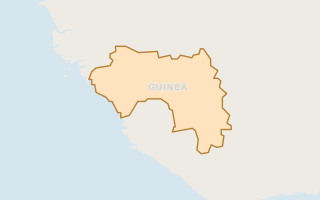
Guinea in 2020, at the end of act III
III2008 – 2021247,000 → 247,000 km²

Junta, elections and Condé

Hours after Conté dies, Moussa Dadis Camara seizes power at the head of a junta. On 28 September 2009 its soldiers attack protesters, killing 157 and raping and mutilating many. An aide shoots Camara that December, and Sékouba Konaté takes over. Alpha Condé wins the first democratic election in 2010 and holds office until 2021.

Watch this act on the live map, from 2008
IV2021 – present

Doumbouya's military government

Gunfire rings out near the presidential palace on 5 September 2021, and Lieutenant Colonel Mamady Doumbouya announces that Condé's government is dissolved. The army takes over the administration; the United Nations, African Union and ECOWAS condemn the coup, and Guinea's African Union membership is suspended until January 2026.

Watch this act on the live map, from 2021

Before and after

Before it

  • French West Africa · replaces
  • French Guinea · replaces
  • People's Revolutionary Republic of Guinea · follows

Where it sits in time

3000 BCE2000 BCE1000 BCE110002000Guinea: 1958 – 2026

Five thousand years, 3000 BCE to 2026; the state in gold.

Its people

Lives across Guinea

19401960198020002020
Statesmen and generalsAll its people on the timeline →

How it was governed

7 presidents

7 presidents on record, 1958 to 2021; a reign lasted 6 years at the median. Each bar is a reign, as long as it lasted.

Ahmed Sékou Touré · 1958 – 1984 · died in office of natural causesLouis Lansana Beavogui · 1984 – 1984 · died in office of natural causesLansana Conté · 1984 – 2008 · died in office, manner not recordedMoussa Dadis Camara · 2008 – 2009 · no death date to read the end againstSékouba Konaté · 2009 – 2010 · no death date to read the end againstAlpha Condé · 2010 – 2021 · no death date to read the end againstMamady Doumbouya · 2021 – … · still in office1960198020002020
How their terms ended, where it is known (4 of 7):Died in office 3In office 1Not on record 3
Every term, with how it ended and its source

Rulers

How 7 reigns ended - choose one to show only those

How they died, where the record says: died of natural causes 2.

RulerReignLengthHow it ended · sourceTo the ruler before
20th century · 3 reigns
Ahmed Sékou Touré · aged 361958 – 198426 yearsdied in officeWikidata's manner of deathdied of natural causes
Louis Lansana Beavogui · aged 611984 – 1984under a yeardied in officeWikidata's manner of deathdied of natural causes
Lansana Conté · aged 501984 – 200824 yearsdied in officeread off the dates alone
21st century · 4 reigns
Moussa Dadis Camara · aged 442008 – 20091 yearending not on record
Sékouba Konaté · aged 452009 – 20101 yearending not on record
Alpha Condé · aged 722010 – 202111 yearsending not on record
Mamady Doumbouya · aged 412021 – in officein office since 2021still in office

7 rulers, 7 with terms dated as terms, covering 1958 – 2021. Median reign 6 years. 6 of 6 handovers irregular - a killing, a deposition, a rival claimant, a rising or a coup beside it. A blank in the last column means no kin on record, which is coverage, never “unrelated”.

Heads of government

The line of Prime Minister of Guinea, drawn and never measured: a cabinet is not a reign.

Louis Lansana Beavogui1972 – 1984
Diarra Traoré1984 – 1984
Sidya Touré1996 – 1999
Lamine Sidimé1999 – 2004
François Lonseny Fall2004 – 2004
Cellou Dalein Diallo2004 – 2006
Lansana Kouyaté2007 – 2008
Eugène Camara2007 – 2007
Ahmed Tidiane Souaré2008 – 2008
Kabiné Komara2008 – 2010
Jean-Marie Doré2010 – 2010
Mohamed Said Fofana2010 – 2015
Mamady Youla2015 – 2018
Ibrahima Kassory Fofana2018 – 2021
Mohamed Béavogui2021 – 2022
Bernard Goumou2022 – 2024
Bah Oury2024 – …

Flags and arms, in order

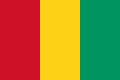
  • Flag of Guinea
    flag, from 1958Flag of Guinea · Public domain
  • Coat of arms of Guinea
    coat of arms, from 1984Coat of arms of Guinea · CC BY-SA 3.0 · Turn685

Its world

Who else stood

Meanwhile, elsewhere

The best-known states of other regions that stood while it did; the band is Guinea’s own years.

1960198020002020

How it compares

Among 3,073 states

Stood longer than 39% of 3,073 states
Guinea · 68 yearsBremenSoviet UnionHow long it stood, among the states with a recorded end or still standing.
Held more ground at its peak than 63% of 1,464 states
Guinea · 246,700 km²GhanaEcuadorThe most ground it held, among the states with a border in Cliopatria.

How it began

How did Guinea begin?

What led to it, and what came of it

French Guinea · Linked · 1894 – 1958French GuineaFrench West Africa · Linked · 1895 – 1958French West AfricaPeople's Revolutionary Republic of Guinea · Linked · 1958 – 1984People's Revolutionary Republic …Askia Daoud · In the article · 1550 · “It continued to prosper until a civil war, over succession, followed the death of Askia Daoud in 1582.”Askia DaoudDiarra Traoré · Coincidence · 1935 – 1985Diarra TraoréStokely Carmichael · Coincidence · 1941 – 1998Stokely CarmichaelGuinea · 1958 – 2026Guinea16001700180019002000
in the articlelinkedcoincidence

Open the investigation: every row with its evidence, the conditions at the time, the theories condition by condition, and the succession analysed.

Its centuries in the record

1900 – 1999: 26 recorded — 1 wars and battles, 2 risings, regime changes and massacres, 23 other19002000 – 2099: 4 recorded — 0 wars and battles, 3 risings, regime changes and massacres, 1 other2000

Wars and battles in red, risings, coups and massacres beside them, everything else in grey, by the century each began in. A tall bar is partly a fact about Wikipedia: better-documented centuries hold more.

Each century’s own page:1900 – 19992000 – 2099

Keep exploring

Share this page
Copy link
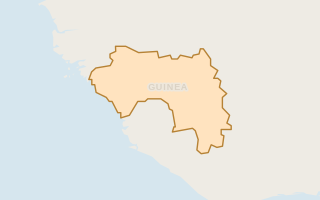
Embed the map
Cite this page

How this page is made

Drawn from Wikidata (Q1006, CC0), the opening and history of its English Wikipedia article retold by the atlas (CC BY-SA 4.0), borders from Cliopatria (CC BY 4.0), coast and rivers from Natural Earth, cities from Reba, Reitsma & Seto 2016 (CC BY 4.0), symbols from Wikimedia Commons, each under its own licence. Data built 2026-11-26 · Pastlas v2.47.1, by Oleh Voronko; the published atlas and its data are for non-commercial use.

How to read it

Areas are measured on an equal-area grid from borders simplified to about five kilometres. “c.” marks an approximate date, and a date known to the century is never printed to the year. Counts are what the atlas holds, and they follow Wikipedia’s coverage: a busy century is partly a fact about the record.

  • Still standing: the span runs to the year of the build, 2026.

Something wrong?

Tell us and name the entry. We fix the data, not just this page.

Report a problem