State · Middle East and North Africa

Guinea-Bissau

1974 – present · 52 years · still standing

Came after Portuguese Guinea

A West African republic born of the PAIGC's guerrilla war, and since shaken by coup after coup.

Guinea-Bissau is a West African country between Senegal and Guinea. Once part of Kaabu and the Mali Empire, it was colonised as Portuguese Guinea. The PAIGC won a war of independence, proclaiming the state in 1973, a year before its recognition, and ran a one-party socialist state, with the army in control from 1984 until free elections in 1994. Coups have since repeatedly toppled governments; the 2025 coup installed a junta under Horta Inta-A Na Man.

What the record holds

Guinea-Bissau began in 1974, replacing Portuguese Guinea.↓ When the borders dataset first draws it, in 1973, it held 33,000 km².↓

The record names 14 rulers in its line, covering 1973 – 2025, the median reign 2 years; 12 of 17 handovers were irregular.↓ The best known of them are João Bernardo Vieira, Umaro Sissoco Embaló and Malam Bacai Sanhá.↓ Most of the 50 rows the atlas files under it are people.↓

From Wikipedia’s article, retold · CC BY-SA 4.0

52 years

Longer than Austria-Hungary, shorter than Hungarians

33,000 km²

At its height in 1973 · about the size of Haiti

14 rulers

the President of Guinea-Bissau

1 war or battle

More per century than 92% of states · 50 entries in all

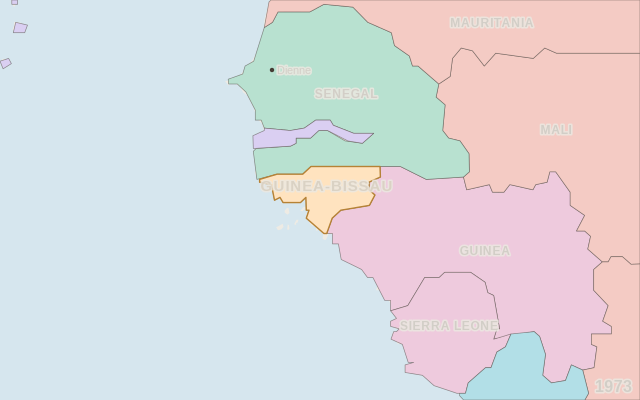
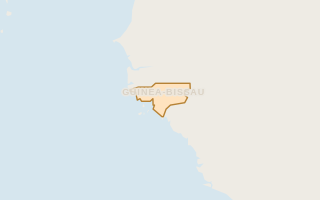
Map: Guinea-Bissau in 1973, its borders in gold among its neighbours
Guinea-Bissau Civil War, 1998 – 19992010 Guinea-Bissau military unrest, 20102012 Guinea-Bissau coup d'état, 20122022 Guinea-Bissau coup attempt, 202219801990200020102020
Beside it on the map in 1973: Guinea, Mali, Senegal, Mauritania, Sierra Leone and Ivory Coast.How far it reached, year by year: its ground inside the borders Cliopatria draws (CC BY 4.0), measured on an equal-area grid; the map shows it at its largest, with the cities of the year.

The story

Four acts, 1974 – present

Guinea-Bissau in 1998, at the end of act II
II1980 – 199933,000 → 33,000 km²

Vieira's long rule

João Bernardo Vieira takes power in the 1980 coup and holds the presidency, save a brief spell in 1984 under Carmen Pereira, until 1999. Coup attempts follow in 1982, 1983, 1984, 1985 and 1993. Free multiparty elections are held in 1994, but civil war breaks out in 1998, and a 1999 coup deposes him.

Watch this act on the live map, from 1980
Guinea-Bissau in 2013, at the end of act III
III1999 – 201433,000 → 33,000 km²

Coups and comebacks

Malam Bacai Sanhá and then Kumba Yala follow; a military coup in September 2003 removes Yala for being 'unable to solve the problems'. Vieira wins the presidency back in a 2005 run-off against Sanhá and holds it until 2009. Sanhá then serves until 2012, the year of another coup, after which Manuel Serifo Nhamadjo leads until 2014.

Watch this act on the live map, from 1999
IV2014 – present

Vaz, Embaló and the junta

José Mário Vaz is president from 2014 to 2019, and Umaro Sissoco Embaló from 2020. A coup attempt fails in 2022 and clashes break out in 2023. In 2025 a coup brings Horta Inta-A Na Man and a military junta to power, and the Economic Community of West African States and the African Union suspend it.

Watch this act on the live map, from 2014

Before and after

Before it

Where it sits in time

3000 BCE2000 BCE1000 BCE110002000Portuguese Guinea: 1474 – 1974Guinea-Bissau: 1974 – 2026

Five thousand years, 3000 BCE to 2026; the state in gold, what it replaced or followed and what replaced or followed it in grey.

Its people

Lives across Guinea-Bissau

19401960198020002020
Statesmen and generalsAll its people on the timeline →

How it was governed

14 presidents

14 presidents on record, 1973 to 2025; a reign lasted 2 years at the median. Each bar is a reign, as long as it lasted.

Luís Cabral · 1973 – 1980 · left office aliveJoão Bernardo Vieira · 1980 – 1984 · left office aliveCarmen Pereira · 1984 – 1984 · left office aliveJoão Bernardo Vieira · 1984 – 1999 · deposed, the article saysAnsumane Mané · 1999 – 1999 · died in battleMalam Bacai Sanhá · 1999 – 2000 · left office aliveKumba Yala · 2000 – 2003 · left office aliveVeríssimo Correia Seabra · 2003 – 2003 · killedHenrique Rosa · 2003 – 2005 · served out the term, the article saysJoão Bernardo Vieira · 2005 – 2009 · killedRaimundo Pereira · 2009 – 2009 · no death date to read the end againstMalam Bacai Sanhá · 2009 – 2012 · died in office of natural causesMamadu Ture Kuruma · 2012 – 2012 · no death date to read the end againstRaimundo Pereira · 2012 – 2012 · deposed, the article saysManuel Serifo Nhamadjo · 2012 – 2014 · left office aliveJosé Mário Vaz · 2014 – 2019 · no death date to read the end againstUmaro Sissoco Embaló · 2020 – 2025 · no death date to read the end againstHorta Inta-A Na Man · 2025 – … · still in office19801990200020102020
How their terms ended, where it is known (14 of 18):Killed 3Deposed or removed 2Died in office 1Left office alive 7In office 1Not on record 4
Every term, with how it ended and its source

Rulers

How 18 reigns ended - choose one to show only those

How they died, where the record says: died of natural causes 6 · killed 4 · died in battle 1.

RulerReignLengthHow it ended · sourceTo the ruler before
20th century · 7 reigns · 2 killed or removed
Luís Cabral · aged 421973 – 19807 yearsleft office aliveread off the dates alonedied of natural causes
João Bernardo Vieira · aged 411980 – 19844 yearsleft office aliveread off the dates alonekilled
Carmen Pereira · aged 481984 – 1984under a yearleft office aliveread off the dates alone
João Bernardo Vieira · aged 451984 – 199915 yearsdeposedread from the ruler's own articlekilled
Ansumane Mané · aged 591999 – 1999under a yeardied in battleWikidata's manner of death
Malam Bacai Sanhá · aged 521999 – 20001 yearleft office aliveread off the dates alonedied of natural causes
Kumba Yala · aged 472000 – 20033 yearsleft office aliveread off the dates alonedied of natural causes
21st century · 11 reigns · 3 killed or removed
Veríssimo Correia Seabra · aged 562003 – 2003under a yearkilled in officeWikidata's manner of death
Henrique Rosa · aged 572003 – 20052 yearsserved out the termread from the ruler's own articledied of natural causes
João Bernardo Vieira · aged 662005 – 20094 yearskilled in officeWikidata's manner of death
Raimundo Pereira · aged 532009 – 2009under a yearending not on record
Malam Bacai Sanhá · aged 622009 – 20123 yearsdied in officeWikidata's manner of deathdied of natural causes
Mamadu Ture Kuruma · aged 652012 – 2012under a yearending not on record
Raimundo Pereira · aged 562012 – 2012under a yeardeposedread from the ruler's own article
Manuel Serifo Nhamadjo · aged 542012 – 20142 yearsleft office aliveread off the dates alonedied of natural causes
José Mário Vaz · aged 572014 – 20195 yearsending not on record
Umaro Sissoco Embaló · aged 482020 – 20255 yearsending not on record
Horta Inta-A Na Man · aged 652025 – in officein office since 2025still in office

14 rulers, 14 with terms dated as terms, covering 1973 – 2025. Median reign 2 years. 12 of 17 handovers irregular - a killing, a deposition, a rival claimant, a rising or a coup beside it. The violent-handover count is withheld: power changed hands so often that any rising falls beside one (exposure 0.83, limit 0.6). A blank in the last column means no kin on record, which is coverage, never “unrelated”.

Heads of government

The line of Prime Minister of Guinea-Bissau, drawn and never measured: a cabinet is not a reign.

Francisco Mendes1973 – 1978
João Bernardo Vieira1978 – 1980
Constantino Teixeira1978 – 1978
Victor Saúde Maria1982 – 1984
Carlos Correia1991 – 1994
Manuel Saturnino da Costa1994 – 1997
Carlos Correia1997 – 1998
Francisco Fadul1998 – 2000
Caetano N'Tchama2000 – 2001
Alamara Nhassé2001 – 2002
Faustino Imbali2001 – 2001
Mário Pires2002 – 2003
Artur Sanhá2003 – 2004
Carlos Gomes Júnior2004 – 2005
Aristides Gomes2005 – 2007
Martinho Ndafa Kabi2007 – 2008
Carlos Correia2008 – 2008
Carlos Gomes Júnior2009 – 2012
Adiato Djaló Nandigna2012 – 2012
Rui Duarte de Barros2012 – 2014
Domingos Simões Pereira2014 – 2015
Carlos Correia2015 – 2016
Baciro Djá2015 – 2015
Umaro Sissoco Embaló2016 – 2018
Artur Silva2018 – 2018
Aristides Gomes2018 – 2019
Faustino Imbali2019 – 2019
Nuno Gomes Nabiam2020 – 2023
Rui Duarte de Barros2023 – …

Flags and arms, in order

  • Flag of Guinea-Bissau
    flag, from 1973Flag of Guinea-Bissau · Public domain
  • Emblem of Guinea-Bissau
    coat of arms, from 1973Emblem of Guinea-Bissau · CC BY-SA 3.0 · DzWiki

Its world

Who else stood

Meanwhile, elsewhere

The best-known states of other regions that stood while it did; the band is Guinea-Bissau’s own years.

198020002020

How it compares

Among 3,073 states

Stood longer than 34% of 3,073 states
Guinea-Bissau · 52 yearsAustria-HungaryHungariansHow long it stood, among the states with a recorded end or still standing.
Held more ground at its peak than 29% of 1,464 states
Guinea-Bissau · 33,000 km²HaitiSwitzerlandThe most ground it held, among the states with a border in Cliopatria.
Had more wars on record per century than 92% of 3,073 states
Guinea-Bissau · 1.0Wars recorded per century, among the states, counting the wars the atlas hosts under each.

How it began

How did Guinea-Bissau begin?

What led to it, and what came of it

Portuguese Guinea · Linked · 1474 – 1974Portuguese GuineaPortuguese Colonial War · Coincidence · 1961 – 1974Portuguese Colonial WarGuinea-Bissau War of Independence · Coincidence · 1963 – 1974Guinea-Bissau War of IndependenceGuinea-Bissau · 1974 – 2026Guinea-Bissau150016001700180019002000
linkedcoincidence

Open the investigation: every row with its evidence, the conditions at the time, the theories condition by condition, and the succession analysed.

Its centuries in the record

1900 – 1999: 42 recorded — 1 wars and battles, 7 risings, regime changes and massacres, 34 other19002000 – 2099: 8 recorded — 0 wars and battles, 7 risings, regime changes and massacres, 1 other2000

Wars and battles in red, risings, coups and massacres beside them, everything else in grey, by the century each began in. A tall bar is partly a fact about Wikipedia: better-documented centuries hold more.

Each century’s own page:1900 – 19992000 – 2099

Keep exploring

Share this page
Copy link
Embed the map
Cite this page

How this page is made

Drawn from Wikidata (Q1007, CC0), the opening and history of its English Wikipedia article retold by the atlas (CC BY-SA 4.0), borders from Cliopatria (CC BY 4.0), coast and rivers from Natural Earth, cities from Reba, Reitsma & Seto 2016 (CC BY 4.0), symbols from Wikimedia Commons, each under its own licence. Data built 2026-11-26 · Pastlas v2.47.1, by Oleh Voronko; the published atlas and its data are for non-commercial use.

How to read it

Areas are measured on an equal-area grid from borders simplified to about five kilometres. “c.” marks an approximate date, and a date known to the century is never printed to the year. Counts are what the atlas holds, and they follow Wikipedia’s coverage: a busy century is partly a fact about the record.

  • Still standing: the span runs to the year of the build, 2026.

Something wrong?

Tell us and name the entry. We fix the data, not just this page.

Report a problem