 Batu Khan,
 Berke and
 Özbeg Khan.
The story
Its key moments
Where it sits in time
Five thousand years, 3000 BCE to 2026; the state in gold.
State · South Asia
1227 – 1500 · 273 years
Its record opens in 1227.↑ In 1363, the first year its borders are mapped, it covered 2.51 million km².↓
Best known for
273 years
Longer than the Qing dynasty, shorter than the Ming dynasty
2.51 million km²
At its height in 1375 · about the size of Kazakhstan
15 rulers
the khan
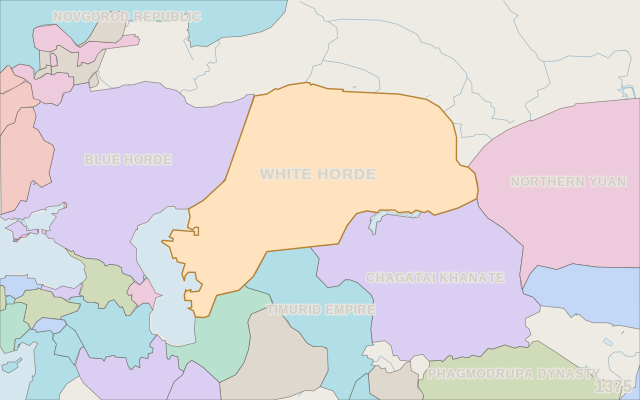
 Northern Yuan, Novgorod Republic,
 Timurid Empire and Phagmodrupa dynasty.How far it reached, year by year: its ground inside the borders Cliopatria draws (CC BY 4.0), measured on an equal-area grid; the map shows it at its largest, with the cities of the year.
The story
Five thousand years, 3000 BCE to 2026; the state in gold.
How it was governed
15 khans on record, 1227 to 1360; a reign lasted 5 years at the median. Each bar is a reign, as long as it lasted.
The line of khan.
| Ruler | Reign | Length | How it ended · source | To the ruler before |
|---|---|---|---|---|
| 13th century · 8 reigns · 1 killed or removed | ||||
 Batu Khan · aged 22 | 1227 – 1255 | 28 years | died in officeread off the dates alone | |
 Sartaq Khan · aged 25 | 1255 – 1256 | 1 year | left office aliveread off the dates alone | child |
 Ulaghchi · aged 9 | 1256 – 1257 | 1 year | died in officeread off the dates alone | child |
 Berke · aged 48 | 1257 – 1266 | 9 years | died in battleWikidata's manner of death | |
 Mengu-Timur · aged 24 | 1266 – 1280 | 14 years | died in officeread off the dates alone | |
 Tode Mongke | 1280 – 1287 | 7 years | died in officeread off the dates alone | sibling |
 Talabuga | 1287 – 1290 | 3 years | died in officeread off the dates alone | |
 Toqta · aged 34 | 1290 – 1312 | 22 years | died in officeread off the dates alone | |
| 14th century · 6 reigns · 1 killed or removed | ||||
| Kubluk · aged 1 | 1301 – 1301 | under a year | left office aliveread off the dates alone | |
 Özbeg Khan · aged 30 | 1312 – 1341 | 29 years | died in officeread off the dates alone | |
 Tini Beg | 1341 – 1342 | 1 year | died in officeread off the dates alone | child |
 Jani Beg | 1342 – 1357 | 15 years | died in officeread off the dates alone | sibling |
 Berdi Beg · aged 47 | 1357 – 1359 | 2 years | killed in officeWikidata's manner of death | child |
 Qulpa · aged 9 | 1359 – 1360 | 1 year | died in officeread off the dates alone | sibling |
15 rulers, 14 with terms dated as terms, covering 1227 – 1360. Median reign 5 years. 3 of 13 handovers irregular - a killing, a deposition, a rival claimant, a rising or a coup beside it. A blank in the last column means no kin on record, which is coverage, never “unrelated”.
Özbeg Khan29 yrsBatu Khan28 yrsToqta22 yrsJani Beg15 yrsMengu-Timur14 yrsIts world
The best-known states of other regions that stood while it did; the band is the White Horde’s own years.
 DenmarkEurope
 SwedenEuropeMongol EmpireEast and Southeast Asia
 Ottoman EmpireMiddle East and North Africa
How it compares
Each column is a share of the states; gold is the White Horde.
Why it fell
Historians still argue. Here is what the atlas records about its last century:
Wars and battles in red, risings, coups and massacres beside them, everything else in grey, by the century each began in. A tall bar is partly a fact about Wikipedia: better-documented centuries hold more.
Each century’s own page:1200 – 12991300 – 13991400 – 14991500 – 1599
“White Horde”, Pastlas, a historical atlas, 2026-11-26. https://app.pastlas.com/state/white-horde/
Drawn from Wikidata (Q2553863, CC0), borders from Cliopatria (CC BY 4.0), coast and rivers from Natural Earth, cities from Reba, Reitsma & Seto 2016 (CC BY 4.0). Data built 2026-11-26 · Pastlas v2.47.1, by Oleh Voronko; the published atlas and its data are for non-commercial use.
Areas are measured on an equal-area grid from borders simplified to about five kilometres. “c.” marks an approximate date, and a date known to the century is never printed to the year. Counts are what the atlas holds, and they follow Wikipedia’s coverage: a busy century is partly a fact about the record.